(Post by Seth M. Rodriquez)
Question: How much dirt does an archaeologist have to move? 
Answer: None. The volunteers do all the hard work.  😉
Actually, the answer to this question depends on the site.  Sometimes an archaeologist only has to scratch the surface and the Early Bronze Age or some other ancient period is revealed.  At other times, there is a massive amount of earth that has to be moved before the archaeologist gets down to the period he or she wants to study.  Here is a good example.
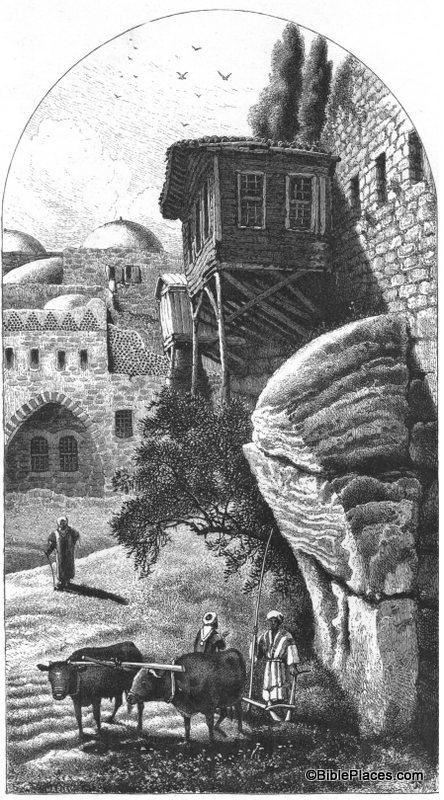
Our picture of the week, “Robinson’s Arch,” comes from a resource available through LifeInTheHolyLand.com, the sister site of BiblePlaces.com.  The resource is called Picturesque Palestine, Volume I: Jerusalem, Judah, and Ephraim.  It is part of the “Historic Views of the Holy Land” collection.  This was originally a book that was published in 1881 and edited by none other than Charles Wilson, one of the most prominent explorers of the Holy Land in the nineteenth century.  The book is a fascinating read as it discusses the landscape, holy sites, archaeological sites, and local culture as they appeared at that time.


Robinson’s “Arch” is really just the lowest section of what was originally an arch.  It is called Robinson’s Arch because it was discovered by Edward Robinson in the 1830s.  You can see the remains of the arch on the right half of this drawing, towering above the two men and the oxen.  The arch originally spanned across the Tyropean Valley in Jerusalem and formed the upper section of a long stairway that provided access to the Temple Mount during the time of Christ.  (A reconstruction of this stairway can be seen here.)  The Tyropean Valley was filled in over the years, beginning with the destruction of the Temple by the Romans in A.D. 70.  Over the centuries the area was built up and torn down over and over again, accumulating debris until it looked like this in the nineteenth century.

Returning to our question (“How much dirt does an archaeologist have to move?”), archaeologists in the 1960s–1990s had to move several meters of debris during their excavation of this area.  The picture above is what the area looked like in the 1870s.  Compare that with what it looks like today:

This picture (taken from the Jerusalem volume of the PLBL) is looking at Robinson’s Arch from the opposite direction as the drawing in Picturesque Palestine.  The arch is at the top of the photograph and circled in red in this photo.  You can see that it now towers over the remains of the 1st-century street below.  If you look carefully, there is a person standing on the street looking up at the arch.  That gives you an idea of the massive amount of dirt and stone that had to be moved by the excavation teams in recent decades.

This is just one example of the value of a work such as Picturesque Palestine.  It allows us to roll back the clock and see how the land appeared to the nineteenth century explorers before the excavations of the last 100 years.

This and other pictures of nineteenth-century Jerusalem are available in Picturesque Palestine, Volume I: Jerusalem, Judah, and Ephraim and can be purchased here.  Additional historic images of the Temple Mount can be seen here and here on the LifeInTheHolyLand.com website.  Several websites related to this topic can be found on the BiblePlaces website here.

Share:

Google Maps now includes floor plans of dozens of museums around the world, including the British Museum and the Smithsonian.

A couple of museums in Israel moved treasures to the vault because of danger from rockets from Gaza.

You can wait years to see an article about the New Testament city of Nain. Miriam Feinberg Vamosh ends the wait.

David Bivin thinks that the Nain where Jesus raised the boy from the dead is near Jerusalem in the upper reaches of the Wadi Qilt (subscription req’d for full article).

Joe Zias attempts to clear things up with regard to his role with the James Ossuary.

Perhaps you didn’t know: Wayne Stiles’ weekly column is available each Monday at the Jerusalem Post, but the edition on his personal site includes more content and higher-resolution photos. This week he travels to Chorazin (“Capernaum with a View”).

The PowerPoint presentation for Itzhaq Shai’s recent lecture on Tel Burna is available for download.

It is interesting to look through even without the audio.

Ferrell Jenkins shares some of his observations from the recent annual meeting of the Near East Archaeological Society.

The Dead Sea Scrolls exhibit formerly at Discovery Times Square and Philadelphia’s Franklin Institute has now rolled into Cincinnati.

A golden brooch from the treasure of King Croesus is returning to Turkey after the museum director sold it to pay off his gambling debts.

The National Museum of Iraq is scheduled to have a grand re-opening early next year.

Conservation efforts at Herculaneum are more successful than at its sister site of Pompeii.

HT: Jack Sasson, Joseph Lauer

Herculaneum Cardo IV from west, tb111405666
Ruins of Herculaneum from the west
Photo from the Pictorial Library of Bible Lands
Share:

An exhibit at the Western Science Center in Hemet, California, and sponsored by La Sierra University, has a display of military equipment from Jordan, Israel, Lebanon, and Syria open through the end of the year. Two lectures will be given this Thursday by university professors:

Kent Bramlett, “Ride that Chariot: The Rise and Fall of Chariot Warfare in the Ancient Near East.”

Douglas Clark, “Burn that Building: The Rise and Fall of a Village in the Early Iron Age.”

For more information about the lectures, see this article in The Press-Enterprise. For details and photos of the museum exhibit, see the university’s press release.

Ramses II on chariot, dg041901630
Ramses II in chariot, Abu Simbel
Photo from Pictorial Library of Bible Lands
Share:

I did not put this list together, but my choices would be quite similar to Wayne Stiles’ picks. He writes:

Most of us give Christmas gifts that are quickly forgotten.
After the iPhone gets cracked, or the DVD gets watched, or the sweater gets snagged, they all end up at the landfill.
This year, why not give a gift that will last a lifetime?
Bible Lands study tools make great gifts because they take your personal Bible study to the next level. What’s more, they don’t wear out.
Here are my top 5 recommendations for gifts you’ll enjoy giving.

You can click over to see Wayne’s top 5, but his comments on the Pictorial Library of Bible Lands are worth quoting:

Even though I’ve been to the Holy Land many times, I’ll never see all of it. One resource will show you more than any other.
israel collection Top 5 Gifts for Bible Lands and Bible Study
All together, the 18-Volume Expanded Edition of the Pictorial Library of Bible Lands includes more than 17,500 High Definition photographs from 9 countries in the ancient Mediterranean world.
My recommendation for starters? Get the “Israel Collection.” It includes volumes 1-5:

  • There are more than 1500 photos of Jerusalem.
  • More than 1500 photos of Judah and the Dead Sea area.
  • More than 2300 photos of the areas of Galilee and Samaria.

These are more than just High-Resolution pictures from the Holy Land. Special care has been taken to photograph biblical sites.
Nothing else rivals the Pictorial Library of Bible Lands. If a picture paints a thousand words, then thousands of high-resolution pictures are even better. I use these images almost daily on my blog, and I have used them for years in my teaching and personal Bible study.

His recommendations include an atlas, a study Bible, several devotional books, and an exclusive tour of Israel.

Share:

From the Caspari Center Media Review:

The Yardenit Baptism Site, situated on the Jordan River, is to undergo extensive development in the coming year. In order to improve the site, a fourth baptism station will be opened up, and “10 new ceramic wall hangings with the text from the Book of Mark 1:9-11, which speaks of John baptizing Jesus, [will be] added to the 70 plaques” that constitute the “Wall of New Life.” A representative from the site says that “the guiding principle underlining Yardenit … is the fact that it is totally non-denominational, and pilgrims are welcome to perform their baptism rituals in accordance with their particular beliefs and traditions.”

This must mean that business is good. In the meantime, it may be more difficult to get photos of the river without bulldozers and rebar.

The above article is not yet online. Copyright of the article remains with the Caspari Center.

Jordan River baptism at Yardenit baptismal site, tb011406482

Jordan River baptismal site at Yardenit
Photo from Galilee and the North
Share: