This week’s photo focuses on what is arguably the last of the “Bible Places.”  If the Garden of Eden is the first Bible Place, the island of Patmos could be considered the last. 
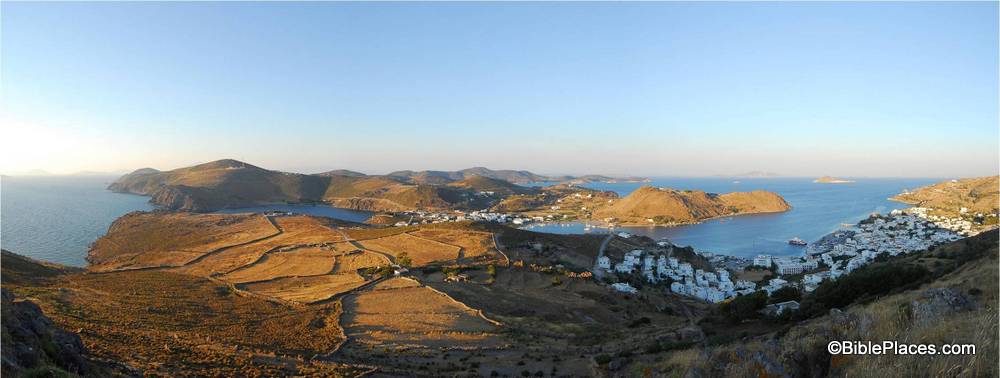
Our picture of the week comes from Volume 12 of the revised and expanded version of the Pictorial Library of Bible Lands, which focuses on the Greek Islands.  The photo is entitled “Patmos, View of Island North from Acropolis Panorama” (picture ID # tb061606331).  If you have this volume, the photo can be found in the Microsoft PowerPoint presentation on Patmos.  This photo is one of several beautiful panoramas that are available as part of the PLBL.  (Click on the photo for a higher resolution.)

Why is this the last of the Bible Places? The small island of Patmos is where John received his heavenly visions which were later written down in the last book of the Bible: the book of Revelation.  In Revelation 1:9 the apostle writes, “I, John, your brother and companion in the suffering and kingdom and patient endurance that are ours in Jesus, was on the island of Patmos because of the word of God and the testimony of Jesus” (ESV).

Patmos is a small island: only 7.5 miles long and 6 miles wide. To walk from one end to the other would take only a few hours.  It is situated between modern Turkey and Greece, and is a volcanic island with rocky soil. The island was settled on and off throughout the centuries. During the Roman period, there is evidence that there was a temple to Artemis and a gymnasium there, so it is unlikely that John was alone during his stay. According to the notes in the PLBL, there have been over 300 churches built on the island over the last 2,000 years. With only 13 square miles of real estate, that means there has been an average of 23 churches per square mile!

 
But is this really the last of the Bible Places?  After all, there are still 22 chapters of scripture after Patmos is mentioned in chapter one. Within these chapters, several other locations are mentioned, such as Ephesus (Rev. 2:1), Sardis (Rev. 3:1), and Laodicea (Rev. 3:14). Yet Patmos is the last identified location of an apostle mentioned in scripture, so that counts for something. 😉 Mount Zion is mentioned in Revelation 14:1, but is this referring to the hill called Mount Zion during biblical times or the modern Mount Zion that was mislabeled by the Byzantines? Until the jury weighs in on that issue, Mount Zion is disqualified. “Babylon” is the focus of Revelation 17 and 18, but Bible scholars are divided about whether that refers to actual Babylon, to Rome, or to something else entirely, so that option should be ruled out. Some people probably would argue that the prize for the last Bible Place should be awarded to the new heaven and the new earth described in Revelation 21 and 22, but unfortunately John did not take any photographs for us and we can’t take tourists there, so that’s not really practical.  So in the end, with our tongue planted firmly in our cheek, we award the illustrious prize of the last BiblePlace to the tiny (yet significant) island of Patmos!
 
This and other photos of Patmos are included in Volume 12 of the Pictorial Library of Bible Lands and can be purchased here.  More information on Patmos and additional photos can be found on the BiblePlaces website here.  For a more serious reflection on the biblical significance of the island and how this may have influenced John’s description of the new creation in Revelation 21:1, check out my post at the Wild Olive Shoot blog here.
Share:

Today is Yom Kippur and I suggest you read Wayne Stiles’ lavishly illustrated article on the tabernacle and its significance for the Day of Atonement.

A full-scale replica of the Tabernacle stands in the very wilderness where Moses and the children of Israel wandered for forty years.
It is like entering a doorway to history—and viewing a picture of your salvation.
Reading the Tabernacle’s dimensions in Exodus 35-40 is so different from seeing them with your own eyes—and in the same wilderness where the Tabernacle stood (Exodus 40:34-38).
The realistic replica echoes of Yom Kippur—the Day of Atonement—when God forgave the sins of His people.

Read the full article here.

Tabernacle model from outside courtyard, tb030807084
Tabernacle replica at Timna Park
Share:

Readers here may be familiar with Jodi Magness from The Holy Land Revealed DVD course, her award-winning book The Archaeology of Qumran and the Dead Sea Scrolls, or her recent excavations of a synagogue at Huqoq.

Cambridge University Press has just released a new archaeological survey by Magness, The Archaeology of the Holy Land: From the Destruction of Solomon’s Temple to the Muslim Conquest.

According to the preface, Magness has wanted to write this book for more than 20 years.

The book has 17 chapters, including these:

2. The Topography and Early History of Jerusalem (to 586 B.C.E.)magness-archaeology-of-the-holy-land-from-the-destruction-of-solomons-temple-to-the-muslim-conquest

7. The Early Roman (Herodian) Period (40 B.C.E.—70 C.E.): Jerusalem

8. The ERP: Caesarea Maritima, Samaria-Sebaste, Herodian Jericho, and Herodium

9. The ERP: Jesus’ Birth and Galilean Setting

10. The ERP: Masada

11. Ancient Jewish Tombs and Burial Customs (to 70 C.E.)

The hardcover is not fairly priced, but the paperback is affordable ($28). Amazon has the “Look Inside” feature enabled, so you can get a feel for the text, maps, sidebars, and recommended readings.

Share:

Excavations along a highway in northern Israel revealed a 50-acre site dating to the Neolithic period. One of the most impressive discoveries was a small stone bowl with several hundred stone beads.

Among the special finds that were uncovered in the excavation is a group of small stone bowls that were made with amazing delicacy. One of them was discovered containing more than 200 black, white and red stone beads. Other important artifacts are clay figurines of animals (sheep, pig and cattle) that illustrate the importance of animal breeding in those cultures. The most importance finds are stone seals or amulets bearing geometric motifs and stone plaques and bone objects decorated with incising. Among the stone plaques is one that bears a simple but very elegant carving depicting two running ostriches. These objects represent the world of religious beliefs and serve as a link that connects Ein Zippori with the cultures of these periods in Syria and Mesopotamia. According to Milevski and Getzov, “The arrival of these objects at the ʽEin Zippori site shows that a social stratum had already developed at that time that included a group of social elite which used luxury items that were imported from far away countries”.

The full press release is here, and three high-resolution images are also available. The discovery is reported by the Jerusalem Post and Haaretz.

DSC_1523

Photo by Clara Amit, courtesy of the Israel Antiquities Authority
Share:

The University of Oxford and the Vatican Library plan “to digitize 1.5 million pages of texts from their collections and make them freely available online.”

A large 3rd or 4th century poolside mosaic has been uncovered in southern Turkey, not far from biblical Attalia.

The Saqqara Serapeum was inaugurated this week.

The Jaffa Cultural Heritage Project has received a 3-year grant from the National Endowment for the Humanities.

Hebrew University will begin offering online courses for free.

Check out Wayne Stiles’ descriptive and devotional thoughts about Tel Dan. “By providing alternative places of worship [at Dan and Bethel], Jeroboam appealed to the laziness of the human spirit.”

If you’re looking for full-color, poster-size maps of biblical history, take a look at WordAction’s Bible Teaching Maps. The $35 set includes 10 large maps bible-teaching-mapsand 10 reproducible charts. The maps were produced by Zondervan and Oxford University Press.

They are easily mounted on foam board for display and transport.

Christianbook.com has many Bible atlases on sale this week, as well as Gary Burge’s The Bible and the Land for $1.99.

A number of distinguished scholars passed away this week, including Manfred Goerg, Bahnam Abu As-Souf, and Itamar Singer.

HT: Jack Sasson, Joseph Lauer

Share:

I’ve been updating the previous post with links to good articles about the subject, including questions of the discovery’s authenticity, genre, and significance. The “blockbuster” documentary airs in 10 days and that rightly concerns everyone not making money off of it. There also is some movement afoot to use this discovery to support the spurious claims made by “Jesus Tomb” proponents who allege that Jesus had a wife and family. Here’s the updated list:

Darrell L. Bock: Quick Thoughts on the New Jesus Wife Text

Michael S. Heiser: Ancient Coptic Fragment Has Jesus Alluding to His Wife

Mark D. Roberts: Was Jesus Married? A Careful Look at the Real Evidence.

James Davila: A Coptic gospel that mentions Jesus’ wife?

Associated Press: Harvard Claim of Jesus’ Wife Papyrus Scrutinized

*Simon Gathercole: Did Jesus have a wife?

Michael Kruger: Apocryphal Gospels and the Mainstream Media

Luke Chandler: Ancient papyrus: Was Jesus Married? Don’t overlook this perspective…

David Bivin: Was Jesus a Confirmed Bachelor?

Thomas L. McDonald: The Gnostic Noise Machine and the “Wife” of Jesus

Preston Sprinkle: Did Jesus Have a Wife?

*Mark Goodacre: The Gospel of Jesus’ Wife: The Story is Moving Fast!

Francis Watson: The Gospel of Jesus’ Wife: How a fake Gospel-Fragment was composed

Ross Douthat: The Jesus Conspiracy

Daniel B. Wallace: Reality Check: The “Jesus’ Wife” Coptic Fragment

Rob Bowman: Karen King’s Jesus Wife Papyrus

Francis Watson: How a fake Gospel-Fragment was composed: Introduction and Summary

AP: Harvard journal: Jesus ‘wife’ papyrus unverified

Henry B. Smith, Jr.: Brief Reflections on the So-Called “Jesus Wife” Fragment

Share: