The news report was that Tel Shiloh would receive about $1.3 million for renovation and preservation of the site, besides an additional $2.5 million from private sources. Only a few bloggers seem to note the new archaeological excavation underway on the southwestern side of the tell, with work scheduled to begin on the proposed tabernacle site in a few weeks.

Arutz-7: “Muslims hurled stones and shoes at police escorting Jewish and Christian visitors on the Temple Mount in Jerusalem’s Old City on Tuesday.”

JPost: “The Tourism Ministry on Tuesday launched an online ballot where the public can vote on what shape the NIS 833 million renovation of the Dead Sea will take in the coming years.”

NASA has a photo showing the weekend’s snowfall on Mount Hermon and the ranges to the north.

Wayne Stiles connects the beauty on display at Neot Kedumim with the Passover holiday.

The Jerusalem Post has a new column named “All Out Adventure.” It begins with a rather tame outing to Sataf in the Judean hills.

Tom Powers has an interesting and well-illustrated post on the Historic Valley Railway that once connected Damascus to Haifa.

G. M. Grena teases his readers with an Arabic-English riddle. I think I can make some sense of it.

James Hoffmeier’s recent lecture on what his archaeological work in Egypt tells us about the exodus is online for viewing.

The royal garden at Ramat Rahel is described in a brief but helpful summary by LiveScience.

HT: BibleX

Shiloh excavations on southwest side, tb010212234

Recent excavations at Shiloh
Share:

When one looks at the amount of information preserved in the archaeological record in the city of Jerusalem, a pattern emerges where a period of abundant evidence is followed by one with minimal data. What can archaeology tell us about Jerusalem in the Late Bronze or Persian periods? Not very much, especially by comparison with the eras that precede and follow. Historical documentation, such as the Amarna Letters and the books of Ezra and Nehemiah, attest to flourishing life in the city in these periods, but the archaeological evidence is quite limited. One might simplify the record as follows:

  • Middle Bronze: Abundance
  • Late Bronze-Iron I: Minimal
  • Iron II: Abundance
  • Persian-Hellenistic: Minimal
  • Hasmonean-Herodian: Abundance
  • Late Roman: Minimal
  • Byzantine: Abundance

One of the reasons for this situation is that later builders apparently destroyed and re-used much of the material from the previous period. Thus the Hasmoneans rebuilt along Nehemiah’s (Persian) walls and David reused existing Jebusite structures.

The Late Roman period (AD 70-330) is one of those for which less archaeological information exists.

But excavations in the last decade have made significant progress in revealing more about the city between the destruction of the Second Temple and the arrival of the Byzantines. Nir Hasson has written an interesting article on Jerusalem in the Late Roman period, noting in particular four discoveries from this period (emphasis added below).

In the rear section of the Western Wall plaza, in the spot where the Western Wall Heritage Foundation intends to erect a large building that it calls “the Core House,” Antiquities Authority researcher Shlomit Wexler-Bedolah discovered an ornate and broad Roman street, complete with shops on each side. This is the eastern cardo, along whose path Hagai Street would later be paved.
Three hundred meters to the south, another Antiquities Authority researcher, Dr. Doron Ben-Ami, discovered the place where the Roman street apparently ended. The corner of the street is adjacent to the Givati parking lot at the top of the Silwan valley – the spot where the Elad organization intends to build a large visitors center. In a large rescue excavation at this location in recent years, Ben-Ami exposed a large, fancy Roman villa unlike any other structure from its time in the entire country. He estimates that the villa he uncovered was the home of the regional governor or some other central authority.
In another excavation, in the tunnel under the Western Wall, Wexler-Bedolah and archaeologist Alexander Onn re-estimated the dating of a large bridge leading to the Temple Mount. As with other ancient monuments this too turned out to be of Roman origin and not from the Second Temple period. Another example is the Roman bathhouse and swimming pool discovered by Sion a year and a half ago. “It’s a tremendous spa, a country club,” Sion says, comparing the bathhouse to similar facilities found in other parts of the Roman Empire.

The rest of the article describes other discoveries in the greater Jerusalem area and it discusses the implications of this new information, including what it means for the alleged abandonment of the Temple Mount during these years. If you’re interested in the history of Jerusalem, this is worth reading.

HT: Joseph Lauer

Valley Cardo excavations near Western Wall, tb010312457

Eastern Cardo near Western Wall
Share:

An official government organization, the Jerusalem Development Authority, sent out their “Monthly Jerusalem Newsletter” today with these “Facts about Jerusalem.”

  • King David made Jerusalem the capital of Israel 3,000 years ago.
  • The Western Wall in the Old City is the last remaining wall of the ancient Second Jewish Temple which was destroyed by the Romans in 70CE.
  • For Christians, Jerusalem is the place where Jesus lived, preached, died, and was resurrected.
  • According to Islam, the prophet Muhammad was miraculously transported from Mecca to Jerusalem, and then ascended to Heaven.
  • Mishkenot Sha’ananim is the first area of habitation in Jerusalem outside the Old City walls. It’s building began in 1860.
  • Jerusalem today has over 10,000 hotel rooms with another 10,000 planned in the coming years.
  • The most visited site in Israel is in Jerusalem. It is the Church of the Holy Sepulcher, the traditional site of Jesus’ crucifixion.

See any problems?

Holy Sepulcher facade and bell tower, tb010312291

Church of the Holy Sepulcher
Share:

The Museum at the Lowest Place on Earth is scheduled to open in April. Displays will share the history of the area, including artifacts from Bab edh-Dhra, Numeira, and the Monastery of Saint Lot.

The museum is located at Deir Ain Abata on the southeastern side of the Dead Sea.

The latest issue of Biblical Archaeology Review has been published. The cover story, not online, will be of interest to many readers here. Amihai Mazar asks “Was King Saul Impaled on the Wall of Beth Shean?” Hershel Shanks writes an editorial on ancient toilet practices.

Amazon is selling the brand-new Rose Guide to the Temple (previously recommended here) for only $20. I’m not sure how long that deal will last.

The life and work of British archaeologist John Garstang is now being celebrated in an exhibition at the Blackburn Museum.

Haaretz reports on some of the history and controversy of the early 20th century photographs of Elia Kahvedjian.

A visit to the synagogue of Baram provides a window to Jewish life in the land of Israel for the last 2,000 years.

HT: Jack Sasson, Joseph Lauer

Baram synagogue, tb032807948

Synagogue of Baram
Share:

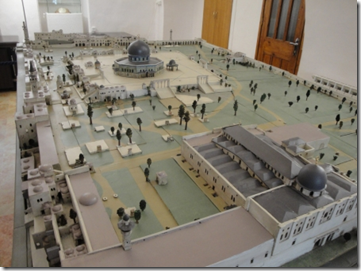
A model of the Temple Mount (Haram esh-Sharif) made by Conrad Schick in 1873 has been put on permanent display at the Heritage Center of Christ Church in Jerusalem. From Haaretz:

The model was made 140 years ago by the architect and archaeologist Conrad Schick, whose work in Jerusalem was supported by the London Society for Promoting Christianity Amongst the Jews. Its details reveal that its creator had access to places where no Western scholar of his day was allowed.
“Every time they dug a hole in the Temple Mount, he ran there to examine it,” said Prof. Haim Goren of Tel Hai Academic College, an expert on Schick’s work.
Schick, who made the model in an orphanage’s woodworking workshop where he taught, crafted it for display at the 1873 Vienna World’s Fair. It’s four meters long and three meters wide.
Like many of Schick’s models, this one had dozens of parts that could be dismantled to show inner, underground areas.
“It’s not only beautiful, it’s also an important research tool, because it was built by a man who visited every pit and understood the topography in a way we can’t fathom,” Gibson said.

The full story is here. You can read more about Conrad Schick at a website dedicated to him. They have many photos of the model at Christ Church, his 1879 model of the Temple Mount, his models at the Schmidt’s Girls School, and others.

image

Temple Mount model by Conrad Schick. (Photo source)
Share:

In contrast to the IAA report on the Givat Yona excavations (previously criticized here), Ran Shapira has written a well-researched and accurate report on the excavations of the site within modern Ashdod.

A commenter on the previous blog post also observed that the place “of Saint Jonah” is depicted on the Medeba Map (c. AD 600). As can be seen in the photo below, its location is quite a bit north of Ashdod and in the area of Dan’s (original) tribal allotment. The map probably refers to Tell Yunis, 4 miles (6.5 km) south of Joppa.

It may also be noted that the Survey of Western Palestine records about half a dozen sites preserving the name Jonah, most of them in Galilee.

medeba-map-jonah

Medeba map showing the place of Jonah in the vicinity of Joppa, not Ashdod
Share: