The folks over at Koinonia are giving away the recently updated Zondervan Atlas of the Bible. The older NIV atlas along with the updated edition (both by Carl Rasmussen) has been one of the classic conservative Bible atlases for many years. You can enter the giveaway here.
This isn’t exactly breaking news, but I did not find any other blogs that had written about it, and it seems worthy of mention.
Back in September 2007, Turkish Daily News (now known as The Hürriyet Daily News and Economic Review) reported that operations to clear the land mines near the site of Carchemish had commenced. At the time, it was estimated the clean-up would take about one-and-a-half years. Todd mentioned it here.
As a follow-up to this story, it was reported last December in Today’s Zaman that the mines had been cleared and the land was now in the process of being turned over to the city. After bidding for the mine-clearing project, work actually commenced in March 2010. Three hundred days later, it was complete. Mine-sniffing dogs were used in the initial stages, and to avoid damaging antiquities, the mines were removed to another location for detonation (usually, mines are detonated on the spot). Now that the mines have been cleared, archaeologists will begin “serious and long-term” excavations, which it is hoped will attract tourism.
The site of ancient Carchemish is cut by the modern Turkey-Syria border. The citadel and inner town are located within Turkey, but most of the outer town is located in Syria. On the Turkish side is the modern village of Karkamiş and on the Syrian side is the village of Jerablus. As part of Turkey’s attempts to open up trade with its neighbors, plans are underway to open three new border crossings with Syria by 2012, one of which will be located at Karkamiş.
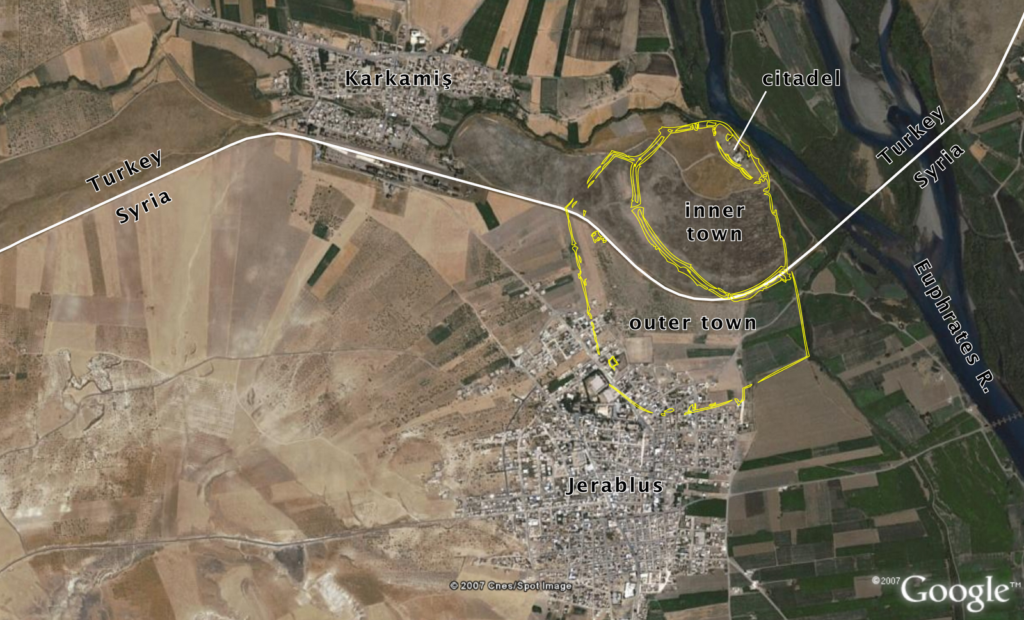
For an account of the earlier excavations conducted by Sir Leonard Woolley, see here.
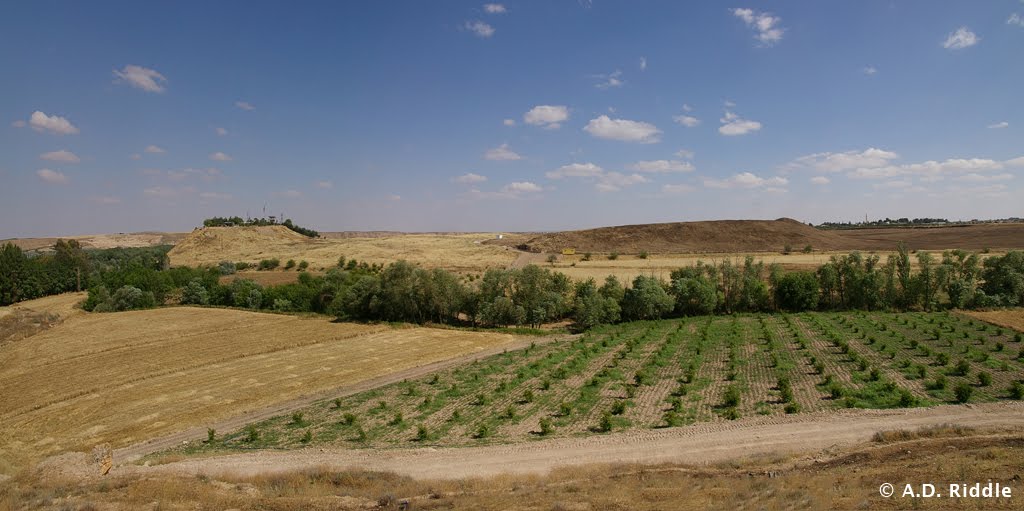 Carchemish from the northwest, view of citadel and inner town wall.
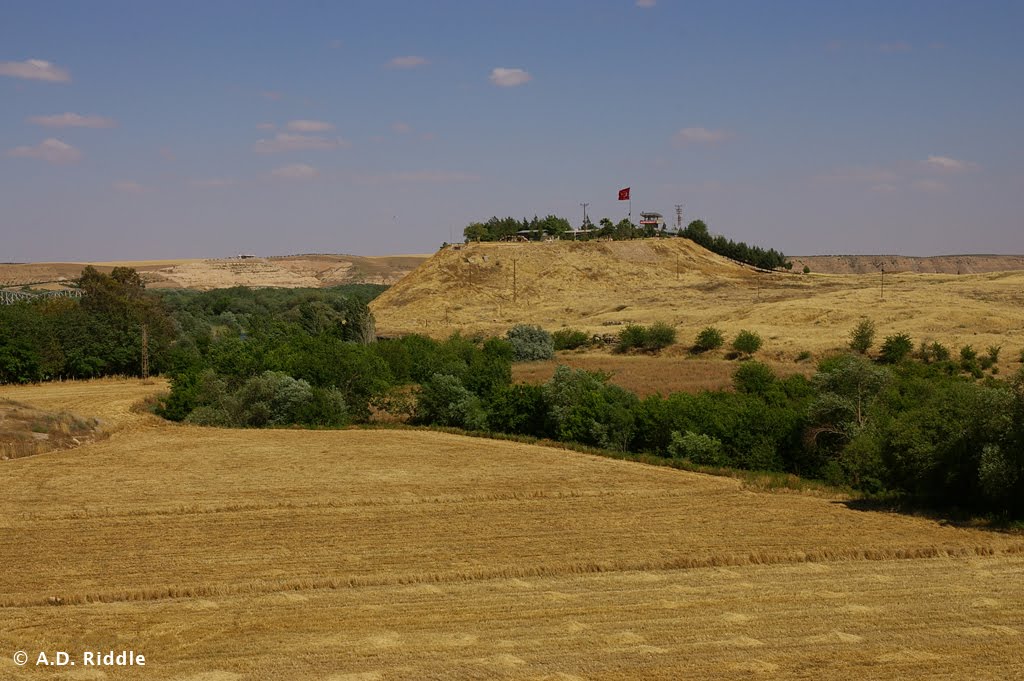 Carchemish citadel from the northwest.
In 2009, I had the privilege of sitting under Anson Rainey in his second-to-last tour of duty at Jerusalem University College (formerly known as the Institute of Holy Land Studies) where he taught for over 50 years. I would always approach that class with great expectation – for I knew that when Prof. Rainey began to speak the scent of long-dead ANE academic battles would soon fill my nostrils. A course with a giant like Rainey was as much about learning the methodological history of the discipline of Historical Geography (as well as the always entertaining “tit for tat” – often with the likes of Albright and the “accursed” Yadin), as it was about learning the actual historical data.
Those of you who knew Prof. Rainey – know that he was never shy of conflict, rather he invited it, he was almost always absolutely certain of his own view (the examples are limitless – Via Maris: Road to Nowhere, Bethel=Beitin, Shimron=Ghost Word – just to name a few…). However, beneath the facade of unabashed directness rested a teacher that was always willing to both hear and offer helpful advice to student’s thoughts and questions about the ANE and even their own lives. He will be greatly missed.
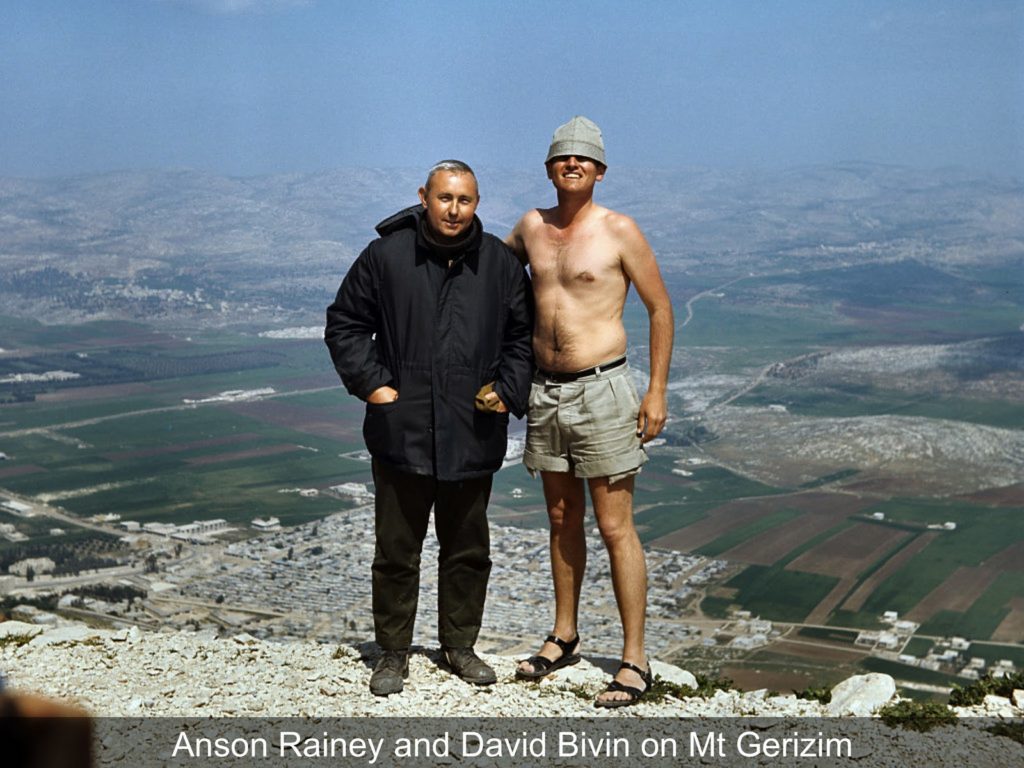 |
| Taken March 1968 – part of the Views that Have Vanished Collection |
The following is some information regarding Anson Rainey’s final resting place and the events leading up to his death from Emanuel Hausman the Chairman of Carta.
Anson was hospitalized on his eightieth birthday. A few days later he was diagnosed with pancreatic cancer, that had advanced far beyond the possibility of surgical intervention. Anson refused alternative treatments such as radiation, chemotherapy or life prolonging medication. Resigned to his fate, he asked for some letters to be written and messages to be sent to friends. His one wish was that his life’s ambition, the collection of The El Amarna Letters, be completed and brought to publication.
Anson passed away on Saturday 2/19/2011 and according to his last wish was buried at Barkan overlooking the hill country of Samaria that he loved so much. Attended by family and many of his friends his funeral took place in weather as turbulent as his life and eponymously RAINY.
You may have heard this from Anson before but he often joked that the first thing on facing GOD was to ask Him how he pronounced YHWH -.- May he rest in peace.
 About four months ago, Todd announced the publication of a new guidebook for Turkey entitled Biblical Turkey: A Guide to Jewish and Christian Sites of Asia Minor, by Mark Wilson (Ege Yayınları, 2010). What prompts this review is the news that the book can now be ordered from Amazon.com and sells for $39.95.
Biblical Turkey is not a guidebook like Lonely Planet or Rough Guide—it does not tell you where to find accommodations or the best places for affordable dining. What Biblical Turkey does do, however, is give you just about all the archaeological and historical information you will need for numerous sites in Turkey. The book includes every well-known and lesser-known site which is mentioned in the Bible, but it includes much more than that. As such, this is rich resource, whether you travel to Turkey or not (though, I recommend that you take a trip at some point).
What sets this book apart from A Guide to Biblical Sites in Greece and Turkey, by Fant and Reddish (Oxford Univ. Press, 2003), is its comprehensiveness. Fant and Reddish did not include a number of sites that are mentioned in the Bible, such as Cnidus, Carchemish, and Harran. Wilson includes all of these as well as many other important archeological sites which are not mentioned in the Bible, such as Van Kalesi (ancient Tushpa, the capital of Urartu), Gordium (the capital of Phrygia), Kanesh/Kültepe (the Old Assyrian trading colony), and Nemrut Dağ (the mausoleum of Antiochus I of Commagene).
 Nemrut Dağ west terrace, toppled heads from colossal statues.
Biblical Turkey is organized by five regions, beginning in eastern Turkey and working westwards. Each chapter begins with historical and geographic descriptions of ancient regions and provinces (e.g., Cappadocia, Galatia) and then covers the ancient cities within that region. For each region and city, biblical references are listed, a historical summary is given, and the relevant inscriptions and archaeological remains are described. Though written in a non-technical style, the text betrays a depth of technical knowledge in these areas which is quite impressive. Nearly every two-page spread is graced with a carefully selected photograph of the site, an architectural element, or an inscription, which is helpful for understanding the text. Finally, for many sites, Wilson provides a title or two for “further reading.” Most of the titles he suggests are guides available at the site itself, often written by the archaeologists, and published in Turkey. These can be difficult to obtain, but it is helpful nevertheless to have this information. (For those who are desperate enough to pay the stiff shipping charges, many of the titles can probably be purchased at Zero Books.)
I find several other features of Biblical Turkey helpful. The Turkish names are provided alongside the more common English names which facilitates navigating by maps and road signs. The book is also generously furnished with site plans and sidebars. The sidebars come in three types: “side trip” boxes provide brief descriptions of lesser-known sites you may want to add to your trip if you have spare time, “in-site” boxes give more background detail (e.g., a New Testament timeline, the seven ecumenical councils, or ancient travel on the Mediterranean), and “ancient voice” boxes discuss ancient textual sources in greater detail.
Maybe I’m gushing now, but I wish all guidebooks were written like this one. A lot of thought and research went into the content and its organization. Turkey is a vast country with many fascinating things to see and study. With this book in hand, no longer will so much of it go unnoticed.
FURTHER NOTE: Mark Wilson is the director of Seven Churches Network and Asia Minor Research Center. You can read more about Mark here. Leen Ritmeyer reviewed and recommended the book here.
Zechariah’s Tomb
A 3-minute video has been added to a Jerusalem Post article about a Byzantine church at Khirbet Midras that may have been the traditional site of Zechariah’s tomb. The article was originally posted on February 3rd. Unfortunately the video contains a couple of historical errors (such as referring to the Madaba Map as “a document”[!] that was “recently found”[!!]), but it does provide more information about the site than the article itself. More information about the discovery can be found here and here.
Is this truly the site of Zechariah’s tomb? Given the fact that (so far) there is only circumstantial evidence that the church was dedicated to Zechariah, and the fact that the Byzantines do not hold a very good track record for correctly identifying holy sites … I wouldn’t get my hopes up.
HT: Joseph I. Lauer, Ferrell Jenkins
Lod Mosaic in New York
The New York Review of Books did a recent post on their blog about the Lod Mosaic. It examines the mosaic in detail, and provides several stunning photographs. The mosaic is currently on display in the Metropolitan Museum of Art and is making a tour around the US, traveling from New York to San Francisco, Chicago, and Columbus.
Boston Globe Article on the Western Wall Tunnels
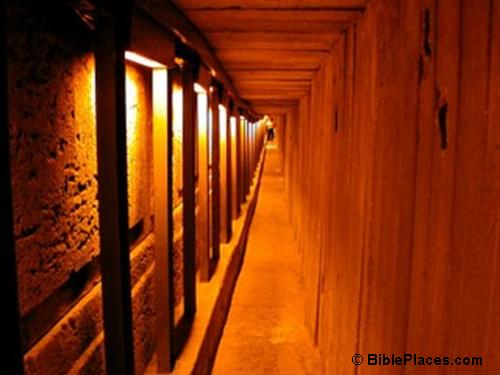
Last Sunday, The Boston Globe posted a brief article about the Western Wall tunnels. The article provides some general information about the wall and its history (both ancient and recent) but contains a couple of errors. (Namely, it states that the Jews worship the Holy of Holies[!], and that the tunnels go under the Temple Mount while in reality they travel alongside the massive retaining wall of the Temple Mount.) However, the article provides details on how you can make a reservation to take a tour and briefly describes what you will see there.
HT: Joseph I. Lauer
Anson Rainey
Of course, one of the biggest news events of the week is that Anson Rainey died on Saturday (as was posted yesterday on this blog). On Friday, interestingly enough, Biblical Archaeology Review posted a lengthy statement by Rainey in the “Scholar’s Study” section of their website. In this statement, he defends himself against recent accusations made by William Dever that he is not an archaeologist.
The statement provides a survey of Rainey’s archaeological experience and his contributions to the field. The introduction to Rainey’s statement can be found here. The actual statement can be found here.
Mummies in Milwaukee
The Mummies of the World exhibit is currently being displayed in the Milwaukee Public Museum.
This is “the largest exhibition of mummies and related artifacts ever assembled.” It will be in
Milwaukee until May 30th.
Bible Alive Seminar in Dallas
For those of you who live in the Dallas area, the Bible Alive seminar is coming to Park Cities Presbyterian Church on April 1-2. This two day event is “a multimedia contextual immersion experience in understanding God’s Word in its original historical, cultural, geographical, literary, and visual context.” The seminar was put together by Preserving Bible Times and will be taught by Doug Greenwold. More information about this event can be found here.
We just received the sad news that Anson Rainey passed away early this afternoon. He was hospitalized about two weeks ago and had been battling pancreatic cancer. The funeral will be held at the cemetery in Barkan at 12 pm tomorrow (Sunday, Feb. 20).
Rainey is familiar to most readers of this blog for his enormous contributions to historical geography and to the study of the Amarna letters, but to many other areas as well. He was responsible for training several generations of students who have become our teachers, or even our teachers’ teachers.
He will be greatly missed. A biography and list of Rainey’s publications can be viewed at his Tel Aviv University webpage. His work, The Sacred Bridge, has been highly recommended before on this blog.
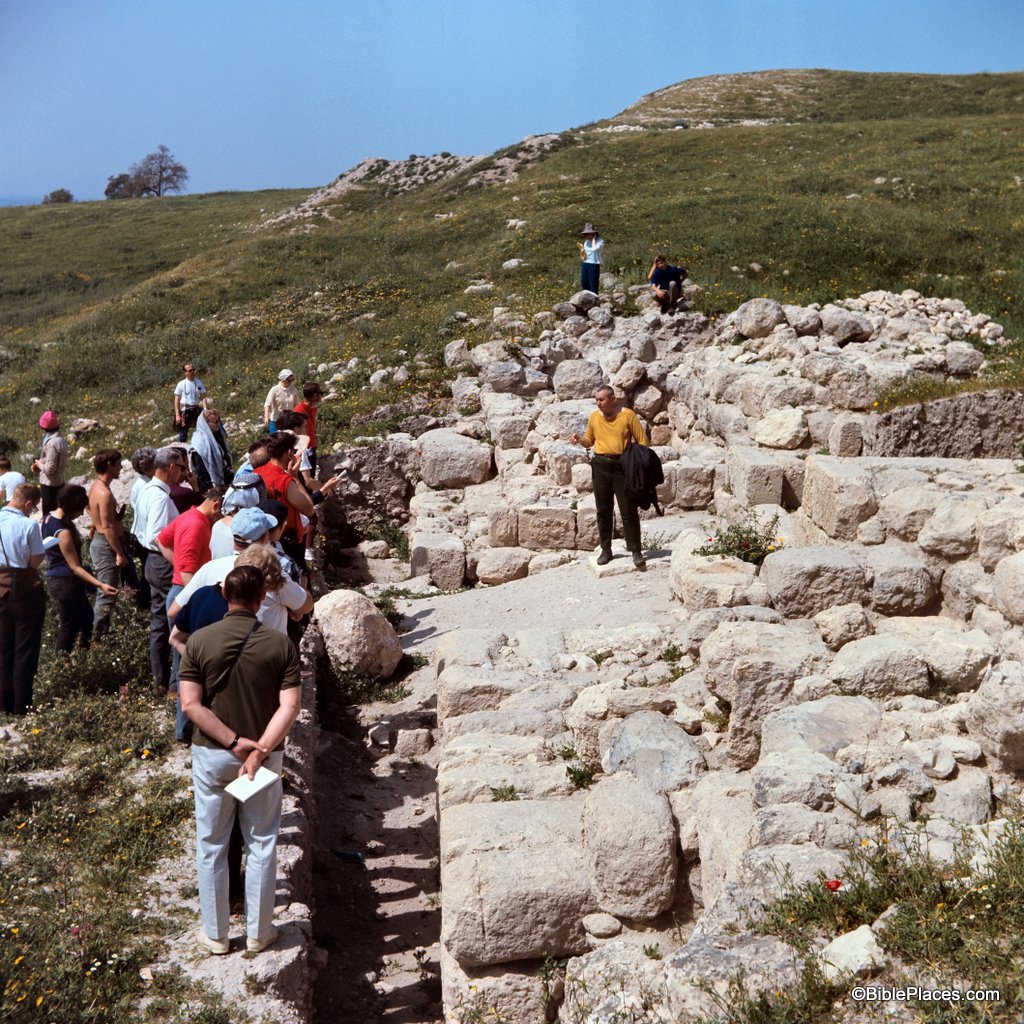 Rainey lecturing at the Solomonic Gate at Gezer in 1968 (David Bivin).
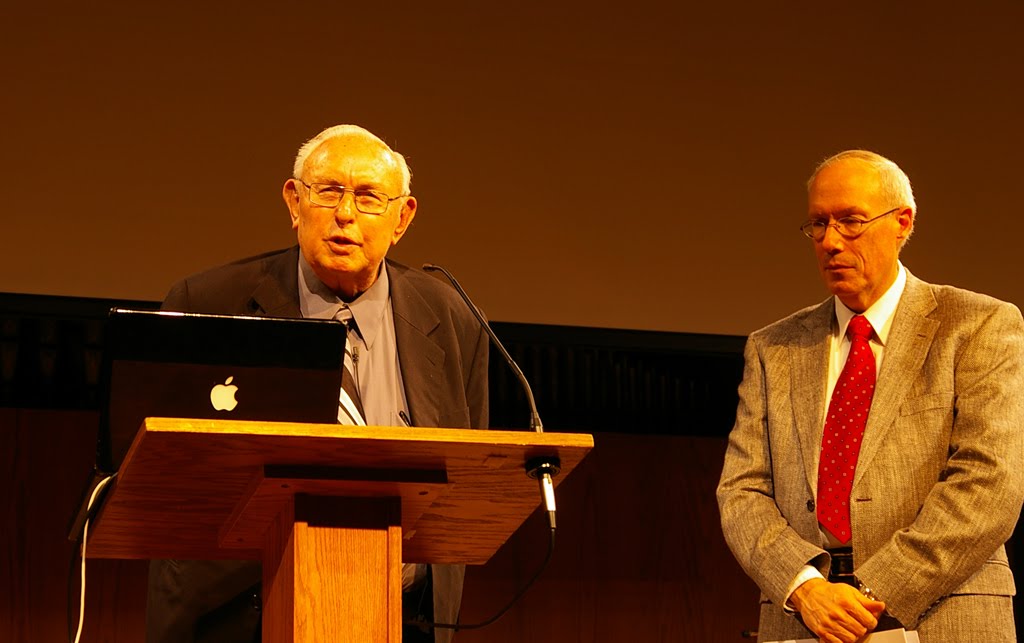
Rainey with K. Lawson Younger at Trinity Int’l University, 2010.
HT: Jack Sasson