This JPost article claims that a new study has “unlocked a key piece,” but as far as I can tell, the research merely confirms what was previously believed.  Mazar, in his Archaeology of the Land of the Bible (1990), says something similar (pages 54-56).  It’s an interesting phenomenon, and I note it here for those who have not studied some of the earlier periods of land of Israel.

University of Haifa researchers have just unlocked a key piece of the mystery of ancient desert survival, as part of their research on “desert kites” in the Negev and Arava regions.
The kites – so called because of their kite-like appearance to British pilots flying over the area in the early 1900s – resemble walls stretching over hundreds of meters of desert, meeting at angles with rounded trenches at the intersections.
The study, headed by zooarcheologist Dr. Guy Bar-Oz, archeologist Dr. Daniel Nadel and landscape ecologist Dr. Dan Malkinson, found that these structures were made by ancient desert people over 5,000 years ago as mass hunting apparatuses.
A number of such kites have been identified in Jordan, Syria, Israel and the Sinai. The archeological community has surmised that they were used for hunting purposes or as cattle pens.
Now, after surveying 11 kites and conducting digs at four different kite locations – from Givat Barnea in the North to Eilat in the South – and utilizing cutting edge measuring devices, two radiometric methods of dating, and aerial and ground photography, the team has concluded that the kites were constructed specifically to direct wild animals along the walls and convey them toward the trenches, where they could be hunted with ease….
“We were not taken by surprise by the technological ability; humans in that period were very similar to us in their capabilities. But nevertheless these were immense efforts,” he said. “Some of the kites are spread across hundreds of meters, and the construction blocks of some of the traps are very large and heavy. We are definitely talking about wide-scope construction in a region that is challenging for survival.”

The full story is hereArutz-7’s version includes four photos.

HT: Joe Lauer
Share:

Daily Mail has a report and photos of the stunning model of Herod’s Temple Mount being constructed by Alec Garrard.  At 30 years and counting, Garrard has worked longer on his model than Herod did on the original (at the time of his death).

Sunday’s Zaman has a review of the “Top 10 Museums” in Turkey.  Most, but not all, of the museums are related to the ancient world.  HT: Explorator.

Dr. Platypus (Darrell Pursiful) has posted the Biblical Studies Carnival XXXIX.  As always, the carnival is a great way to see what is going on in the wider blogosphere.

John Walton posts on what the Bible means in its description of “the land flowing with milk and honey.”

Arabia meets America in the Wild Wadi Water Park.

Share:

In 1967 the University Museum of the University of Pennsylvania filmed a 27-minute movie about archaeological work in Jordan and the West Bank.  “The Book and the Spade” gives a general introduction to the value and discipline of archaeology, which includes footage of important biblical sites that are not usually on the itinerary of visitors today, including Hebron, Shechem, and Samaria. 

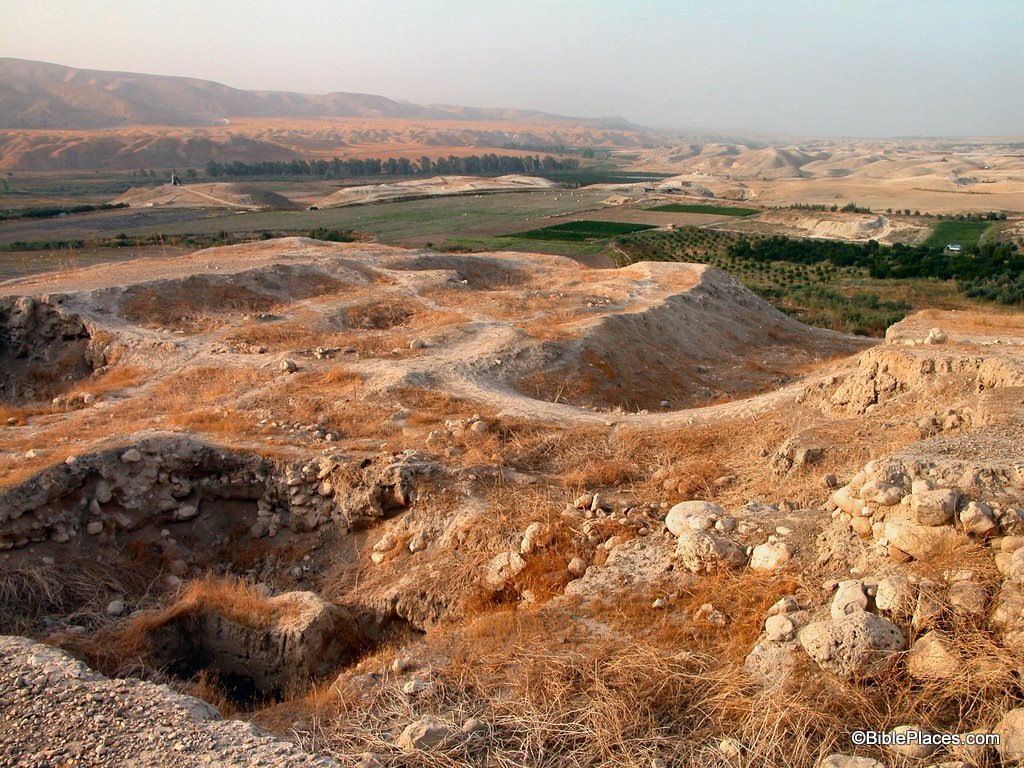
The film naturally focuses more on the excavations sponsored by the University of Pennsylvania, Gibeon and Tell es-Saidiyeh.  The latter site is the subject of the second half, and the one who is patient is rewarded with shots of the on-going excavations and an interview with the archaeologist James B. Pritchard.  Pritchard is probably best known today for his three editions of Ancient Near Eastern Texts, but he made significant contributions in his excavations of Gibeon (1956-62) and Tell es-Saidiyeh (1964-67). The film also documents the construction of a mudbrick house.  Though the movie was slow-moving by today’s standards, I enjoyed seeing many sites the way they were 40 years ago.  You can see the contrast of the excavations in the film with a recent photo below.

Tell es Saidiyeh view of Rift Valley to nw, tb110503948Excavation area of Tell es-Saidiyeh, 2003

Other University of Pennsylvania films that may be of interest to readers of this blog include:
Athens (1939)

Ancient Earth: Making History Everlasting (1940)

Iran (1963)

Windows on the Past (1967)

Turkey (1967)

Jordan (1969)

Cyprus (1969)

And more

HT: Ferrell Jenkins and Gordon Govier

Share:

Midwestern Baptist Theological Seminary is hosting a conference on “The Dead Sea Scrolls and Christian Origins” on March 12-14, 2009.

A tentative schedule (pdf) gives the lectures:

“A Dialogue on the Gospel of Thomas,” Craig A. Evans, Acadia Divinity College; Stephen J. Patterson, Eden Theological Seminary

“The Scrolls and the Hebrew Bible,” Peter W. Flint, Trinity Western University

“The Scrolls and the New Testament,” Craig A. Evans, Acadia Divinity College

“The Scrolls and the Dead Sea Community,” John J. Collins, Yale University

“The Scrolls and Interpretation of Scripture,” George J. Brooke, University of Manchester

“The Scrolls and the Scribes,” Terry L. Wilder, B&H Academic Publishers

“The Scrolls and the Messiah,” William M. Schniedewind, University of California, Los Angeles

“‘Dark Secrets’ of the DSS?,” R. Philip Roberts, Midwestern Baptist Theological Seminary

You can also download a poster (pdf) promoting the conference.

Share:

Excavations are set to resume at Khirbet el-Maqatir, a small site about half a mile (1 km) west of et-Tell, the scholarly choice for biblical Ai.  Bryant Wood led excavations at Maqatir from 1995 to 2000, when the second Intifada interrupted the work.  Wood has published in Israel Exploration Journal his view that Maqatir is the best candidate for the Late Bronze city of Ai.  More information about the excavation, including a solicitation for volunteers, is online at the website of the Associates for Biblical Research.

I wrote an article about ten years ago (Bible and Spade 12/3 [1999], p. 91ff) in which I showed that local tradition located Ai at Maqatir, not et-Tell.  Unfortunately Calloway (and every other scholar
I’ve read) ignored this rather important piece of data reported by Edward Robinson (1841).  No kidding.

Share:

Recent excavations have uncovered six inscriptions from the Iron Age and one from the Hasmonean period.  The site has been identified with biblical Netofa (2 Sam 23:28-29).  From the Israel Antiquities Authority:

Royal seal impressions were discovered in excavations of the Israel Antiquities Authority at Umm Tuba, in the southern hills of Jerusalem.
A large building that dates to the time of the First and Second Temples, in which there was an amazing wealth of inscriptions, was discovered in a salvage excavation conducted by Zubair Adawi, on behalf of the Israel Antiquities Authority, in the village of Umm Tuba in southern Jerusalem (between Zur Bahar and the Har Homa quarter), prior to construction work by a private contractor.
Considering the limited area of the excavation and the rural nature of the structure that was revealed, the excavators were surprised to discover in it so many royal seal impressions that date to the reign of Hezekiah, King of Judah (end of the eighth century BCE). Four “LMLK” type impressions were discovered on handles of large jars that were used to store wine and oil in royal administrative centers. These were found together with the seal impressions of two high ranking officials named Ahimelekh ben Amadyahu and Yehokhil ben Shahar, who served in the kingdom’s government. The Yehokhil seal was stamped on one of the LMLK impressions before the jar was fired in a kiln and this is a very rare instance in which two such impressions appear together on a single handle.

The full press release is here.  A link to 7 photographs is given only on a non-permanent posting of the release.  The story is reported by Haaretz and the Jerusalem Post.  Umm Tuba is located near Tsur Baher, south of Talpiot and north of Har Homa.  You can see a map here.  You can read more about LMLK seals here.

HT: Joe Lauer

Share: