As is often the case, the publication of a book is accompanied by an article in a popular magazine and a summary in a newspaper article. Unfortunately, the New York Times doesn’t seek out mainstream scholars to get their take, and so from reading their article, you might conclude that scholars no longer believe that Essenes live at Qumran. That is just not so.
The book The Site of the Dead Sea Scrolls: Archaeological Interpretations and Debates, edited by Katharina Galor, Jean-baptiste Humbert, and Jurgen Zangenberg includes a chapter on which the articles are based.
The magazine article, Qumran – The Pottery Factory , is in the Sept/Oct edition of the Biblical Archaeology Review ($50 subscription to read online; much less to subscribe to the print edition).
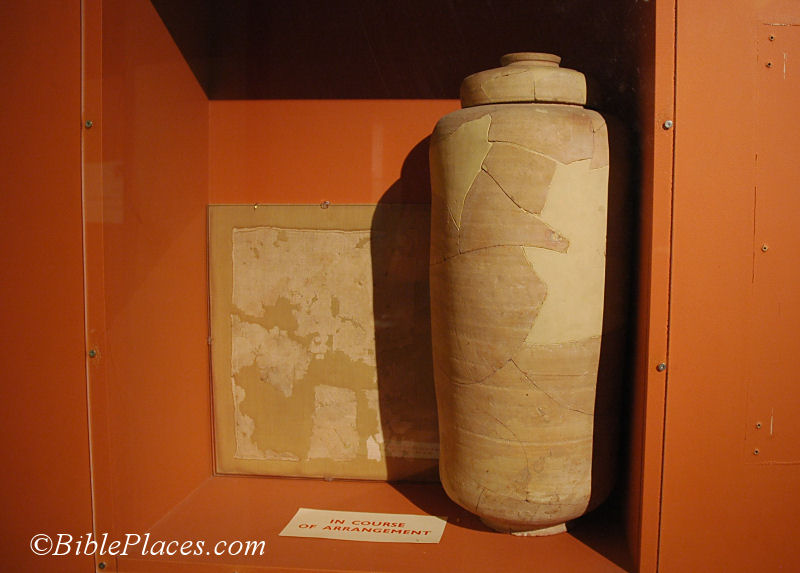
That Qumran was not home to the Essenes has been suggested before, with theories that identify the site as everything from a Roman villa, military fortress, fortified farm, and now a pottery factory. To be sure, Magen and Peled are respected scholars who have excavated at Qumran. But their view is clearly in the minority. When you read a statement like this, “There is not an iota of evidence that it was a monastery,” red flags should be flying. That the majority of scholars would hold to a certain interpretation without one iota of evidence tel ls us more about the speaker than the theory. That the only outside scholar that the NYT quotes is Norman Golb should cause all the bells to be sounding. Anyone who has spent time in the area has to just bust out laughing when reading Magen’s idea that these caves are “the last spot they could hide the scrolls before descending to the shore” of the Dead Sea. I can just picture these guys running away from the Romans and just stopping by Cave 1 to drop off some scrolls! Oh wait, we need some jars for these – quick, run to the pottery factory and bring some back here! Those who have been to Cave 1 will understand the humor more; it’s not exactly “on the way” (Cave 2 even less so). The proximity of Caves 4, 5, 7, 8, 9, and 10 to the site is telling as well. They are all less than 50 meters from the inhabitation. The attempts to separate the scrolls from the site are an utter failure.
I certainly wouldn’t discourage anyone from reading the articles or the book about this theory. But here’s the problem: too often these minority theories get the sensational coverage and people read about them and, lacking any other knowledge, are taken in. Instead, they should be first directed to the theories which have long been held and tested. After reviewing the mountain of evidence that Qumran was an Essene settlement, then go and weigh it against the latest view.
There are a lot of good books on the subject, but one of the best is Jodi Magness, The Archaeology of Qumran and the Dead Sea Scrolls. Another advantage to this route: this book will cost you $13 instead of $147 for the one above.
There’s a video to go along with the NYT article here.
Side point: if scholars can’t agree on the function of a site in a relatively late period where there is lots of archaeological and historical evidence, how is it that they can be so certain about events much earlier in history for which almost no evidence has been preserved? The less evidence we have, the more certainty that scholars have.