A ritual bath was discovered in excavations beneath the Western Wall Plaza. A sealed layer of ash indicates that the mikveh was in use until the Roman destruction in AD 70. The 2-minute video shows imagery of the large space being excavated underneath the prayer plaza.

An extraordinary stalactite cave has been discovered near Ofra in Samaria.

The Great Isaiah Scroll was originally two scrolls, written separately and then joined together. The break is between (what was later marked as) chapters 33 and 34.

“A new version of a bill whose purpose is to extend Israeli authority over antiquities and heritage sites in the West Bank, aims to include Areas A and B — where the Palestinian Authority has civilian control — under the scope of its applicability.”

Some very old cedar beams on the Temple Mount were left uncovered, provoking a protest.

The Times of Israel interviews Avraham Faust and Zev Farber about their new book, The Bible’s First Kings – Uncovering the Story of Saul, David, and Solomon. “The book brings together archaeology, anthropology, and biblical scholarship to support the thesis that the kingdom did exist and that findings from the ground offer evidence for it.”

The Biblical Archaeology Society has posted a list of excavation opportunities for 2026, including Azekah, Dan, el-Araj, En-Gedi, Hazor, Jerusalem, and Tel Shimron. They also are offering Dig Scholarships of $2,000 to qualified individuals. They are also accepting donations for scholarships.

The theme of the latest volume of ‘Atiqot is “Archaeological Perspectives on Water Use and Management.” All articles are available for download.

Zoom lecture on Jan 13: “Herod’s Many Faces as Reflected in His Art and Architecture,” by Orit Peleg-Barkat

Religion in Ancient Israel: Essays in Honour of John Day, edited by Katherine E. Southwood, Stuart Weeks, and H.G.M. Williamson (Bloomsbury, $87-106)

Accordance is selling many photo collections at 40-67% off, through Monday.

Israel’s Good Name reports on his visit to the Israel Aquarium in Jerusalem.

HT: Agade, Ted Weis, Arne Halbakken, Explorator, Paleojudaica
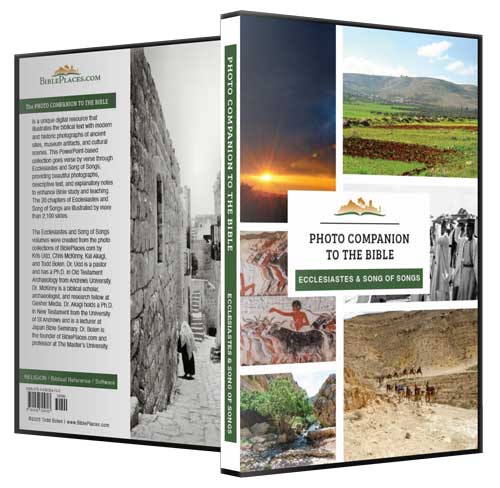
This week we released new photo collections for Ecclesiastes and Song of Songs. If you like to stay up-to-date on our latest resources, the BiblePlaces Newsletter is the place to do that. (Subscribe here.)

If you click over to this week’s newsletter, you’ll see some of the beautiful photos, read three kind endorsements, and learn about a 2-for-1 deal ending soon. For less than $40, you can get more than 2,000 photos, all organized and ready for learning and teaching. Do you think that Solomon might have liked something like this? I hope he wouldn’t say that it’s all just vanity. 🙂 In any case, take a look here. And if you know someone who might enjoy such a resource, let ‘em know. Thanks!

An article in the latest issue of Scandinavian Journal of the Old Testament suggests that the Rephaim Valley should be located not in the vicinity of Jerusalem but east of the Elah Valley.

Excavations at Khirbat an-Nahas reveal a marked improvement in technology of copper mining in the early 10th century BC.

Experts are joining forces to protect what may be the last wild olive trees in Israel, located on kurkar ridges south of Haifa.

In an expansive article for Haaretz (subscription), Elon Gilad explains how modern Hebrew addressed the problem of the lack of fish terminology in biblical Hebrew.

Walking The Text’s latest video explores how the Bible uses the metaphor of “bedouin host” for God.

A new study reveals that Greco-Roman statues were “enriched with fragrances.”

With Purim being celebrated this week, Bryan Windle wrote an excellent illustrated essay on the top 10 discoveries related to the book of Esther. Archaeology has done much to illuminate this book!

HT: Agade, Gordon Franz, Arne Halbakken, Explorator

“Excavations at a Byzantine-era church in the northern Negev desert have revealed 1,500-year-old wall etchings of ships, likely left by Christian pilgrims who had arrived by sea to the Holy Land.”

The Times of Israel has a follow-up article on the major carbon-14 study of Jerusalem that was recently published.

John Drummond pulls together the archaeological evidence for the reign of Solomon.

The latest issue of Biblical Archaeology Review includes articles on Solomon’s royal complex at Gezer, the large Moabite site of Kh. Balu’a, and the dawn of the Iron Age in Israel.

Israel21c identifies the top seven archaeological sites in Israel related to Jewish history as the Western Wall, Masada, Caesarea, Tiberias, Megiddo, En Gedi, and the City of David.

The Qumran Digital Project Lexicon has a new website.

Archaeologists have identified the original sarcophagus of Ramesses II from a fragment discovered in 2009 at Abydos.

The “Hazael and His World: Commemorating the 30th Anniversary of the Discovery of the Tel Dan Inscription” conference will be held in Tel Aviv and Jerusalem on June 5 and 6.

The 100th issue of Syria: Archéologie, Art et Histoire has been released (open-access).

Online lecture on June 2 in the BAS Scholars Series: “Paul on Cyprus: Crossing the Divide,” by Thomas Davis.

Paul’s hometown of Tarsus is not on the itinerary of most tourists to Turkey, but it has much to offer. Jason Borges identifies ten sites within the city and five sites in the vicinity that are worth seeing.

The Institute of Biblical Culture is giving away hundreds of books related to the Old Testament.

In light of a recent conference celebrating William Dever, Glenn Corbett reflects on the future of biblical archaeology.

HT: Agade, Gordon Franz

Registration for my course on The History of Israel’s United Monarchy closes on Friday, and the class begins on Monday. The time commitment is minimal (90 minutes a week), and the cost affordable ($189).

My goal is to deepen your understanding of the century or so when all twelve tribes were united under a single king. To do that, I’ll be drawing on archaeological discoveries, geographical insights, and extrabiblical sources to supplement what the Bible records.

My interest goes beyond decades of teaching a related course and leading “life of David” field studies around Israel to writing a (forthcoming) book and creating photo collections for 1-2 Samuel and 1-2 Kings. I’ll be bringing the best of everything to this homework-free course.

The class meets on six successive Mondays, from May 13 to June 17, from 8:00-9:30 pm (Eastern Time). Everyone who registers will receive the valuable course materials along with access to the lecture recordings.

The course is one of three offerings in the Jerusalem University College Online Summer Institute. The other two are: Edible Landscapes of the Biblical World, taught by Chandler Collins on Tuesdays, and Jesus the Galilean, taught by Wave Nunnally on Thursdays.

Registration closes on Friday.

Jerusalem University College is offering three online courses this summer, and I am teaching one of them. I’d love to have you join me on a six-week study of “The History of Israel’s United Monarchy.”

We’ll meet every Monday from 8:00 to 9:30 pm Eastern Time, from May 13 to June 17. The lectures will be recorded, so you can review them later or watch for the first time if you’re unable to attend some/all of the sessions live. This is a Summer Institute course that is offered for $189 per study, and no credit is offered. No homework will be required either, but I will providing you with some recommended readings, including some of my own research, both published and (yet) unpublished, along with some free photo resources.

My goal is to help you understand what was going on in Israel when Saul, David, and Solomon reigned over the twelve tribes. Our primary source is the biblical text, but we can learn a lot from extrabiblical texts, geographical studies, and archaeological excavations. I will bring lots of charts, maps, and photos to help make sense of it all. I have been teaching this subject for (exactly) 25 years, and I love it. (I’m teaching it at my university right now, but you get it at a much cheaper cost, and without having to write a research paper!) This course will be the first I have ever taught that is open to the public, and I’m looking forward to the adventure!

The JUC Summer Institute includes two other excellent courses that meet at other times, so you don’t have to choose between them:

Chandler Collins, “Edible Landscapes of the Biblical World,” Tuesdays, 8:00-9:30 pm Eastern

Wave Nunnally, “Jesus the Galilean,” Thursdays, 7:00-8:30 pm Eastern

You can get all the details and register here.