“An impressive section of Jerusalem’s fortification wall from the second century BCE has been uncovered on the grounds of the Tower of David complex in the Old City.” About 130 feet of the “First Wall” has been uncovered in the Kishle.

Archaeologists have found evidence for the famous battle at Bet Zecharia described in 1 Maccabees. “It is the first time we have possible archaeological evidence from one of Judah Maccabee’s battlefields.”

A scholar believes that he has cracked Cryptic B, a rare alphabet known only from two uses in the Dead Sea Scrolls.

Coins previously believed to sloppy versions of coins minted by Alexander Jannaeus should instead be understood as coming from the economically weak era of the Hasmonean civil war between 60 and 40 BC.

Hartebeests went extinct in Israel not in the Iron Age but in the Byzantine period.

Doron Spielman spoke about some of his experiences in the City of David at a recent event in Jerusalem.

On Digging for Truth, Scott Stripling explains the archaeology that is related to Hanukkah.

On the Biblical World podcast, Kyle Keimer talks with David deSilva about his two new archaeology books.

Dig has released a 27-minute video about Labayu of Shechem.

The foundation stone of the Pontifical Biblical Institute in Jerusalem was laid 100 years ago.

A powerful winter storm caused death and destruction all over Israel this week.

New release: The Archaeology of the Kingdom of Judah, by Yosef Garfinkel (SBL Press, $75)

You can now purchase soil from the Temple Mount.

Jerusalem University College will be presenting its 6th annual online seminar on January 10. The “Geography and the Bible” seminar is free and will include four sessions:

  • “Road Systems from Egypt through Sinai,” by James Hoffmeier
  • “Trekking from the Desert to the Land of Milk and Honey,” by Hélène Dallaire
  • “What Does it Mean that Jerusalem was ‘Built as a City which is Compact Together?’ A Geographical and Archaeological Reading of Psalm 122:3,” by Chandler Collins
  • “The Early Church’s Encounter with the Roman Imperial Cult,” by Carl Rasmussen

There is no hat tip (HT) below to Gordon Franz, because Gordon died on November 22. I met Gordon when studying at IHLS in the early 90s, and we stayed in touch over the years, including a tour he gave my family of NYC. Gordon taught for various schools over the years, including the Israel and Turkey/Greece/Rome programs for the Talbot School of Theology.  Most recently Gordon sent me stories for these roundups, and in the last email he wrote me, he said he was on his way to buy Rabbi Landy’s latest book. He was quite the book connoisseur. And he had much yet he planned to accomplish. Some of Gordon’s writings are still available on his website. A recording of his celebration of life service is online. He will be missed.
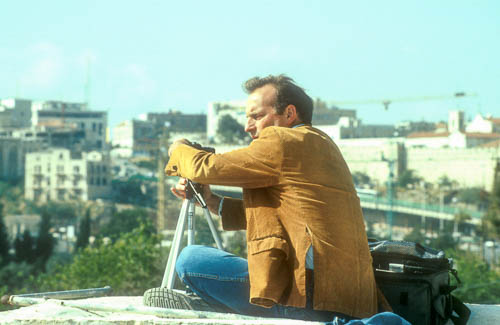
Gordon Franz taking photos from the rooftop of the Institute of Holy Land Studies in Jerusalem, 1993

HT: Agade, Ted Weis, Keith Keyser, Arne Halbakken, Alexander Schick, Explorator

Share:

A Roman sarcophagus was discovered in Hungary, “untouched by looters and sealed for centuries … with its stone lid still fixed in place, secured by metal clamps and molten lead.”

Five theatrical mask reliefs have been discovered during excavations in the theater area of Kastabala, an ancient city in Osmaniye, southern Türkiye.”

Excavations at Ugarit have resumed after a 14-year hiatus.

Remember the Jordan Lead Codices? A new scientific analysis provides some answers about their dating. (James Davila gives some background.)

“A stunning replica of an ancient trireme will be displayed as the centerpiece of the new Greek Underwater Archaeology Museum” in Piraeus, opening next year.

The Dead Sea Scrolls exhibition opens at The Museum of the Bible this weekend. “The exhibition will feature biblical texts and scrolls from the community at Qumran, as well as hundreds of artifacts that reveal details about life and Judaism during the Second Temple period.”

“More than 40 precious artifacts from the Church of the Holy Sepulchre in Jerusalem are currently on display at the Frick in New York City.”

The Metropolitan Museum of Art just launched a virtual reality tour of the 1st-century BC Egyptian Temple of Dendur.

New release: Assur 2024: Continuing the Excavations in the New Town and Other Research across the Site, edited by Karen Radner and Andrea Squitieri. Exploring Assur 2. (PeWe-Verlag; 59 €; open-access)

New release: Excavating Ancient Egypt: Fifty Years of Archaeological Memories, by Jeffrey Spencer (Archaeopress; £16-£32)

In the latest episode on the Biblical World podcast, Mary Buck explains the importance of the Achaemenid Empire, including figures like Cyrus and Darius.

HT: Agade, Arne Halbakken, Alexander Schick, Gordon Franz, Ted Weis, Explorator

Share:

“A 5,000-year-old wine press has been unearthed next to the iconic archaeological site of Tel Megiddo, providing the earliest evidence of wine production in the Land of Israel.” There are more photos here.

After years of survey work, a couple of Israeli archaeologists identified the probable location of the ancient synagogue in the Syrian village of Yehudiya in the Golan Heights. Then they confirmed it with excavations.

Archaeologists discovered red fox tracks in the fresh plaster of a Byzantine wall at Bethsaida (el-Araj).

Chandler Collins has written an excellent summary and analysis of the newly discovered “Siloam Dam” in Jerusalem. 

Work is underway on a Visitor Education Center on the Mount of Olives. The story includes other details about the area, such as the cost of a burial plot in the cemetery.

The entire Great Isaiah Scroll will be on display at the Israel Museum to mark the museum’s 60th anniversary.

Iran is not happy about the British Museum’s plan to loan the Cyrus Cylinder to the National Library of Israel. [EDIT: This story is from early 2024. The Cyrus Cylinder has not been in Israel since this story was written, as far as I know.]

New from IAA Reports: Khirbat ‘Amra: A Rural Site from the Hellenistic to Early Islamic Periods in the Beʼer Sheva‘ Valley, by Itamar Taxel and Noé D. Michael (open-access).

Hybrid lecture at the Albright on Dec 3: “The Legacy of Hansen House in Jerusalem,” by Susan Kennedy-Arenz. “This talk will describe the living conditions of Jerusalem’s leper community prior to the establishment of the first leper hospice in the mid-19th century.”

Hybrid lecture at the Albright on Dec 10: “The Rise of Christianity in Galilee: A Perspective from the Jewish Cities of Sepphoris and Tiberias,” by Shulamit Miller

Hybrid lecture at the Albright on Dec 17: “Albright 2025: The Year in Review,” by Director James Fraser

Preserving Bible Times is streaming Digging Deeper I (The Great Commission) and Digging Deeper II (The Jewish Mind of Jesus’ Day), free on YouTube.

Leon Mauldin shares several photos of the ancient city of Jokneam.

Logos subscribers can purchase Holman Illustrated Guide to Biblical Geography: Reading the Land, by Paul H. Wright, for about $8.

Alumni of Jerusalem University College are invited to an alumni gathering in Boston during the Annual Meetings.

Wayne Stiles is hosting an advanced tour of Israel next year, with visits to places that most groups never visit (including Dothan, Samaria, Solomon’s Pools, Bethany, Temple Mount, an optional 10-mile hike and river rafting, and more).

The new Job volume in the Photo Companion to the Bible includes 1,600 photos. The introductory sale ends in a few days.

HT: Agade, Gordon Franz, Ted Weis, Arne Halbakken, Explorator, Paleojudaica

Share:

The Israel Antiquities Authority: “To the best of our knowledge, no damage has been caused thus far to archaeological artifacts under the responsibility of the Israel Antiquities Authority, and no reports have been received regarding damage to exhibits in museums.” Some precautions have been taken.

The opening of the Grand Egyptian Museum will be delayed until later in the year due to the Israel-Iran war.

The Garden of Hercules in Pompeii has been restored and reopened to the public following “the planting of 800 ancient roses, 1,200 violets, 1,000 ruscus plants, cherry trees, vines, and quince trees.”

A team of researchers is working to recreate Egyptian blue, and they created 12 different recipes for the endeavor.

Officials in Rome have unveiled a new piazza around the Mausoleum of Augustus.

Looting and trafficking of ancient artifacts has increased in Syria since the fall of the government.

Bible History Daily asked a few scholars for their perspective on a new study dating the Dead Sea Scrolls earlier than previously believed. Rollston, for example, knows that the calibrated dates are in error since we know that Daniel 8-11 cannot be dated to earlier than the events occurred in 167 BC.

New website: Iron Age Hebrew Ostraca in the Silicon Age – Computerized Paleography – “our research in the last few years has focused on solving some problems, avoiding others and shedding new light on literacy in biblical Israel and Judah through statistical analysis.”

Conference on June 25-27: “Exodus in Transdisciplinary Perspective,” at UC San Diego, with a YouTube livestream.

New from Preserving Bible Times: Encounters with Jesus, by Doug Greenwold, in audiobook format

Preston Sprinkle invited me on to his Theology in the Raw podcast to talk about archaeology and the Bible, including Jericho, David, and Hezekiah’s Tunnel (YouTube, Apple, Spotify). He kicked it off by recalling comments I wrote on his archaeology paper 25 years ago.

HT: Agade, Ted Weis, Alexander Schick, Explorator

Share:

Scholars have used radiocarbon dating and artificial intelligence to date some Dead Sea Scrolls manuscripts, with the results often providing earlier dates than previously believed based on paleographical analysis. Of particular interest is 4Q114 which preserves Daniel 8-11, now dated to 230–160 BC (earlier than it was written, according to critical scholars). The underlying journal article is here.

Excavations at Samaria-Sebaste have been underway for two weeks, and discoveries include a stone pavement and the base of a monument near the city gate.

Following a kerfuffle over a 5-ton Herodian stone on display at Ben Gurion Airport, the IAA has promised to rebury all Western Wall stones. The parties agree that Western Wall stones “must not be treated as archaeological exhibits but rather as sacred relics subject to Jewish law.” Stones on display elsewhere will be returned for burial, and the site will be fenced off to prevent the public from touching them.

Nathan Steinmeyer explains what the Galilee is.

Zoom lecture on June 10: “Hearing the Voices of the Dead in Ancient Israel,” by Elizabeth Bloch-Smith ($10)

BAS is offering a four-lecture course with Sidnie White Crawford about ancient libraries, focusing especially on the Dead Sea Scrolls ($149).

I recently read The Odyssey of Marcus Panthera: A Journey to the Land of Israel in the First Century, by Makram Mesherky (Gesher Media, 2024, $25). The author is a Palestinian believer whose fictional account reads like a travelogue during the time of Jesus. The book is not long, is easy to read, and is loaded with full-color illustrations.

HT: Agade, Keith Keyser, Arne Halbakken, Alexander Schick, Gordon Franz, Mark V. Hoffman, Ted Weis

Share:

The ancient harbor of Adramyttium, mentioned on Paul’s voyage to Rome (Acts 27:2), became visible when the Aegean sea receded. Photos are posted in the Turkish article.

Recent excavations in Perga have uncovered five statues.

Egypt has begun restoring the Ramesseum in Luxor.

MrBeast spent 100 hours inside the Giza pyramids, including visiting areas not open to the general public.

Mark V. Hoffman notes a temporary exhibition entitled “In the Footsteps of Paul” that is at the Archaeological Museum of Thessaloniki through April and then will be in Athens.

Mark V. Hoffman also gives an introduction to MARBLE (Modular Aggregation of Resources on the Bible), a UBS project that includes biblical texts, semantic dictionaries, images, and videos.

New release: Tel Dover (Khirbet ed-Duweir) on the Yarmuk River: The Late Bronze and Iron Age Levels, by Amir Golani and Samuel R. Wolff (Ägypten und Altes Testament 130; Zaphon; €75).

New release: Slavery and Servitude in Late Period Egypt (c. 900–330 BC), by Ella Karev (Ägypten und Altes Testament, €70)

New release: Scribes and Language Use in the Graeco-Roman World, edited by Sonja Dahlgren, Martti Leiwo, and Marja Vierros (The Finnish Society of Sciences and Letters, free pdf).

Color paintings made by Joseph Lindon Smith in an Egyptian tomb remain valuable today.

An archaeological exhibition entitled “From Sharjah to Rome via the Spice Route” is currently on display at the Colosseum in Rome.

Lawrence Schiffman is giving two lectures on the Dead Sea Scrolls at Penn State University on February 19:

  • 12:15 to 1:30 pm: “Temple City: Jerusalem and its Temple in the Urban Planning of the Dead Sea Scrolls” (register for Zoom here)
  • 6:00 to 7:30 pm: “The Dead Sea Scrolls and the History of Judaism” (register for Zoom here)

The Itinerarium, written by the anonymous Piacenza Pilgrim circa 570 and translated by Andrew S. Jacobs, is now available online.

Colleen Morgan explains how AI imagery could be used to develop fake archaeology.

Chris McKinny and Kyle Keimer discuss the best archaeological finds of 2024 on the Biblical World podcast.

HT: Agade, Gordon Franz, Arne Halbakken, Explorator, Paleojudaica

Share: