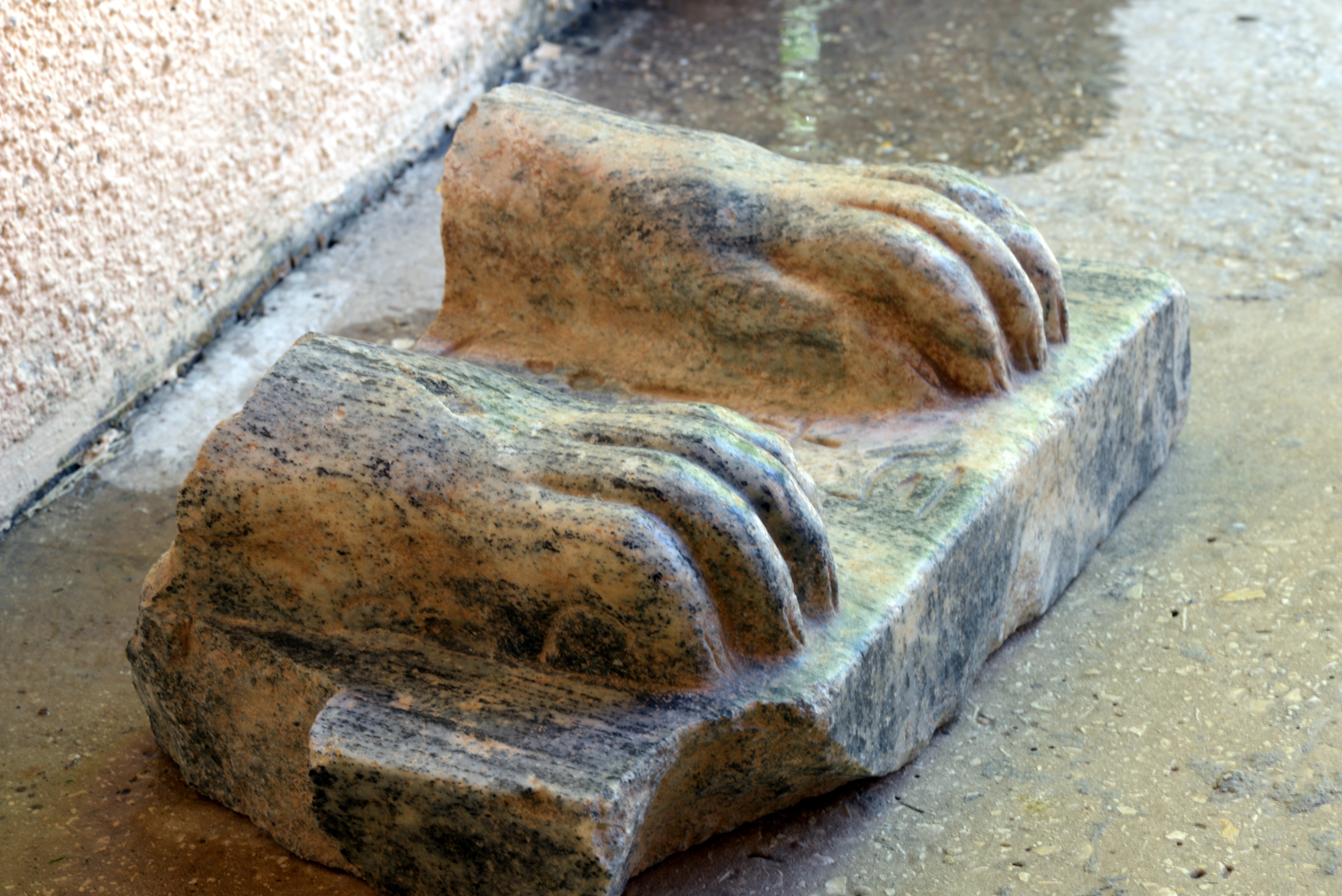
Looking back over the year is a profitable exercise for me personally because I forget so much and so quickly. Perhaps it is the volume of information coming from all corners of the globe that trains the mind to retain very little. A review of the posts here over the past year reminds us of recent history but it also allows us to judge what was more important and what was less.

I have compiled several lists of “top stories.” Today we will review major discoveries, top technology-related stories, and losses. Tomorrow we will survey significant stories, noteworthy posts, and favorite resources of the year.

These lists are subjective, and since they are based on what the authors of this blog decided to post (and not to ignore), they are doubly subjective. The primary criteria for inclusion here was that the story was posted on this blog and then it caught my eye when I reviewed the year’s stories. The lists follow a roughly chronological order.


Top 10 Discoveries of 2012:
Vessel of Jewelry Discovered at Megiddo (with update)

Egyptian Scarab Discovered in City of David

Cultic Objects Discovered at Khirbet Qeiyafa (and more)

New Gezer Boundary Inscription (and another re-discovered)

Seal Impression from Bethlehem Discovered in Jerusalem

New Sculpture from Tell Tayinat (and the treaty tablet) (and update)

Samson Mosaic Discovered in Galilee Synagogue

Massive Reservoir Discovered near Temple Mount

Desecrated Temple Discovered at Beth Shemesh

Judean Temple Discovered Near Jerusalem


More Discoveries of 2012:
Iron Age Fortress Excavated in Ashdod

Cave for Demeter Worship Identified in Judean Hills

Seal of Mattaniah Discovered in Jerusalem

Cave Discovered in Gezer Water System

Gold and Silver Treasure Hoard Discovered from Bar Kochba Revolt

Alleged Samson Seal Discovered at Beth Shemesh

Gold Coin Cache Discovered in Apollonia

Neolithic Jewelry Discovered near Sepphoris

Hasmonean Village Found in Jerusalem Neighborhood


Top Technology-Related Stories of 2012:
Microarchaeology in Gath Excavations

Egyptian Pyramids Discovered with Google Earth

Dead Sea Scrolls Now Online

Wikipedia wins: Photography is now allowed in the archaeology wing of the Israel Museum


Losses:
Manfred Goerg

Itamar Singer

James Mellaart

Itzhak Beit-Arieh

Frank Moore Cross

Gus W. Van Beek

Jean Perrot

Tomorrow I will share my choices for most significant stories, noteworthy posts, and favorite
resources.

Sunset over Jerusalem, tb123109454

Sunset over Jerusalem, December 31, 2009
Source: Pictorial Library of Bible Lands
Share:

A Judean temple from the 10th-9th centuries BC has been discovered four miles northwest of ancient Jerusalem. The structure has massive walls, faces east, and contained a cache of sacred vessels. The site of Tel Motza may be the town of Mozah mentioned in the city list of Joshua 18:26 and some believe the Emmaus mentioned in Luke 24 was located nearby.

moza
Location of Moza in relation to Jerusalem.
Map from Google Earth.

Archaeologists have dated the building to the Iron Age IIA, a period dated by most scholars to 980–830 BC, contemporary with the reigns of Solomon, Rehoboam, Asa, and Jehoshaphat. Each of these kings was faulted for not “destroying the high places” (1 Kgs 11:7; 14:23; 15:14; 22:43). Few such illicit worship sites are known from the land of Israel; the best preserved ones were excavated at Dan and Arad.

According to Anna Eirikh, Dr. Hamoudi Khalaily and Shua Kisilevitz, directors of the excavation on behalf of the Israel Antiquities Authority, “The ritual building at Tel Motza is an unusual and striking find, in light of the fact that there are hardly any remains of ritual buildings of the period in Judaea at the time of the First Temple. The uniqueness of the structure is even more remarkable because of the vicinity of the site’s proximity to the capital city of Jerusalem, which acted as the Kingdom’s main sacred center at the time.”

The site was excavated as part of road construction works on Highway 1, the Tel Aviv-Jerusalem road.

The press release of the Israel Antiquities Authority is here and six high-resolution photos are available from this link. The story is reported by the Jerusalem Post, Arutz-7, and other sites.

6
Aerial view of excavation site. Photograph: Skyview, courtesy of the Israel Antiquities Authority.
1
Figurines of bearded men. Photograph: Clara Amit, courtesy of the Israel Antiquities Authority.
5
Figurine of horse. Photograph: Clara Amit, courtesy of the Israel Antiquities Authority.
Share:

Leen Ritmeyer has photos from Alexander Schick of a wooden version of the formerly Holyland Hotel model of Jerusalem, now on display at Ben Gurion Airport.

Haaretz has a story about a Canaanite banquet hall discovered at Tel Kabri.

The Samaritans are using genetic testing (and abortion) to reduce the chances of birth defects caused by inbreeding.

The first snow of the season has fallen on Mount Hermon.

Vandals have attacked the Monastery of the Cross in Jerusalem for the second time this year.

You can now purchase the high-resolution artwork from the ESV Study Bible. The maps, illustrations, and charts/diagrams are available in packages for $10, or you can download everything for $25.

Eisenbrauns has a 30-50% off sale on the 4 volumes of the Ashkelon reports.

HT: Jack Sasson

IMG_1291
Model of Jerusalem at Ben Gurion Airport.
Photo by Alexander Schick.
Share:

From the Times of Israel:

Israeli archaeologists digging under a road in Jerusalem have uncovered the remains of an agricultural community that could yield new information on the lives of residents before and after the rise of the Hasmonean dynasty around 2,200 years ago, the Israel Antiquities Authority said Monday.
The excavation in the city’s modern-day Kiryat Hayovel neighborhood has yielded a perfume bottle, wine press, bread oven and the remains of houses and agricultural buildings, according to an IAA statement.
Archaeologists also found a hand-made lead weight with a letter carved on it — seemingly the letter “yod,” the tenth letter of the Hebrew alphabet and the equivalent of the English letter “y.”
The community seems to have been active both before and after the Maccabees took Jerusalem and re-dedicated the Temple in 164 BCE, marking the beginning of Hasmonean rule, according to the IAA.
That victory is commemorated this week by the festival of Hanukkah.

The story continues here. Kiryat Hayovel is three miles southwest of the Old City.

HT: Joseph Lauer

workers-revealing-rock-cut-foundations-635x357-IAA
Excavations in Kiryat Hayovel. Photo by Israel Antiquities Authority.
Share:

From the Christian News Network:

Archaeologists have uncovered what they believe is a road that was traveled by Jesus and the disciples in the ancient town of Bethsaida.
In conducting a dig near the Northeastern shore of the Sea of Galilee in Israel, which was originally meant to serve as a mission to find artifacts from the Roman period, archaeologists came across a distinctive discovery.
“We uncovered a paved street from the time of Jesus’s disciples, which runs westward through the residential area from the corner of the Fisherman’s House down toward the Jordan valley,” Nicolae Roddy of Creighton University in Omaha, Nebraska, one of the leaders of the dig, told the publication Popular Archaeology. “I tell people that Andrew, Peter and Phillip almost certainly walked on it because they would have had to have gone out of their way to avoid it!”

The article does not include a photo, and I don’t see any other reports on this besides this brief one.

HT: Joseph Lauer

Bethsaida house of fisherman, tb060105684

Newly discovered road ran from the “house of the fisherman” shown above toward the Jordan River. Photo from the Pictorial Library of Bible Lands.
Share:

A press release from the American Friends of Tel Aviv University announces the recent discovery of a holy place that was not always a holy place.

Tel Aviv University researchers have uncovered a unique 11th-century BCE sacred compound at the site of Tel Beth-Shemesh, an ancient village that resisted the aggressive expansion of neighboring Philistines. The newly discovered sacred complex is comprised of an elevated, massive circular stone structure and an intricately constructed building characterized by a row of three flat, large round stones. Co-directors of the dig Prof. Shlomo Bunimovitz and Dr. Zvi Lederman of TAU’s Sonia and Marco Nadler Institute of Archaeology say that this temple complex is unparalleled, possibly connected to an early Israelite cult — and provides remarkable new evidence of the deliberate desecration of a sacred site.
[…]
After ruling out the use of the site as a domestic structure, the researchers knew that they had found something unique. Excavations revealed almost only shards of painted chalices and goblets found spread on the floor but no traces of domestic use. One of the three flat stones was surrounded by animal bone remnants, and the two other stones were seemingly designed to direct liquids. These clues convinced Prof. Bunimovitz and Dr. Lederman that they had uncovered a likely place of sacred worship.
But the temple didn’t remain sacred. Samples of earth taken from layers above the destroyed temple and analyzed at the Weizmann Institute of Science revealed astonishing results. Directly above the temple was a packed-in layer containing phytoliths (remains of weeds that are commonly eaten by livestock) and spherulites (microscopic remnants of manure produced by grass-eating animals), indicating the presence of animal pens directly on top of the sacred site, explains Prof. Bunimovitz. Intermittent burning in order to clean the pens likely resulted in the concentrated state of the layer.
This desecration was no accident or coincidence, the researchers believe. Instead, it represents the see-saw of political might between the Philistines and the local population. Presumably the Philistines gained temporary control of Beth-Shemesh, and brought in livestock to live on what they knew had been a sacred site to their enemies.

The article does not mention Samson, but this is roughly the period when he lived in the town across the valley.

HT: David Coppedge

Zorah and Eshtaol from Beth Shemesh, tb062300343
View from the excavations of Beth Shemesh towards Samson’s place of birth and burial
Share: