(Post by A.D. Riddle)

There have been a dozen or so online pieces in the last two days about the colossal statue found at Tel Tayinat this summer, but most of them repeat what can be found in the official news release (see the update added to the end of our first post).

A few new photos have appeared, and the Toronto Star describes the discovery of the statue by Darren Joblonkay, a student working on the dig this summer.

(photo by Jennifer Jackson)

(photo by Jennifer Jackson)

 Darren Joblonkay with statue fragment (photo from The Star).
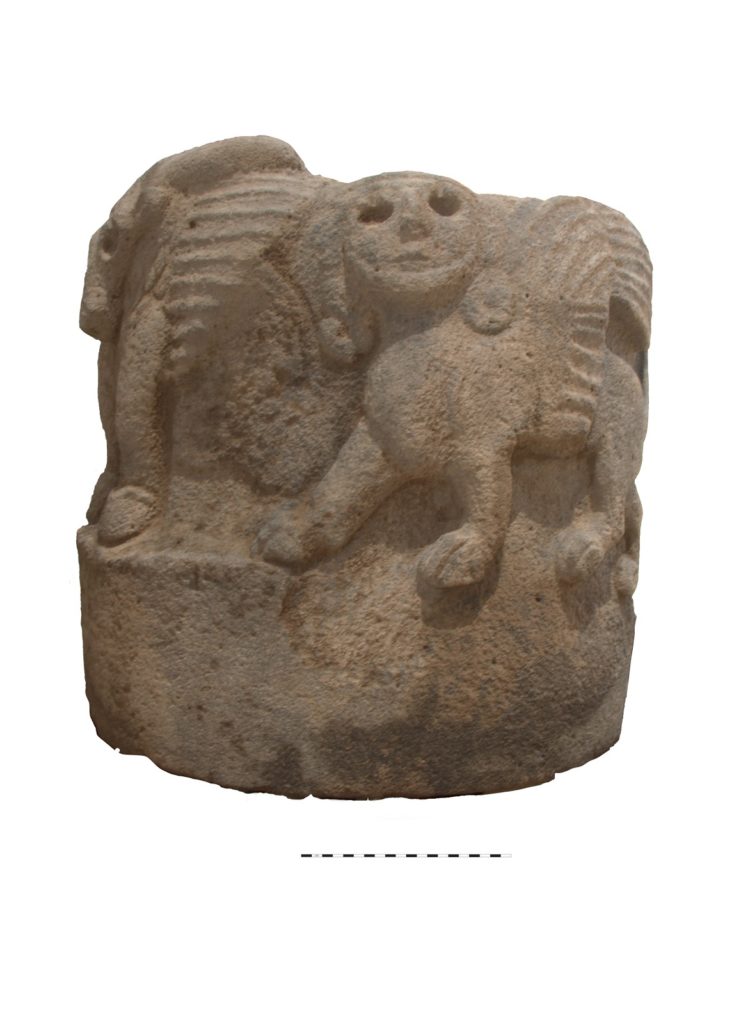
In the lower photo, one can barely see that the back of the statue, from the shoulders down, has an uneven surface. This must be the “lengthy Hieroglyphic Luwian inscription” in raised relief. The article in the Toronto Star gives a few intriguing details about the content of the inscription. It belongs to the Neo-Hittite king Suppiluliuma (9th cent. B.C.) and describes his “taking land from eight neighbouring kingdoms, establishing a border, and building a monument to his father.” The photo shows another piece of monumental sculpture, a column base fragment depicting a winged bull. The other reports state that the column base also has a relief of a sphinx.
The low mound of Tell Tayinat in the Amuq Plain, Turkey.
(photo source)

UPDATE: The official announcement was also released at the website of the University of Toronto, including a link to a photo of the column base fragment.
(photo by Jennifer Jackson)
Share:

Some scholars are suggesting that the depiction on a seal found in the Sorek Valley shows the biblical hero Samson subduing a lion. From Haaretz:

A small stone seal found recently in the excavations of Tel Beit Shemesh could be the first archaeological evidence of the story of the biblical Samson.
The seal, measuring 1.5 centimeters, depicts a large animal next to a human figure. The seal was found in a level of excavation that dates to the 11th century B.C.E. That was prior to the establishment of the Judean kingdom and is considered to be the period of the biblical judges – including Samson. Scholars say the scene shown on the artifact recalls the story in Judges of Samson fighting a lion.
But excavation directors Prof. Shlomo Bunimovitz and Dr. Zvi Lederman of Tel Aviv University say they do not suggest that the human figure on the seal is the biblical Samson. Rather, the geographical proximity to the area where Samson lived, and the time period of the seal, show that a story was being told at the time of a hero who fought a lion, and that the story eventually found its way into the biblical text and onto the seal.

The story continues and explains some of the geographical connections. This discovery reminds me that while Samson’s life largely centers in the Sorek Valley, the most prominent city of that valley is never mentioned in the narrative (Judges 13-16). If the interpretation of this seal is correct, the people of Beth Shemesh remembered their local hero with some pride.

A high-resolution photo of the seal by Raz Lederman is available here.

HT: Joseph Lauer

Share:

(Post by A.D. Riddle)

According to an online article at Hürriyet Daily News, excavations at Tell Tayinat unearthed the head of a large statue last month. The Tayinat Archaeological Project is directed by Timothy Harrison of the University of Toronto. The head is made of basalt with inlaid eyes, is about 5 feet tall (1.5 m) and weighs 1.5 tons. Some excerpts give a few details:

“It is a figure with a beard and long hair, and it seems to be holding a weapon…The rest of the sculpture has not been found, indicating that it may
well have been damaged. However, the upper part is in very good
condition…The sculpture has been sent to the Hatay Archeology Museum, where it
will be restored by a professional team…Harrison also showed that
there is writing that says ‘Suppiluliuma’ at the back of the sculpture.”

In related news, an Assyrian vassal treaty tablet was discovered at Tell Tayinat in 2009 (see here).

Two articles including the publication of the treaty tablet and a discussion of the archaeological context appear in the latest issue of Journal of Cuneiform Studies (pdf downloads available here).

Harrison, T.P. and Osborne J. F.
2012          “Building XVI and the Neo-Assyrian Sacred Precinct at Tell Tayinat.” Journal of Cuneiform Studies 64: 125-143.

Lauinger, J.
2012          “Esarhaddon’s Succession Treaty at Tell Tayinat: Text and Commentary.” Journal of Cuneiform Studies 64: 87-123.

For a number of years (or rather, decades), Kenneth Kitchen has been working on collecting all Ancient Near Eastern treaties, covenants, and law codes. The culmination of this work now appears in print as:

Kitchen, Kenneth A. and Paul J. N. Lawrence.
2012          Treaty, Law and Covenant in the Ancient Near East. 3 parts. Wiesbaden: Harrassowitz.

A detailed table of contents and introduction (pdf) can be downloaded at the publisher’s website. (I am counting on my library to get a copy, since I don’t have quite enough change in my pocket to cover the nearly €300 [= $370] price tag.) The introduction notes that this work includes 106 documents in 10 different languages. Parts 1 and 2 include the texts in transliteration and translation, with notes, indexes and color diagrams. Part 3 is a nearly 300 page commentary and synthesis of all this material. See here for a discussion of the significance of this study for the book of Deuteronomy in particular. (Deuteronomy and other biblical treaties and covenants are included in Treaty, Law and Covenant in the Ancient Near East, but the new Tayinat treaty tablet is not—it is probably too recent to have made it in.)

UPDATE (Jul 30, Mon): An official announcement concerning the new statue fragment was released this morning by the University of Toronto. It includes two more photos and states that the fragment was found underneath the paved surface of a monumental gateway leading to the Neo-Hittite citadel.

From the release:

The head and torso of the human figure, intact to just above its waist,
stands approximately 1.5 metres in height, suggesting a total body
length of 3.5 to four metres. The figure’s face is bearded, with
beautifully preserved inlaid eyes made of white and black stone, and its
hair has been coiffed in an elaborate series of curls aligned in linear
rows. Both arms are extended forward from the elbow, each with two arm
bracelets decorated with lion heads. The figure’s right hand holds a
spear, and in its left is a shaft of wheat. A crescent-shaped pectoral
adorns its chest. A lengthy Hieroglyphic Luwian inscription, carved in
raised relief across its back, records the campaigns and accomplishments
of Suppiluliuma, likely the same Patinean king who faced a Neo-Assyrian
onslaught of Shalmaneser III as part of a Syrian-Hittite coalition in
858 BC.

Share:

In April 2009, Israeli archaeologists announced the discovery of a harbor at Acco dating to the 3rd-2nd centuries BC. More evidence has been uncovered in recent excavations, including a destruction layer and a slipway probably used for military ships. From the Israel Antiquities Authority:

According to Kobi Sharvit, director of the Israel Antiquities Authority Marine Archaeology Unit , “Among the finds we’ve discovered now are large mooring stones that were incorporated in the quay and were used to secure sailing vessels that anchored in the harbor c. 2,300 years ago. This unique and important find finally provides an unequivocal answer to the question of whether we are dealing with port installations or the floor of a building. In addition, we exposed collapse comprised of large dressed stones that apparently belonged to large buildings or installations, which was spread of a distance of dozens of meters. What emerges from these finds is a clear picture of systematic and deliberate destruction of the port facilities that occurred in antiquity”. Sharvit adds, “Recently a find was uncovered that suggests we are excavating part of the military port of Akko. We are talking about an impressive section of stone pavement c. 8 meters long by c. 5 meters wide that was partially exposed. The floor is delimited on both sides by two impressive stone walls that are also built in the Phoenician manner. It seems that the floor between the walls slopes slightly toward the south, and there was a small amount of stone collapse in its center. Presumably this is a slipway, an installation that was used for lifting boats onto the shore, probably warships in this case”. According to Sharvit, “Only further archaeological excavations will corroborate or invalidate this theory”.
The bottom of the ancient harbor was exposed at the foot of the installations. There the mooring stones were found as well as thousands of fragments of pottery vessels, among which are dozens of intact vessels and metallic objects. The preliminary identification of the pottery vessels indicates that many of them come from islands in the Aegean Sea, including Knidos, Rhodes, Kos and others, as well as other port cities located along the Mediterranean coast.

The story includes photographs of the ancient quay, a mooring stone, and an imported bowl. High-resolution images are available from the IAA here.

The city of Acco was known as Ptolemais in the Hellenistic and New Testament periods. It is mentioned once in the New Testament in connection with Paul’s return from his third missionary journey (Acts 21:7). You can read more about the city here.

Share:

More photos and a video of the gold treasure from Apollonia have been released. The value of the coins is now given (in at least one article) as $500,000.

The “Egyptian Antiquities’ Renaissance Project” has been launched in order to turn archaeology into a major source of income in Egypt.

The Museum of the Bible, featuring the collection of the Steve Green family, will open not in Dallas and not in New York, but in Washington, DC.

I wonder if you could name 6 Christian Sites in Rome You Should Know About.

Shmuel Browns describes and illustrates the newly opened archaeological site on Mount Gerizim.

Joe Yudin visits “Genesis Land” in the Judean wilderness.

The owner of a bed-and-breakfast in Sepphoris was convicted of damaged antiquities when carrying out renovations on his property.

“Israel’s Tourism Ministry is planning to upgrade the hotel strip area at the southern end of the Dead Sea….The Dead Sea was the most crowded leisure destination in Israel in 2011, with some 857,000 visitors during the year.”

Itzhak Beit-Arieh, Associate Professor of Archaeology at Tel Aviv University, has passed away.

HT: Daniel Wright, Jack Sasson

Dead Sea from west, tb092706278
Dead Sea from the northwest
(photo source)
Share:

Luke Chandler is volunteering at the excavations on the northern side of the Elah Valley and he briefly notes a few items of interest:

  • An early Iron Age inscription has been discovered.
  • This may be the final season of excavating Khirbet Qeiyafa.
  • The excavators have identified the next site they wish to excavate.
  • Chandler has also has posted a series of photos from the first week of the dig.

Don’t miss his great photo of a sling stone!

Khirbet Qeiyafa west gate, tb010410826
Excavations near western gate of Khirbet Qeiyafa
(photo source)
Share: