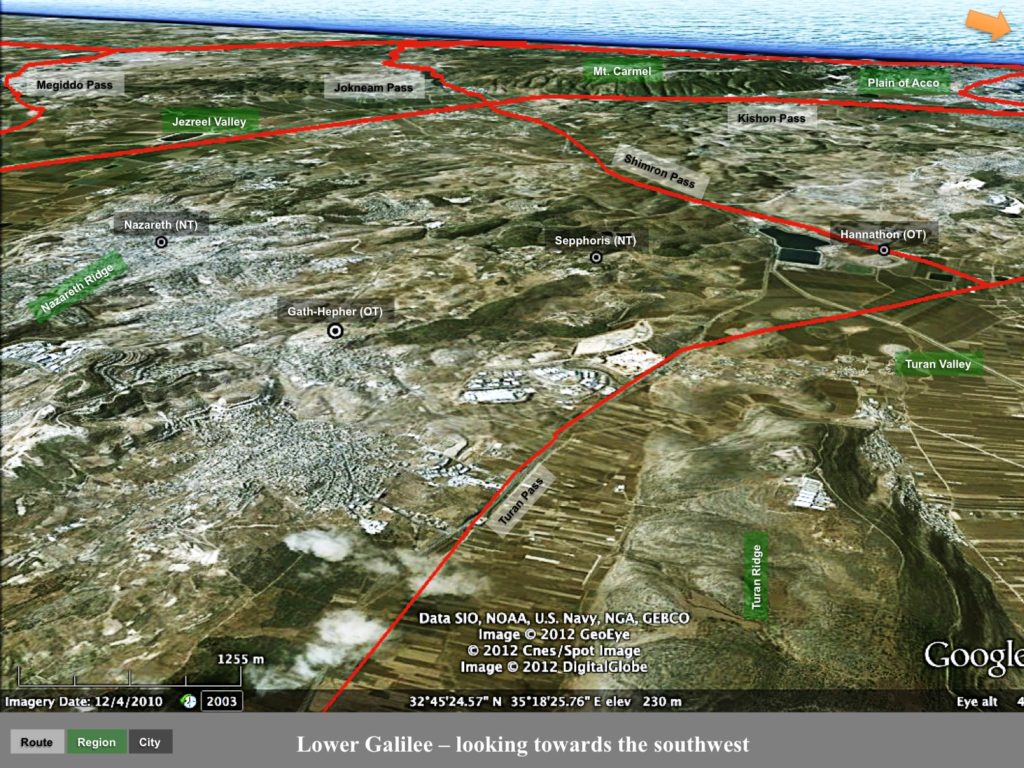
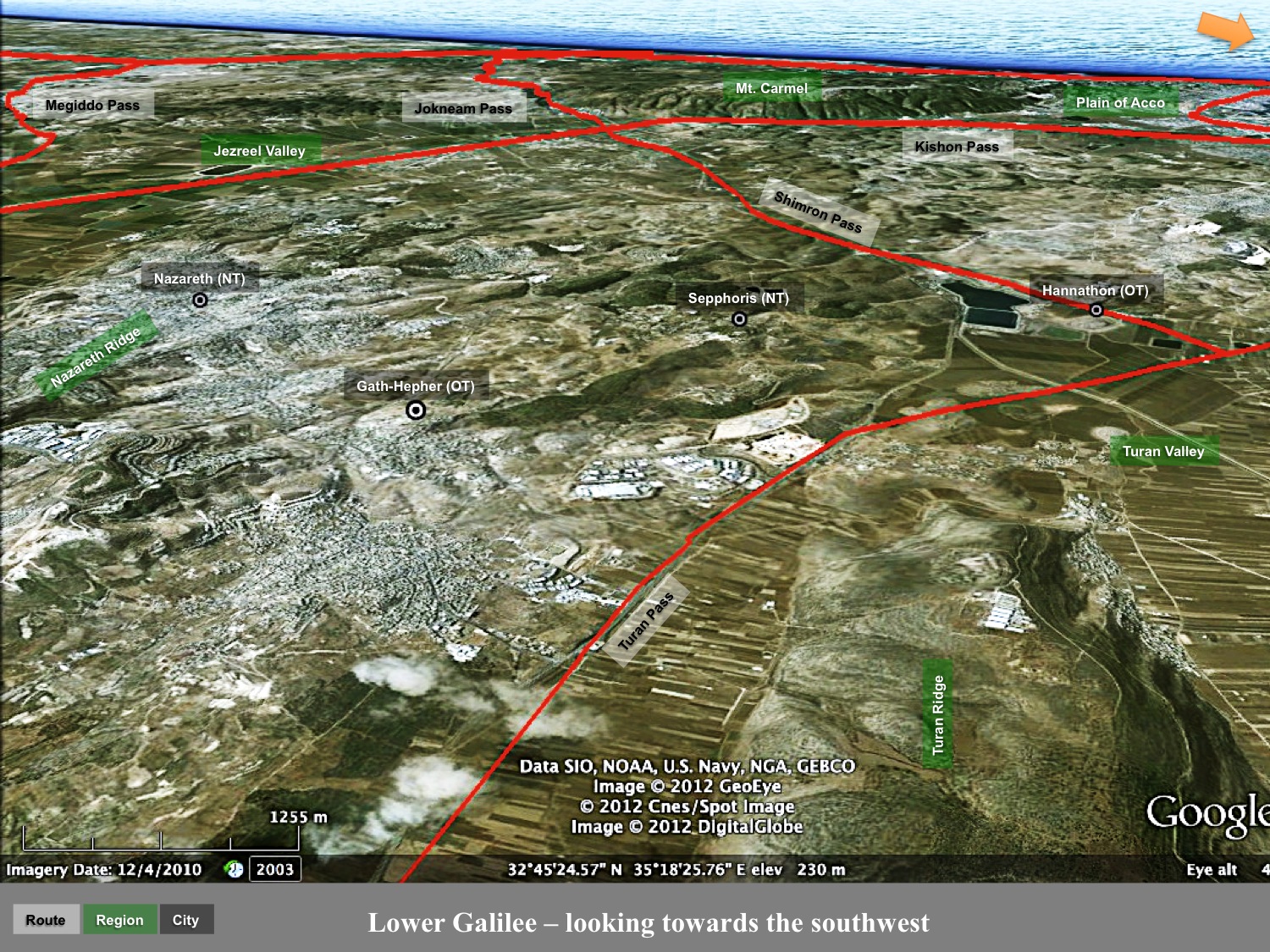
In light of the current discussion concerning the so-called “Jesus Discovery” of the depiction of a Jonah/resurrection motif on a 1st century CE ossuary (see here) it is probably prudent to re-examine the typological relationship between the two prophets of Jonah and Jesus.
Besides the explicit connection of “the sign of Jonah” mentioned in Matt. 12:38-41; 16:4; Luke 11:29-32 there are several probable connections that can be derived through comparing the Gospels to the book of Jonah and 2 Kings 14:25 (i.e. the only Old Testament mention of the prophet outside of the prophetic book of Jonah).
Consider the following suggested similarities/parallels:
1. Each prophet heralded from and began his ministry in Lower Galilee. Jonah/Gath-Hepher and Jesus/Nazareth – 2 Kings 14:25; Matt. 2:23.
2. Each prophet’s ministry occurred during a time in which Israel’s hierarchical, wealthy members “trampled upon the poor.” Jonah/“cows of Bashan” during the time of Jeroboam II (8th cent. BCE); Jesus/”devourers of widow’s households” – Amos 4:1-3; 5:11-12; 8:3-7; Matt. 19:23-25; Mark 12:41-44; Luke 16:19-31; 20:46-47.
3. Each prophet preached Yahweh to Gentiles despite a desire to primarily minister to their own Israelite/Jewish population. Jonah joined Phoenicians on their way to North Africa (i.e. Tarshish) to avoid the goyim of Nineveh (Jonah 1:1-3) and Jesus stated that he was sent “only to the lost sheep of the house of Israel” (Matt. 15:24). However, both eventually ministered to Gentile populations – Jonah with Nineveh and Jesus for example with the Syro-Phoenician woman (Mark 7:25-28), Legion of the tombs of Gadera (Luke 8:26-34), and the centurion’s servant at Capernaum (Matt. 8:5-13).
4. Each prophet slept in the bottom of a ship in the midst of a raging storm while the ship’s sailors were wracked with fear and bewilderment due to the prophet’s slumber (Jonah 1:4-6; Mark 4:35-38). Additionally, each prophet was the reason for the ceasing of the storm (Jonah 1:7-16; Mark 4:39-41).
5. Explicit connection (see above) Each prophet spent “three days and three nights” in the “heart” of the earth before being “brought up from the pit.” Compare Jonah’s prayer (Jonah 2) and Jesus’ “sign of Jonah” (Matt. 12:38-41; 16:4; Luke 11:29-32) to Jonah’s expulsion (Jonah 3:1) and Jesus’ resurrection (e.g. Matt. 28:1-6).
6. Each prophet, despite being from northern Israel (i.e. Israel in the 8th cent. BCE and Galilee in the 1st cent CE), were obedient to the Law of Moses in worshipping Yahweh at his chosen location of Jerusalem (Deut. 12:5-7; 2 Sam. 7:13; 1 Kings 5:5). Compare Jonah’s “worship in the temple” (Jonah 2:4, 7), despite the enduring presence of the syncrestic temples of Dan and Bethel, to Jesus going up to Jerusalem for various feasts (e.g. Luke 2:41; 22:1).
7. Each prophet proclaimed coming destruction upon his audience’s capital city. Compare Jonah’s proclamation to Nineveh (Jonah 3) and subsequent, vengeful grief over their repentance (Jonah 4:1-4) to Jesus’ prophecy of doom to Jerusalem (e.g. Matt. 24) and subsequent, knowing grief over their rejection (Matt. 23:37; and especially Luke 19:41-44). As an aside, I find Jonah’s statement in Jonah 4:3 to be an ironic double entendre in the vein of Caiaphas’ statement in John 11:49-50.
8. Each prophet left the city that they had just preached in and went to the east of the city and prayed. Compare Jonah’s selfish, languishing prayer concerning the loss of his shade east of Nineveh and Yahweh’s response (Jonah 4:5-11) to Jesus’ selfless, anguish-filled plea to “let this cup pass” in Gethsemane and Yahweh’s silence (e.g. Luke 22:39-44).
More could be said about the typology of Jonah in relation to Jesus, especially with regards to the notable differences between the two. Nevertheless, in my opinion the above similarities undergird the connection between Jonah and early Christian motifs (see for example Jensen’s post which mentions 4th cent. CE depictions in Rome). Whether, the Talpiot ossuary is the first known example of this connection is an open, debatable question, but in either case it seems clear that the motifs derive from a clear typology that is rooted in the Gospels.
And I thought the days of archaeological treasures was long past…
The Megiddo Expedition have recently discovered a collection of gold, silver and bronze jewelry, wrapped in fabric, hidden in a vessel at Tel Megiddo. The vessel was found in a domestic context that was dated to the Iron Age I (around 1100 B.C.). This vessel was actually excavated during the 2010 season, but remained uncleaned while awaiting for a molecular analysis of it’s [sic] content (soil). When it was finally emptied during the summer of 2011, the pieces of jewelry appeared.
Both the textile and the jewelry itself were sent to analysis that should tell us more about the origins of this exceptional collection.
According to the biblical record, Megiddo was held by the Canaanites during the period of the judges (Judg 1:27).
The official website for “The Jesus Discovery” is now up. And down (bandwidth limit exceeded). An interview with the authors is here, when the site is back up.
The Jesus Discovery book by James Tabor has skyrocketed to #1 in all of its categories at Amazon and an overall rank of #174.
More than a dozen photos from the press conference are online. (HT: Joseph Lauer). Apparently
James Charlesworth, lead academic consultant to the team, skipped the show.
In a comment on Eric Meyers’ post, Tabor advances the view that Jesus’ body was first buried at the Holy Sepulcher site and then moved to the Talpiot tomb.
Robert Cargill suggests that the “fish” is a tomb nephesh and he claims (in the comments) that two photos supplied by the authors have been doctored or of different “fish.” (I’m not convinced.)
James Tabor confirms Gordon Franz’s observation that everyone has the fish turned the wrong way. If so, why were all of the photos released as horizontal shots?
Jodi Magness is chagrined to see archaeology “hijacked in the service of non-scientific interests.” In a comment, Tabor disagrees that such is the case and he writes of the fish etching that “at least half a dozen art historians have agreed with the Jonah interpretation.” Stephen Goranson notes that none of them have been quoted and he wonders if “signed non-disclosure agreements help scholarship.”
Michael Heiser explains why the process of using the “clueless archaeo-media” is rejected by scholars as a pursuit for cash and not for accuracy. “It’s the methodological equivalent to using mainstream media connections to announce a cure for cancer without clinical trials, or presenting one’s off-the-radar conspiratorial theory (the academic word would be avant garde) about Zionism instead of getting critical feedback from field experts first. But that’s boring and doesn’t generate sales.”
James Davila is pleased with the scholarly response to the announcement and that the media appears to be heeding it (unlike in times past).
The “excavation” was conducted by Rami Arav and James Tabor.
Simcha Jacobovici is listed as film director and “professor in the Department of Religion at Huntington University, Ontario.” (Wikipedia indicates that he has an M.A. in International Relations.)
James Charlesworth is listed as “primary academic consultant.”
Eight ossuaries were found in the tomb.
The tomb was first studied in 1981. Some of the artifacts and documentation from this previous excavation are missing.
The tomb has been sealed under a condominium building since the 1981 excavation.
What is being hailed now as the “archaeological find that reveals the birth of Christianity” was not seen by archaeologists in the 1981 excavation. The four-line Greek inscription and the iconographic image (fish?) were first observed in the recent camera study.
The challenges to studying the tomb chamber by means of a robotic camera were significant.
One ossuary may be inscribed with Jonah, John, or Julia.
The interpretation of the 4-line inscription is quite difficult and there are a number of possibilities.
One work lists 108 images of Jonah in early Christian art, but these are found in the catacombs of
Rome and are no earlier than the 3rd century.
Tabor: “We are convinced that our inscription clearly makes some affirmation about either resurrection from the dead or lifting up to heaven. Whether one might identify it as “Christian,” or to be more historically precise—as associated with the early followers of Jesus, is another question. I would strongly argue in the affirmative. Although it is true that ideas of resurrection of the dead and even ascent to heaven are found in a multiplicity of Jewish sources in the late 2nd Temple period, they do not appear as expressions in burial contexts unless we have an exception here in the Talpiot tomb. That, along with the unprecedented example of writing the divine name Yahweh in Greek letters in a Jewish tomb—a place of tum’a or ritual defilement—argues for a heterodox or sectarian context.”
Tabor rejects the possibility that the iconographic image depicts a nephesh or an amphora.
Tabor believes a previously discovered ossuary with the name Yeshua (Jesus) depicts Jesus inside a fish.
Tabor: “Context is everything.”
The report includes 28 figures: maps, photos, and plans.
This preliminary report is a very helpful review and analysis of the evidence. James Tabor is to be commended for providing this to readers who want to know the basis for some of the conclusions being announced in the media. You can read the whole report here.
The Huffington Post provides an excerpt from The Jesus Discovery book along with a series of photos from inside the tomb. Here are some excerpts from the excerpt, with emphasis added:
The discovery provides the earliest archaeological evidence of faith in Jesus’ resurrection from the dead, the first witness to a saying of Jesus that predates even the writing of our New Testament gospels, and the earliest example of Christian art, all found in a sealed tomb dated to the 1st century CE….
We believe a compelling argument can be made that the Garden tomb is that of Jesus of Nazareth and his family. We argue in this book that both tombs are most likely located on the rural estate of Joseph of Arimathea, the wealthy member of the Sanhedrin who according to all four New Testament gospels took official charge of Jesus’ burial….
We now have new archaeological evidence, literally written in stone, that can guide us in properly understanding what Jesus’ earliest followers meant by their faith in Jesus’ resurrection from the dead, with his earthly remains, and those of his family, peacefully interred just yards away. This might sound like a contradiction, but only because certain theological traditions regarding the meaning of resurrection of the dead have clouded our understanding of what Jesus and his first followers truly believed. When we put together the texts of the gospels with this archaeological evidence, the results are strikingly consistent and stand up to rigorous standards of historical evidence.
James Tabor stated in a comment here yesterday that he is “not sure how finding the earliest evidence of faith in Jesus’ resurrection would negate Christianity,” but the book excerpt above shows otherwise. In their interpretations of the evidence, the authors claim that the evidence refutes “certain theological traditions” about the bodily resurrection of Jesus. They claim that Jesus’ followers denied his physical resurrection. Yet the traditions of his resurrection go back to one of the earliest books in the New Testament (ca. AD 50). Paul wrote in 1 Corinthians 15:1-8:
Now I would remind you, brothers, of the gospel I preached to you, which you received, in which you stand, 2 and by which you are being saved, if you hold fast to the word I preached to you—unless you believed in vain.
3 For I delivered to you as of first importance what I also received: that Christ died for our sins in accordance with the Scriptures, 4 that he was buried, that he was raised on the third day in accordance with the Scriptures, 5 and that he appeared to Cephas, then to the twelve. 6 Then he appeared to more than five hundred brothers at one time, most of whom are still alive, though some have fallen asleep. 7 Then he appeared to James, then to all the apostles. 8 Last of all, as to one untimely born, he appeared also to me.
These verses and the rest of the chapter make it clear that Paul is speaking of a bodily resurrection.
The same Christ that was buried was raised. The Christ that appeared to the disciples could be seen.
If Jesus’ body is still in the tomb, our faith is in vain. A spiritual resurrection is no resurrection at all.
Christopher A. Rollston has published a brief review of “the new Jesus Discovery” at the ASOR Blog. Among other things he concludes:
3. There is no necessary connection between these two tombs and there is no convincing evidence that some famous figure of history (such as Jesus of Nazareth, Joseph of Arimathea, or Mary Magdalene, etc.) was buried in these tombs.
4. Furthermore, these tombs do not provide any evidence that can be construed as suggesting that Jesus of Nazareth and Mary Magdalene were married or had a child together.
5. I highly doubt that the inscription in Talpiyot Tomb B refers to a resurrection. In any case, many Jews during the Second Temple Period believed in a resurrection, long before the rise of Christianity. Thus, even if there were some evidence for a notion of a resurrection in this tomb, it does not necessarily follow that this was a Jewish-Christian tomb.
6. I am certain that the tetragrammaton (i.e., “Yahweh”) is not present in the four-line inscription from Talpiyot Tomb B.
7. The ornamentation on the ossuary in Talpiyot Tomb B that Tabor and Jacobovici wish to consider “Jonah and the Whale” (with Jonah pitched on the nose of the whale!) is a nephesh tower or tomb façade, just as Eric Meyers has stated. Such an image is quite common in the corpus of ossuaries.
Ultimately, therefore, I would suggest that these are fairly standard, mundane Jerusalem tombs of the Late Second Temple period. The contents are interesting, but there is nothing that is particularly sensational or unique in these tombs. I wish that it were different. After all, it would be quite fascinating to find a tomb that could be said to be “Christian” and to hail from the very century that Christianity arose. Moreover, it would be particularly interesting to find a tomb that could be associated with Jesus of Nazareth and his family. But, alas, the evidence does not suggest this. A basic methodological stricture is this: dramatic claims require dramatic and decisive evidence. In this case, Tabor and Jacobovici have strained the evidence far beyond the breaking point.
Thus he is essentially rejecting everything that would make this new discovery worthy of media attention. You can read his full review here. (The link has been acting up this morning, so if it doesn’t work, go directly to www.asorblog.org.)
Eric M. Meyers is no more positive.
The book is truly much ado about nothing and is a sensationalist presentation of data that are familiar to anyone with knowledge of first-century Jerusalem. Nothing in the book “revolutionizes our understanding of Jesus or early Christianity” as the authors and publisher claim, and we may regard this book as yet another in a long list of presentations that misuse not only the Bible but also archaeology.
I am posting an article at http://bibleinterp.com that offers a preliminary report and analysis with maps and illustrations of the recent Talpiot “patio” tomb exploration by remote camera that Rami Arav and I conducted in 2009-2011. It should go up on that web site by noon today.
The BiblePlaces Blog provides updates and analysis of the latest in biblical archaeology, history, and geography. Unless otherwise noted, the posts are written by Todd Bolen, PhD, Professor of Biblical Studies at The Master’s University.