The University of Haifa has announced some discoveries from its 2009 season of excavations at Hippos/Sussita, reported in a press release (Hebrew) and in an English article in Ha’aretz

Remains of an ancient cult to the goddess of love have come to light in the southern Golan Heights site of Susita.
At the site, on a 350 meter-high-plateau overlooking the eastern shore of Lake Kinneret, archaeologists found a cache of three figurines of Aphrodite (whom the Romans called Venus), dating back about 1,500 years. The figurines, made of clay, are about 30 centimeters tall. They depict the nude goddess standing, with her right hand covering her private parts – a type of statue scholars call “modest Venus.”

I’m personally more interested in another find, described at the conclusion of the article:

Another special find at Susita is an odeon – a small, roofed theater-like structure with seats for about 600 people, uncovered for the first time in Israel, according to the excavators. They said such structures were fairly common in the Roman period and were used for the reading of poetry and musical presentations to a select audience, in contrast to theaters, which could seat around 4,000 people.

The claim that this is the first odeon discovered in Israel is not true; another has been excavated at Aphek/Antipatris (NEAEH 1: 71, with photo).

The press release includes several photos.

HT: Joe Lauer
Share:

A third-century A.D. Roman building has been excavated in the City of David in Jerusalem. 

Excavations in this past and future parking lot located in the Central (Tyropean) Valley have formerly revealed a first-century A.D. palace believed to have belonged to Queen Helene of Adiabene.

From the press release of the Israel Antiquities Authority:

A spacious edifice from the Roman period (third century CE) – apparently a mansion that belonged to a wealthy individual – was recently exposed in the excavations the Israel Antiquities Authority is carrying out in the ‘Givati Car Park’ at the City of David, in the Walls Around Jerusalem National Park. The excavations are being conducted at the site on behalf of the IAA and in cooperation with the Nature and Parks Authority, and are underwritten by the ‘Ir David Foundation.
According to Dr. Doron Ben-Ami, the excavation director on behalf of the IAA, together with Yana Tchekhanovets, “Although we do not have the complete dimensions of the structure, we can cautiously estimate that the building covered an area of approximately 1,000 square meters. In the center of it was a large open courtyard surrounded by columns. Galleries were spread out between the rows of columns and the rooms that flanked the courtyard. The wings of the building rose to a height of two stories and were covered with tile roofs”.
A large quantity of fresco fragments was discovered in the collapsed ruins from which the excavators deduced that some of the walls of the rooms were treated with plaster and decorated with colorful paintings. The painted designs that adorned the plastered walls consisted mostly of geometric and floral motifs. Its architectural richness, plan and particularly the artifacts that were discovered among its ruins bear witness to the unequivocal Roman character of the building. The most outstanding of these finds are a marble figurine in the image of a boxer and a gold earring inlaid with precious stones.

The full release can be found here (temporary link).

Three high-resolution photos can be downloaded from the IAA website, including photos of the earring and statue and an aerial photograph of the building.

HT: Joe Lauer

Share:

The headline above reflects the article’s story, but I think a better English word for the discovery would be “synagogue.”  Traces of many Jewish synagogues have been found in Turkey and this is likely just another.  The word “temple” is sometimes used to refer to a worship building, without intending to specify a singular structure such as that in Jerusalem.

The location of the discovery is interesting to New Testament readers for another reason: Paul visited this place.  A search of the NT won’t reveal any references to Andriake/Andriace, but this was the name of the port of Myra, where Paul changed ships on his way to prison in Rome (Acts 27:5-6).

From Today’s Zaman:

Ongoing excavations at the ancient port city of Andriake in Lycia — located in Antalya’s Demre district — have uncovered a centuries-old Jewish temple.

Site chief Dr. Nevzat Çevik, an archaeology professor at Akdeniz University, told the Anatolia news agency that his team believes the temple is from around the third century. Located on a choice spot facing the sea, the temple was likely built following a law instituted in 212 that allowed Jews the right to become Roman citizens, Çevik said.

The find is important as it is the first archaeological trace of Jewish culture found in Lycia. “For the archaeological world, the world of science and particularly for Lycian archaeology and history, we’re facing an important find here. It’s the first remnant of Lycian Jewish culture we’ve found,” Çevik said, describing the find. “When we first discovered the temple, we weren’t sure what it was, but after continuing to dig, the archaeological findings and particularly the first-quality marble slabs that we found were evidence for us that they were part of a Jewish temple.”

The finding came as a great surprise, the archaeologist said, and the team is continuing to work excitedly. “To encounter remnants of Jewish culture for the first time has caused great excitement. We’re adding another layer to what we know of Lycian culture — now that we know that there was a Jewish presence in Lycia as well, we can follow this path and better understand other finds,” he explained.

As part of the temple find, the team located a menorah and pieces inscribed with traditional Jewish symbols and figures. Çevik also noted the importance that the find would eventually have for tourism in the region.

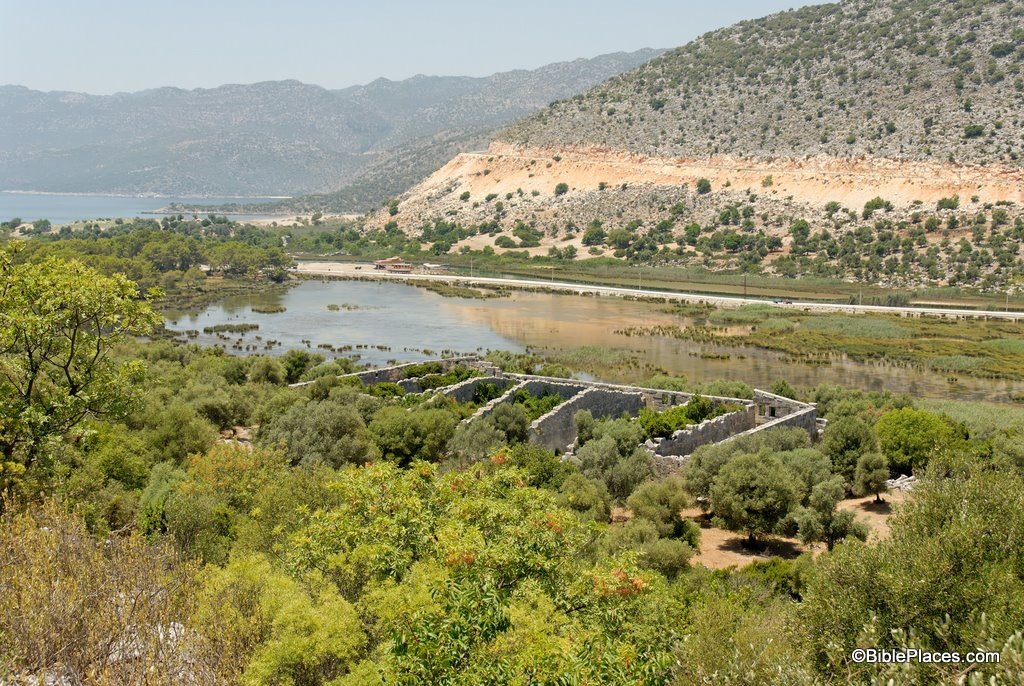
Andriace Hadrian's granary near harbor, tb062406329ddd

Andriace harbor with well-preserved granary of Hadrian in foreground (2nd century A.D.)

HT: Paleojudaica

UPDATE (10/8): The story is covered by the Jerusalem Post.

Share:

The tablets may be “part of a possible archive.”  From a press release from the University of Toronto:

Excavations led by a University of Toronto archaeologist at the site of a recently discovered temple in southeastern Turkey have uncovered a cache of cuneiform tablets dating back to the Iron Age period between 1200 and 600 BCE. Found in the temple’s cella, or ‘holy of holies’, the tablets are part of a possible archive. The cella also contained gold, bronze and iron implements, libation vessels and ornately decorated ritual objects.
“The assemblage appears to represent a Neo-Assyrian renovation of an older Neo-Hittite temple complex, providing a rare glimpse into the religious dimension of Assyrian imperial ideology,” said Timothy Harrison, professor of near eastern archeology in the Department of Near and Middle Eastern Civilizations and director of U of T’s Tayinat Archaeological Project (TAP). “The tablets, and the information they contain, may possibly highlight the imperial ambitions of one of the great powers of the ancient world, and its lasting influence on the political culture of the Middle East.”
Partially uncovered in 2008 at Tell Tayinat, capital of the Neo-Hittite Kingdom of Palastin, the structure of the building where the tablets were found preserves the classic plan of a Neo-Hittite temple. It formed part of a sacred precinct that once included monumental stelae carved in Luwian (an extinct Anatolian language once spoken in Turkey) hieroglyphic script, but which were found by the expedition smashed into tiny shard-like fragments.

The press release continues here.

HT: Joe Lauer

Share:

A “clear but cryptic” ten-line inscription from the 1st century A.D. found in excavations of Mount Zion is reported in an article in the the Jerusalem Post.  This discovery was mentioned previously on this blog here and by excavation director James Tabor on his blog here

A unique ten-line Aramaic inscription on the side of a stone cup commonly used for ritual purity during Second Temple times was recently uncovered during archaeological excavations on Jerusalem’s Mount Zion, The Jerusalem Post learned on Wednesday. Inscriptions of this kind are extremely rare and only a handful have been found in scientific excavations made within the city…. The new Aramaic inscription from the first century CE is currently being deciphered by a team of epigraphic experts in an effort to determine the meaning of the text, which is clear but cryptic. The dig also produced a sequence of building remains dating back to the First and Second Temple periods through to Byzantine and Early Islamic periods. From the Second Temple period, archaeologists uncovered a house complex with an mikve (purification pool) with a remarkably well preserved vaulted ceiling. Inside this house were three bread ovens dating back to the year 70 CE when Titus and the Roman troops stormed the city.

The Jerusalem Post article includes a photo of two lines of the inscription.  I do not recall seeing an image of the inscription in previous reports.

Share:

From the Jerusalem Post:

An ancient quarry covering approximately one dunam and dating back to the end of the Second Temple period was uncovered during excavations on Shmuel Hanavi Street in Jerusalem ahead of the construction of residential buildings, Israel Antiquities Authority said on Monday.
According to Dr. Ofer Sion of the Authority, who directed the dig along with Yehuda Rapuano, the 2,300 year-old site was probably the source of the stones used to build the Second Temple walls.
“The immense size of the stones indicates it was highly likely that the large stones that were quarried at the site were destined for use in the construction of [legendary builder of ancient Jerusalem King] Herod’s magnificent projects in Jerusalem, including the Temple walls,” Sion said.

The article continues here.

The article gives conflicting dates for the quarry.  It is dated to the “end of the Second Temple period,” which is the years before A.D. 70.  But it was used for Herod’s projects, and he ruled in Jerusalem from 37-4 B.C.  But the site is 2,300 years old.  Given the monumental construction of Herod’s rule, I would guess that it dates from this period.

The location of the site is Shmuel Hanavi Street, which is a major thoroughfare about one mile north-northwest of Damascus Gate, running between Sanhedria and Mea Shearim.

Other major quarries from roughly the same time period have been discovered in Ramat Shlomo (location, photos), Sanhedria, and “Solomon’s Quarries” near Damascus Gate.  The quarry at Ketef Hinnom (now covered by the Menahem Begin Heritage Center) may date to the same period.

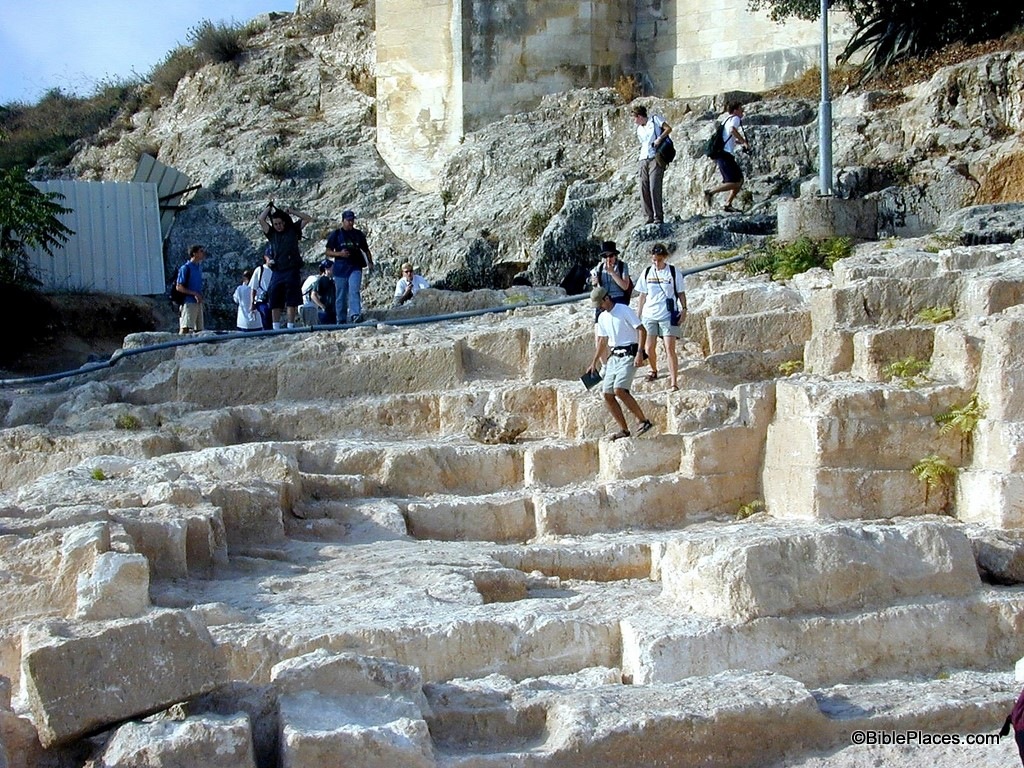
Ketef Hinnom new excavations, tb090299803

Ketef Hinnom quarry, September 1999

UPDATE: Joe Lauer notes that a couple of high-resolution images are available from the Israel Antiquities Authority here (zip).  The press release is posted here, and Arutz-7 also has an article.

Share: