National Geographic has posted five photographs of the Jericho quarry-monastery. For previous stories on this discovery, see here and here.
Paleojudaica also notes a story on current difficulties in the Samaritan community.
HT: Paleojudaica
Does the newly discovered Roman quarry mark biblical Gilgal? The excavator thinks this is possible. From Haaretz:
Zertal says their working theory is that the site is Galgala, biblical Gilgal, mentioned on the sixth-century Madaba mosaic map. The cave, buried 10 meters underground, is about 100 meters long, 40 meters wide and 4 meters high, is the largest artificial cave so far discovered in Israel.
Potsherds found in the cave and the carvings on the columns led Zertal to date the first quarrying of the cave to around the beginning of the Common Era. It was used mainly as a quarry for 400 to 500 years,” but other finds give the impression it was used for other purposes, perhaps a monastery or even a hiding place,” Zertal said.
Zertal said scholars wondered why people would dig a quarry underground considering the effort needed to just to pull the stones out of the ground.
A possible answer may be in the famous Madaba Map of ancient Palestine, found in Jordan. In it, a place named Galgala is marked and an accompanying Greek word meaning “12 stones.” The map also depicts a church near the site. Archaeologists say they have found two ancient churches near the cave.
According to Zertal, scholars had always assumed that “12 stones” refered to the biblical story of the 12 stones the Israelites set up at Gilgal after they crossed the Jordan.
However, the discovery of the quarried cave may mean the reference was to a quarry established where the Byzantines identified Gilgal. Zertal explains that in antiquity sanctuaries were built out of stones from sacred places.
The rest of the article is here.
I would note that there is sometimes a big difference between a biblical site and what Byzantines thought was a biblical site. In any case, the quarry’s location, 3 miles north of Jericho, is approximately where biblical scholars have supposed ancient Gilgal may have been located. What has always been lacking is any archaeological evidence for a site from the time of Joshua. A Roman quarry does not provide that evidence, but it may be a step in the right direction.
References to Gilgal in the Bible include Josh 4:19-20, Josh 10:6-7, 1 Sam 11:14-15, 1 Sam 13:4-15, 2 Sam 19:15; 2 Kings 2:1, Hos 4:15, and Amos 4:4.
HT: Joe Lauer
UPDATE (6/22): Thanks to Joe Lauer for sending along links to articles with photos. The University of Haifa has issued a press release which includes four high-resolution photos. Ynet includes a slideshow with six images, including one of the cave’s entrance.
UPDATE (6/25): National Geographic has an article about the discovery, including some quotations from Jodi Magness.
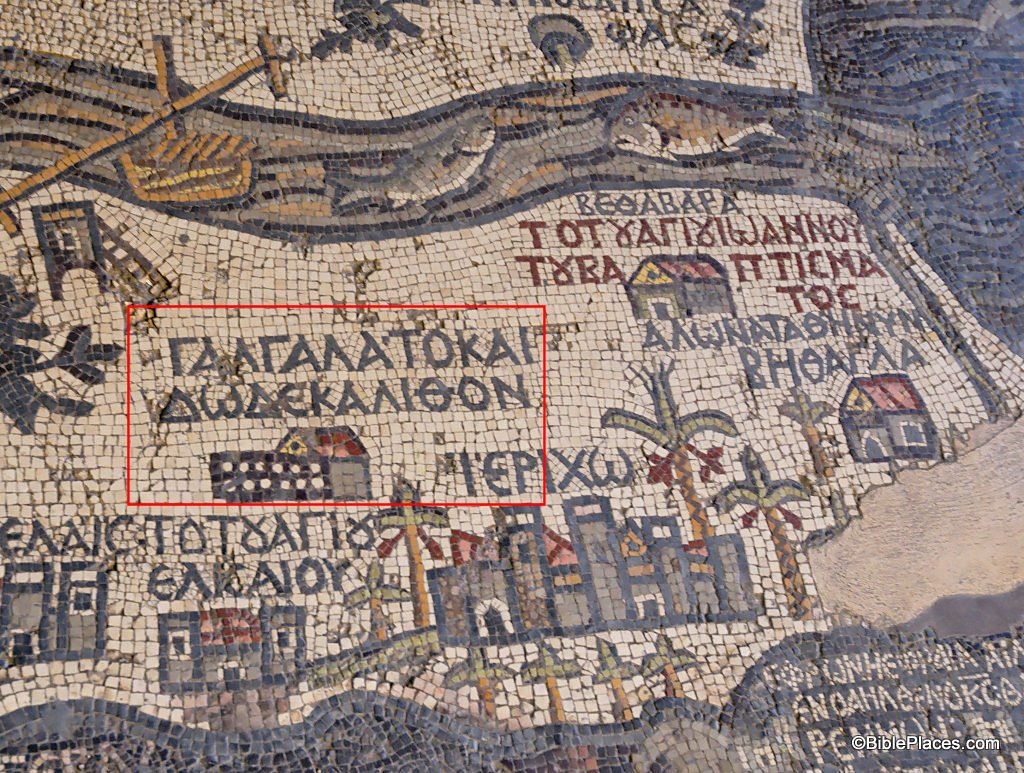 Jericho and Gilgal on the Medeba Map
 For more about the Medeba Map, see this BiblePlaces page.
One of the most impressive building projects of King Herod and others of his period is the aqueduct system that brought water to Jerusalem from the area south of Bethlehem. Most people aren’t familiar with this project, or if they are, they really can’t fathom how remarkable the system is. This is because unless you get out and hike around for at least a few hours, it is difficult to get a sense for the obstacles that were overcome.
Several aqueducts brought water to a series of three massive pools known today as “Solomon’s Pools.” Two aqueducts then transported the water to Jerusalem. The upper-level aqueduct led to the area of Herod’s Palace on the Western Hill and the lower-level aqueduct fed the pools and cisterns around the Temple Mount.
The relationship and date of Sultan’s Pool (photo below) to the low-level aqueduct has never been clear. The pool is located in the Hinnom Valley on the western side of Jerusalem, and recent excavations suggest that it was only constructed in the Byzantine period.
The Israel Antiquities Authority announced today that they have discovered a channel that diverted water from the low-level aqueduct into Sultan’s Pool. Built in the Byzantine period (330-640), the channel was repaired multiple times in the Ottoman period (1517-1917).
The IAA has issued a press release and two high-resolution aerial photos (zip). Arutz-7 has the story (“Jerusalem’s Secret Revealed”) and includes low-res photos in the article.
From the press release:
The Israel Antiquities Authority uncovered the main aqueduct that conveyed water to the Sultan’s Pool during an excavation prior to the construction of the Montefiore Museum in Mishkenot Sha’ananim by the Jerusalem Foundation. The ancient aqueduct supplied pilgrims and residents with water for drinking and purification.
Most Jerusalemites identify the Sultan’s Pool as a venue where large cultural events are held; however, for hundreds of years it was one of the city’s most important water reservoirs.
In an archaeological excavation the Israel Antiquities Authority recently conducted prior to the construction of the Montefiore Museum, which the Jerusalem Foundation plans to build in Mishkenot Sha’ananim, an aqueduct was uncovered that conveyed water to the Temple Mount and also served as the principal water supply to the Sultan’s Pool. The excavation, directed by Gideon Solimany and Dr. Ron Beeri of the Israel Antiquities Authority, focused on a section along the course of the Low-level Aqueduct, on the western side of Ben Hinnoam Valley above the Derekh Hebron bridge.
According to Dr. Ron Beeri, excavation director on behalf of the Israel Antiquities Authority, “We are dealing with a very impressive aqueduct that reached a height of three meters. Naturally, one of the first things Sultan Suleiman I hastened to do in Jerusalem (along with the construction of the city wall as we know it today) was to repair the aqueduct that was already there which supplied the large numbers of pilgrims who arrived in Jerusalem with water for drinking and purification. Suleiman attached a small tower to the aqueduct, inside of which a ceramic pipe was inserted. The pipe diverted the aqueduct’s water to the Sultan’s Pool and the impressive sabil (a Muslim public fountain for drinking water), which he built for the pilgrims who crossed the Derekh Hebron bridge and is still preserved there today”. Dr. Beeri said, “It is evident that the location of the aqueduct was extremely successful and efficient: we found four phases of different aqueducts that were constructed in exactly the same spot, one, Byzantine, from the sixth-seventh centuries CE and three that are Ottoman which were built beginning in the sixteenth century CE. The last three encircle a large subterranean water reservoir that was apparently built before the Ottoman period”.
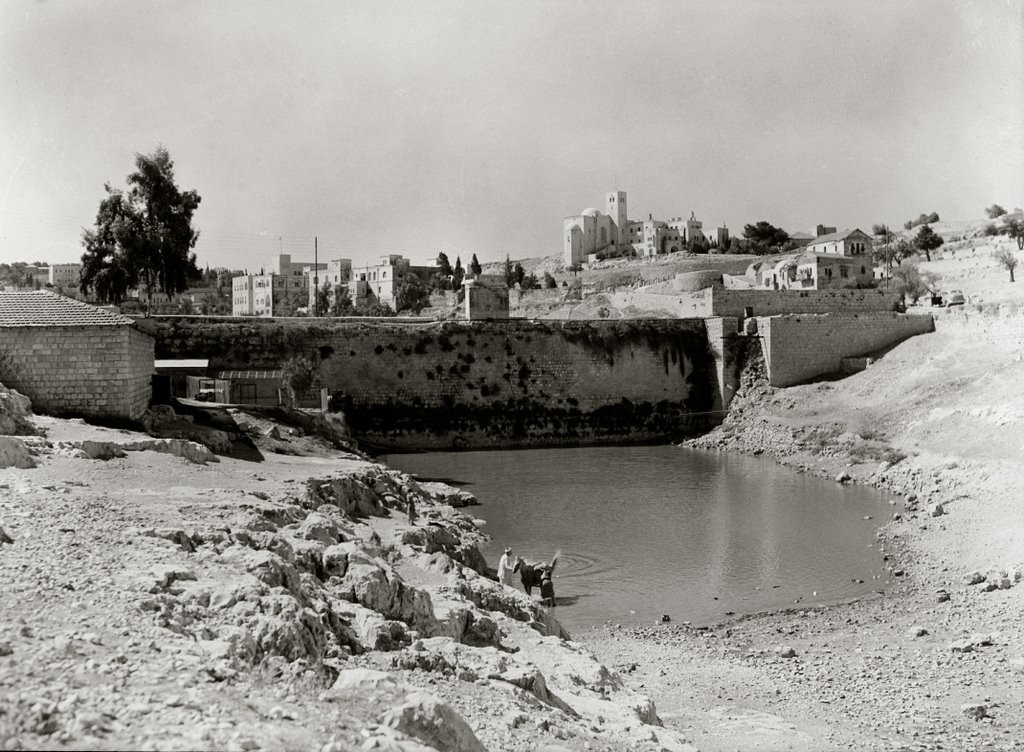 Sultan’s Pool in the Hinnom Valley, September 1943