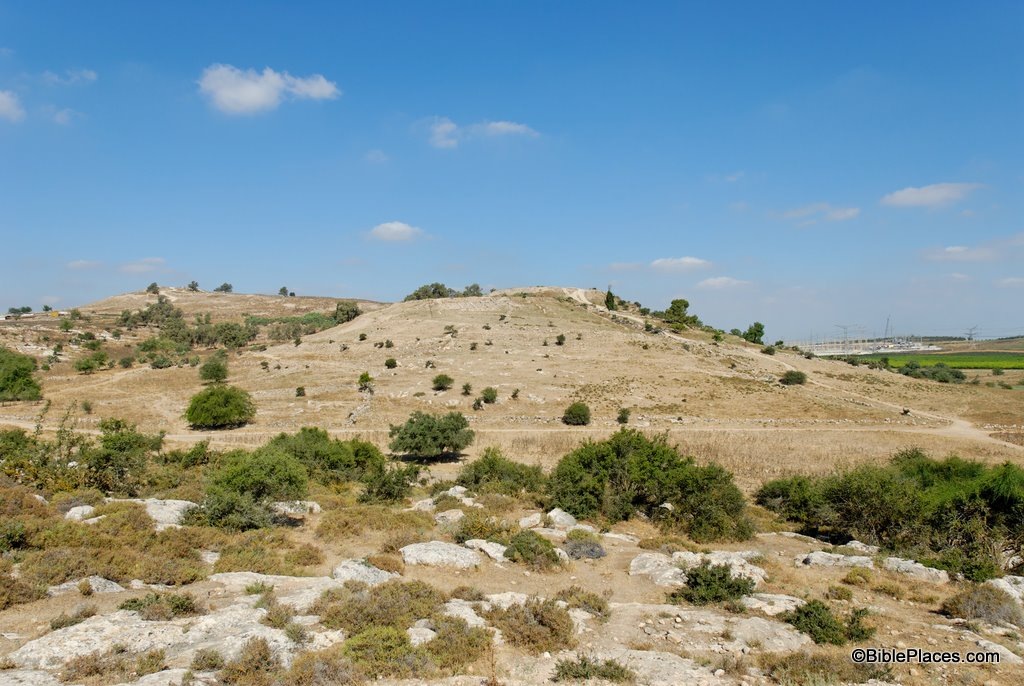
There was a flurry of news coverage of the Khirbet Qeiyafa inscription yesterday, even though only a few words of that inscription have been translated (or, at least, announced).  Here are a few highlights.

CBS News has a 45-second video showing a man opening and handling the inscribed potsherd (ostracon).  A few letters are visible.

You can watch a 5-minute interview with the excavator, Yosi Garfinkel (in Hebrew) (via Yitzhak Sapir).

A few photos were released, but they appear to be deliberately impossible to read, as the excavators naturally want to translate the inscription before someone on the internet does.  It also has been suggested that high-tech photos may be necessary before the excavators are able to read the inscription in its entirety.  Here are a few photos: ostracon 1, ostracon 2, aerial view of the site and the gatehouse.

There is some debate on the ANE-2 list about whether this is a (Proto-)Canaanite inscription or a Hebrew inscription.

A member of the excavation team has posted some of his thoughts on Jim West’s blog.

The most ridiculous headline belongs to a British rag: ‘Proof’ David slew Goliath found as Israeli archaeologists unearth ‘oldest ever Hebrew text’

And if you prefer your inscriptions on a coffee mug, Eisenbrauns just announced the 2008 Gezer Calendar mug

There are a couple of other stories that I don’t have time to comment on now, but you can read about Eilat Mazar’s discovery of the tsinnor (water shaft) that David used to conquer Jerusalem and about an inscribed stone seal found in Jerusalem.  Don’t believe everything you read.
Share:

The Jerusalem Post has some details about the inscription from today’s archaeology conference in Jerusalem.  Some extracts:

A teenage volunteer found the curved pottery shard, 15 centimeters by 15 centimeters, in July near the stairs and stone washtub of an excavated home. It was later discovered to bear five lines of characters known as proto-Canaanite, a precursor of the Hebrew alphabet. Carbon-14 analysis of burnt olive pits found in the same layer of the site dated them to between 1,000 and 975 B.C., the same time as the Biblical golden age of David’s rule in Jerusalem. Scholars have identified other, smaller Hebrew fragments from the 10th century B.C., but the script, which Garfinkel suggests might be part of a letter, predates the next significant Hebrew inscription by between 100 and 200 years…. The shard is now kept in a university safe while philologists translate it, a task expected to take months. But several words have already been tentatively identified, including ones meaning "judge," "slave" and "king." The Israelites were not the only ones using proto-Canaanite characters, and other scholars suggest it is difficult – perhaps impossible – to conclude the text is Hebrew and not a related tongue spoken in the area at the time. Garfinkel bases his identification on a three-letter verb from the inscription meaning "to do," a word he said existed only in Hebrew. "That leads us to believe that this is Hebrew, and that this is the oldest Hebrew inscription that has been found," he said…. If the inscription is Hebrew, it would indicate a connection to the Israelites and make the text "one of the most important texts, without a doubt, in the corpus of Hebrew inscriptions," Maier said. But it has great importance whatever the language turns out to be, he added.

The full story is here.

Share:

An update for the 2008 season at Gath (Tell es-Safi) is now posted at The Bible and Interpretation website.  Director Aren Maeir has summarized the discoveries and it’s worth reading in full.  Some of the highlights:


Early Bronze Age: the site was apparently huge


Middle Bronze Age: more excavation of the city wall and glacis


Late Bronze Age: a very large building, with rich collection of pottery


Iron Age I: remains of plants and animals could help determine the Philistines’ diet; Mycenaean IIIC pottery found


Iron IIA (1000-800 B.C.): – all bullet points are direct quotations from the article

  • clear early Iron IIA pottery
  • a well-dated fragment of a seal impression (of the late 21st Dynasty in Egypt, ca. mid-10th cent BCE)
  • several nice clusters of carbonized grape pips. This latter find should be able to provide robust 14C datings for this phase
  • One cannot overemphasize the importance of the finds in this level, since it may provide the first concrete, well-dated (from several perspectives) context from the early Iron Age IIA in Philistia. In fact, the finds from this level may serve as a central key to solving the “hot debate” on the chronology of the Iron Age, raging for now for more than a decade. Hopefully, the 14C results will be available by late 2008.
  • these finds demonstrate conclusively that our original assumption that the city of Gath was very large during the Iron Age IIA, reaching ca. 45-50 hectares [108-120 acres] in size, was correct. This makes it perhaps the largest site in Philistia, and perhaps in the entire Land of Israel during this period. As such, it appears to match the image of Gath that is portrayed in the biblical texts that relate to the early monarchy, in which the city is described as the largest and most important of five cities of the Philistine Pentapolis, the primus inter pares among the five cities.


Iron IIB (c. 700 B.C.): two destruction layers, possibly related to Sargon II and Sennacherib


Methodology: “in-field laboratory (including an IR spectrometer in the field), which was supplemented by the additional laboratories back in the base camp, provided us with “on-line” results of these analyses – which enabled “real-time” understanding of the archaeological finds. This joint program is unparalleled at ANY excavation in Israel, and in fact, in the world. The close integration of a “regular” excavation team with a wide team of archaeological scientists IN THE FIELD, is simply unparalleled anywhere.”

For many reasons, this excavation looks like it will be extremely beneficial for archaeological and biblical studies.

Gath, Tell es-Safi, from east, tb060906175 Gath, view from the east
Share:

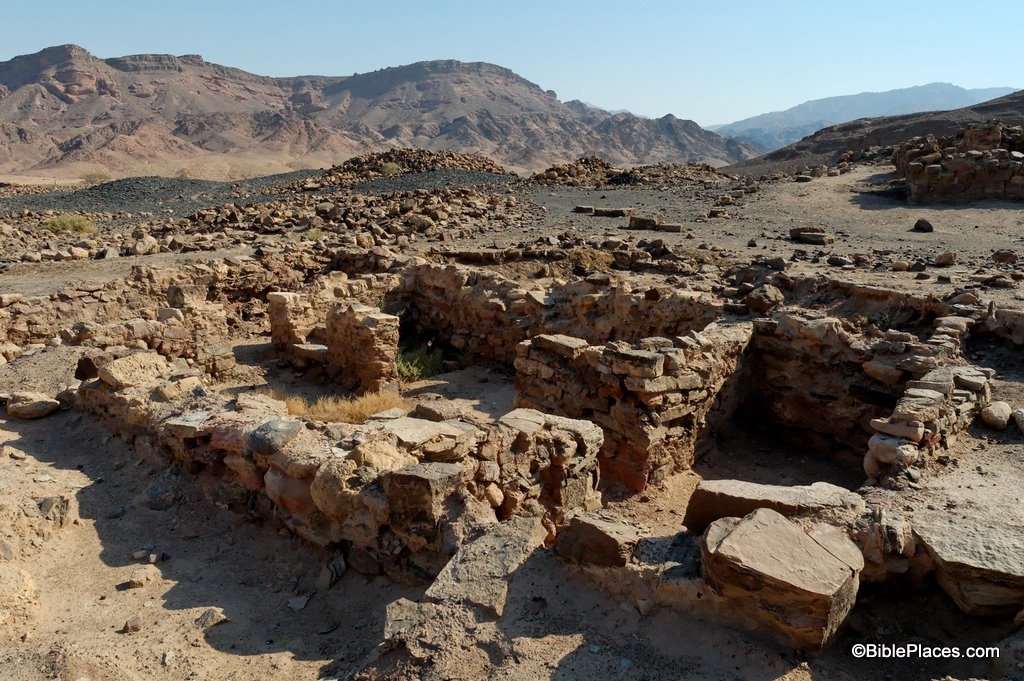
Recently Dr. Thomas Levy of the University of California at San Diego was inducted into the National Academy of Sciences.  In conjunction with that, he published an article in their journal (abstract here) about his work at Khirbet en-Nahas, including his belief that the copper mines were in operation here during the time that the Bible records King Solomon as mining copper.  Lots of new sources and blogs have made a big deal out of the story, and while it is a good story, it is not a new story.  If you haven’t read about it before, or if you need a refresher, by all means read it again.  But if it all sounds familiar, you know why (NY Times 2006 article here; see also article in a recent issue of Biblical Archaeology Review). 

The university press release is here.  There’s a good 12-minute video made by the university  (with dozens of BiblePlaces.com photos used without even a kind mention of their source).  You can find many more articles by searching for “Levy copper mines.”

Kh en-Nahas overview to nw, df080207181dxo
Khirbet en-Nahas, view from southeast
Kh en-Nahas Area S, Iron Age four-room workshop, view ne, df080207014dxo
Khirbet en-Nahas, Iron Age workshop
Kh en-Nahas slag remains on surface, df080207332dxo
Copper slag remains on surface
Share:

Arutz-7 reports:

Archaeologists excavating north of Jerusalem have found a piece of a sarcofagus – a stone coffin – belonging to a son of a High Priest.  The visible inscription reads, “the son of the High Priest” – but the words before it are broken off.  It thus cannot be ascertained which High Priest is referred to, nor the name or age of the deceased…
The precise location of the find is not being released, for security reasons. 
The sarcophagus cover fragment – 60 centimeters (2 feet) long by 48 centimeters (19 inches) wide – is made of hard limestone, is meticulously fashioned, and bears a carved inscription in Hebrew letters that are both similar to today’s script and typical of the Second Temple period.
A number of High Priests served in the Temple in its final decades – it was destroyed in 70 C.E. – and there is no way of knowing which one is noted in the fragment.  Among the known High Priests of the end of the Second Temple period were Caiaphas, Theophilus (Yedidiya) ben Chanan, Shimon ben Baitus, Chanan ben Chanan and others…
Other discoveries at the site include public and residential buildings, agricultural installations, pools and cisterns.

Tombs from the 1st centuries B.C. and A.D. are very common in Jerusalem.  There was a large upper class that built lavish stone tombs, approximately 1,000 of which have been found.

The full story (and a tiny photo) is here.

UPDATE: The Israel Antiquities Authority press release includes a link to a zip file with three high-res photos, including one of the excavation site and two of the inscription. 

HT: Joe Lauer

UPDATE (10/8): Haaretz has the story with some new details, and the Jerusalem Post has a 2-minute video about the excavation and discovery.

Share:

Here’s a strange one: An archaeologist in Alexandria, Egypt claims to have found a cup with a Greek inscription, “Dia Chrestou Ogoistais” (“through Christ the Magi”).  What’s stranger is that he’s claiming that he found it in a stratified context dating to A.D. 50. 

You can read the article (in Spanish) here.  Some comments and nice photos are here.  More comments are here.

HT: Gene Brooks

Share: