Last month I was in Israel when a friend called and said that one of the students in a group he was leading found a jar handle with a LMLK seal impression laying on the ground at Ramat Rahel (two miles south of the Old City of Jerusalem).  I’ve led student groups around Israel for 15 years and none of them has ever found a LMLK handle and my friend is three days into his first trip when one is found.  Within a day or so, he had sent a photo of the seal impression to “Mr. LMLK” (who immediately published an analysis of it here) and got the expert opinion of Dr. Gabriel Barkay. 

Yesterday, the story made it into the newspaper.  If you’re recruiting for next year’s tour, you can try enticing your students with the hope of such a discovery.  And you might take a closer look at that next potsherd before you toss it.
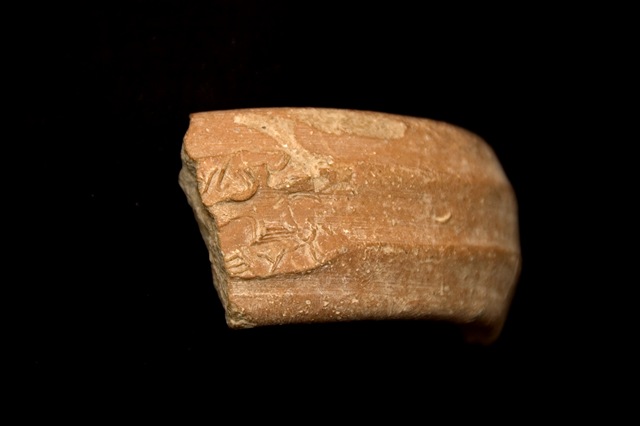
Lemelek, found by Sanchez
LMLK seal impression; photo by Steven Sanchez
Share:

From Haaretz:

A marine scientist has discovered a series of mysterious stone patterns on the lake bed of drought-stricken Lake Kinneret.
The man-made piles of stone, which are now above water, jut out from the freshwater lake, and sit 30 meters from each other along a 3.5-kilometer stretch of the eastern shore, from the Kinneret College campus to Haon resort.
Gal Itzhaki of Kibbutz Afikim first noticed the stones while strolling along the lake’s receded shoreline. He says the patterns are a “fascinating phenomenon” and are part of an “impressive building enterprise.”
Though they have not yet been scientifically examined, there are several hypotheses as to what functions they fulfilled. One theory postulates that they were part of a boundary between the ancient lakeside towns of Hippos, also known as Sussita, and Gadara. Both towns were part of the Decapolis, a group of 10 towns that flourished in the eastern part of the Roman province of Palestina, and are mentioned in the New Testament. Others have hypothesized that the patterns were part of a string of watchtowers or small buildings, or were used to set up fishermen’s nets.

Read the rest here.  The Hebrew version includes a photo.

HT: Joe Lauer

Share:

When a sensational but unsubstantiated archaeological discovery is reported, my inclination is to ignore it.  Since the goal to gain headlines and popularity (and sometimes to stir up tourism), the best way to thwart the guilty is to not publicize their claim.  As they know, all publicity is good publicity.

This doesn’t work very well when mainstream news sources carry the story and one gets multiple requests about the accuracy of the report.  So I succumb.

The claim by Jordanian archaeologists that they have found the “earliest church” ever is the latest in an apparently on-going competition by archaeologists.  According to everything I’ve read about it, there is no basis for this claim whatsoever.  All evidence noted in the story runs counter to this claim. 

Jerome Murphy-O’Connor says it well:

“Pushing the (date) back to the year 70 is very speculative. (The Jordanians) are desperate to create church sites (for tourism),” Father Murphy-O’Connor said. “I would be suspicious of this sort of hype.”

Be suspicious of archaeologists, pseudo-archaeologists, and government departments of tourism.

Share:

From National Geographic:

Archaeologists have uncovered more remnants from Tharu, the largest known fortified city in ancient Egypt, which sits near the modern-day border town of Rafah.
The fortress, also known as Tjaru or Tharo, covered about 31 acres (13 hectares), Egyptian authorities say. Its discovery near the Suez Canal was announced in July 2007.
Tharu helped guard the empire’s eastern front in the Sinai Peninsula and served as a military cornerstone for Egypt’s ancient leaders.
“It was built [more than] 3,000 years ago, and it was an important and strategic point,” said Mohamed Abdel-Maqsoud, of Egypt’s Supreme Council of Antiquities.
The fort’s remains were found as part of a project that began in 1986 to explore the “Horus Way,” an ancient military road that connected 11 fortresses linking Egypt and Palestine.
The path also served as an entry point for traders coming from Asia.
“This is the only way to enter Egypt by land coming from the east,” said Fayza Haikal, a professor of archaeology and Egyptology at the American University in Cairo. “It was the way not only for armies but also commercial [expeditions].”
So far Egyptian authorities have discovered four fortresses along the Horus Way, which essentially formed the same line as Egypt’s current eastern border (see map).

The story continues here.

HT: Joe Lauer

Share:

Like the quarry found last year, this one is north of the Old City.  From the Jerusalem Post:

For the second time in the past year, archeologists have uncovered a Second Temple Period quarry whose stones were used to build the Western Wall, the Israel Antiquities Authority announced Monday. The latest archeological discovery was made in the city’s Sanhedria neighborhood, located about two kilometers from the Old City of Jerusalem. The quarry was uncovered during a routine "salvage excavation" carried out by the state-run archeological body over the last several months ahead of the construction of a private house in the religious neighborhood. The quarry is believed to be one of those used to build the Jerusalem holy site because the size of the stones match those at the Western Wall. "Most of the stones that were found at the site are similar in size to the smallest stones that are currently visible in the Western Wall, and therefore we assume that the stones from this quarry were used to build these structures," said Dr. Gerald Finkielsztejn, director of the excavation. The stones were dated by pottery found at the site, he added. "This is a rather regular quarry except that there are really big stones," Finkielsztejn said. The largest of the stones found at the quarry measures 0.69 x 0.94 x 1.65 m, while some of the stones were apparently ready for extraction but were left in place. The quarry was probably abandoned at the time of the Great Revolt against the Romans in 66-70 CE, he said.

Share:

Trend News reports the discovery of Queen of Sheba’s palace.  I have no independent knowledge of this excavation, so it not impossible that there’s a kernel of truth in the story.  But I would note a few things that suggest caution before you include this in your list of “greatest discoveries of the Bible.” 

1) The news sources which are currently carrying the story are not ones I’m familiar with.  If this was carried by a source like the Associated Press, then it would carry more weight.

2) The story’s claim that Sheba was married to Solomon is based on late tradition, and certainly is not mentioned in the Bible, as the article says.  Getting simple facts like these wrong makes me wonder if the rest of the facts are based on such flimsy reporting. 

3) There is no evidence that the ark of the covenant went to Ethiopia.  The tradition is based in part on the tradition that Sheba was married to Solomon (or at least gave birth to his child). 

4) Many scholars believe that Sheba was in modern Yemen. 

Archaeologists believe they have found the Queen of Sheba’s palace at Axum, Ethiopia and an altar which held the most precious treasure of ancient Judaism, the Ark of the Covenant, the University of Hamburg said Wednesday, the dpa reported.
Scientists from the German city made the startling find during their spring excavation of the site over the past three months.
The Ethiopian queen was the bride of King Solomon of Israel in the 10th century before the Christian era. The royal match is among the memorable events in the Bible.
Ethiopian tradition claims the Ark, which allegedly contained Moses’ stone tablets on which the Ten Commandments were written, was smuggled to Ethiopia by their son Menelek and is still in that country.
The University said scientists led by Helmut Ziegert had found remains of a 10th-century-BC palace at Axum-Dungur under the palace of a later Christian king. There was evidence the early palace had been torn down and realigned to the path of the star Sirius.

The story continues here.

HT: Paleojudaica

Share: