A couple of developments in the land of the Philistines are worth noting:

A Philistine temple is being excavated at a site south of the five major Philistine cities.  The temple dates to late Iron I (circa 1000 B.C.) and is a few miles south of biblical Gerar (Tel Haror) and northwest of Beersheba.  Aren Maier has a brief report of his visit and some of the finds.

The Canaanite gate at Ashkelon has now been completely restored.  They claim that it is the “oldest arched gate in the world,” but pushing the date of the Ashkelon gate a little earlier and the date of the Dan gate a little later.  Even archaeologists are competitive!  The JPost has a picture of the gate with a modern arch which looks like it was designed for schoolkids.  Below is a photo before they added the arch.

Ashkelon Middle Bronze gate, tb083006557
Ashkelon Middle Bronze Gate (circa 1800 B.C.)
Share:

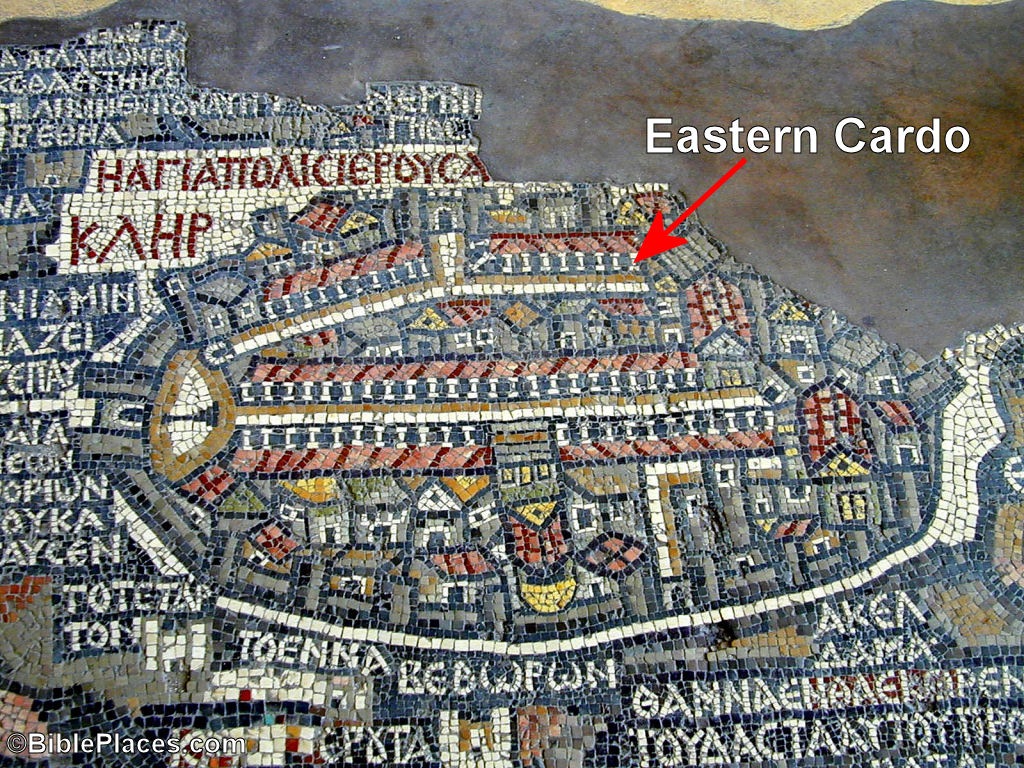
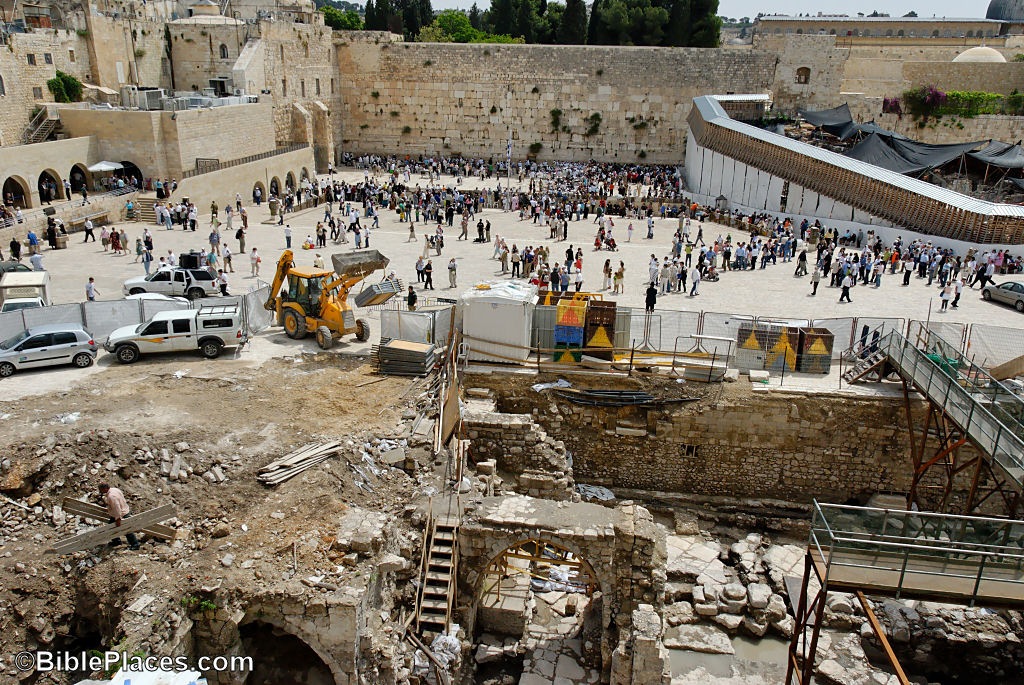
The Israel Antiquities Authority (IAA) has announced the discovery of an Iron Age seal from the excavations in the Western Wall plaza.  This is the second of two seals previously reported and it reads “[belonging] to Netanyahu ben Yaush.”  Both names are known from the Bible, but this particular person is not mentioned.  This seal was found a debris layer dating to the end of the Iron Age (c. 586 B.C.) underneath the “Eastern/Valley Cardo.”  The area of the excavations is shown in the photo below.  More information about the discovery and a photo of the seal is available in the IAA press release (and repeated by Arutz-7).

Western Wall plaza excavations, tb051707664
Excavations in Western Wall plaza, May 2007
Medeba map, Jerusalem, tb031801034
Medeba Map depiction of Jerusalem, 580 A.D.

The following paragraph from the press release seems strange to me, and if it wasn’t the IAA reporting it, I’d not believe it:

In addition to the personal seal, a vast amount of pottery vessels was discovered, among them three jar handles that bear LMLK stamped impressions. An inscription written in ancient Hebrew script is preserved on one these impressions and it reads: למלך חברון ([belonging] to the king of Hebron).

My guess is that this is a standard LMLK seal impression, and it simply gives one of the four place names that are listed on LMLK seals (Hebron, Ziph, Socoh, MMST).  The place name is a royal distribution center, and is not a reference to the domain of the king.  “To the king” means that it was royal property.  “Hebron” is the place of distribution.  All of this is well-known (and you can learn more than you ever wanted to know at www.lmlk.com), which makes me wonder if this discovery is something different, or if the press report was written by a secretary.

UPDATE (3/17): The JPost now has an article on the discovery, which essentially covers the same ground, including repetition of the error of the seal “belonging to the king of Hebron.”  The article ends with details I don’t recall seeing:

The newly-found remnants of the city’s past will be preserved next to a new Western Wall Heritage Center, slated to be built at the site, and whose planning prompted the salvage dig.
The construction of the building, which is expected to take several years and is being underwritten by the American media mogul Mort Zuckerman, will include an educational center, a video conference room, a VIP lounge and a police station.

Share:

A seal recently discovered in the City of David reads “Rephaihu (ben) Shalem.”  Archaeologist Aren Maier, who directs the on-going excavations at Philistine Gath, reports on an inscription which may be connected to the word “Rephaim,” mentioned in the Bible in various places including 2 Samuel 21:16-22.

UPDATE (3/4): The post above has been greatly altered from the original.  This inscription is from Gath, not Jerusalem, and it was incised on a jar, and is not a seal.  Thanks to Aren Maier for the correction.  My apologies to all for the errors.  When word comes of the second seal found in the City of David, I’ll note it on this blog.

Share:

I don’t remember seeing this published elsewhere and you might miss it under the title “What Happened to the Clerks and Merchants of the 8th Century BCE?”  Ronny Reich and Eli Shukrun have discovered more seals in the City of David, these from the 8th century (the time of kings Uzziah, Jotham, Ahaz, and Hezekiah).  These excavators had previously discovered a collection of seals from the 9th century, and these did not bear inscriptions.  But they recently found two stone seals and three bullae (seal impressions), all inscribed with Hebrew names.  The best preserved has the name “Rephaihu (ben) Shalem.”  The article is brief and includes a photo of the complete seal. 

Though they operate without much fanfare, Reich and Shukrun’s excavation in Jerusalem over the last 13 years has produced more interesting results than probably any other dig in Israel, including discovery of the two towers at the Gihon Spring, the reinterpretation of Warren’s Shaft, the discovery of the Pool of Siloam, and many other related architectural features and small finds.

HT: Joe Lauer

Share:

Antonio Lombatti has word of reports of (recent) excavations of Magdala and (not-so-recent) excavations of the area now known as “Nazareth Village.” 

Magdala: You can read Lombatti’s intro here (with beautiful photos) or read the report in Italian here.  If you’re wondering if you’ve ever visited Magdala, you haven’t.  You may have driven by it (or possibly hiked or biked if you’re one of those sort), but the area has been locked and sealed for a long time, and entrance available only to those who know the right people.  Hopefully that will all change…

Nazareth: You can read Lombatti’s intro here or go straight to the report (pdf) by Stephen Pfann.  If you’re wondering why you were unimpressed with Nazareth when you visited, it’s probably because you didn’t visit Nazareth Village, a modern reconstruction of the 1st century village.

Share:

Many seals have been found with the names of people mentioned in the Bible, but it’s always nice to find another. From the Jerusalem Post:

A stone seal bearing the name of one of the families who acted as servants in the First Temple and then returned to Jerusalem after being exiled to Babylonia has been uncovered in an archeological excavation in Jerusalem’s City of David, a prominent Israeli archeologist said Wednesday.
The 2,500-year-old black stone seal, which has the name “Temech” engraved on it, was found earlier this week amid stratified debris in the excavation under way just outside the Old City walls near the Dung Gate, said archeologist Dr. Eilat Mazar, who is leading the dig.
According to the Book of Nehemiah, the Temech family were servants of the First Temple and were sent into exile to Babylon following its destruction by the Babylonians in 586 BCE.
The family was among those who later returned to Jerusalem, the Bible recounts.
The seal, which was bought in Babylon and dates to 538-445 BCE, portrays a common and popular cultic scene, Mazar said.
The 2.1 x 1.8-cm. elliptical seal is engraved with two bearded priests standing on either side of an incense altar with their hands raised forward in a position of worship.

The rest of the article is here.

The article mentions the mention of Temech (spelled Temah in NIV, NAS and ESV) in Nehemiah 7:55, but not Ezra 2:53.

HT: Joe Lauer

UPDATE (1/17): The JPost article now includes a photo. And on the ANE-2 list, Peter van der Veen suggests that the inscription should be read the opposite way, thus sh-l-m-t or Shlomit.

UPDATE (1/19): Chris Heard has a good analysis, together with some helpful illustrations showing the suggested readings. From the discussion at ANE-2 and elsewhere, it seems that the majority of scholars favor the “Shlomit” reading. There is a Shlomit mentioned in the Bible from this time period as well, in Ezra 8:10.

UPDATE (1/31): Mazar now agrees with those who read the seal from left to right. For more, see this post.

Share: