Many will probably quickly skip over this article, but those who have visited or studied the sites of Penuel and Mahanaim will be interested, though the article mentions neither possible identification.  Excavations have (finally!) begun at Tall adh-Dhahab, often identified by biblical scholars as the place where Jacob wrestled with the angel, where David fled from Absalom, and where Jeroboam built his Transjordanian capital.  But what was not known (at least to me) was the Herodian attraction to the site.  This makes perfect sense, given its history.  A professor of theology at Technische Universität Dortmund began work last year.  From their recent press release.

This year Thomas Pola, professor for theology at TU Dortmund, and his team have continued the excavations in the East Jordan Land. With their findings on the mountain Tall adh-Dhahab (West) in the Jabbok Valley the archeologists could substantiate one assumption: everything points to the fact that the building remains from the Hellenistic and Roman era, found in 2006, were part of a yet unknown monumental building of Herod the Great (73-4 BC).
This assumption is based on the floors of one of the discovered peristyle yards (yards enclosed by continuous columns) which the archeologists were able to excavate. Prof. Pola sees the parallels with the architecture of Herod’s West Jordan Alexandreion as prove that there also was a monumental building of Herod the Great on the plateau of the mountain Tall adh-Dhahab. That would mean that in addition to his reign over the West Jordan Land, the Jewish king had a security system with which he could have controlled the ancient long-distance traffic in the middle Jordan Valley and the access ways to the plateau of the East Jordan Land.
Above that, the team of Prof. Pola for the first time discovered a layer from the late Bronze Age or the Early Iron Age on a natural terrace directly underneath the plateau. The ruins of a tower from the city wall at least show three building phases. “On the level of the oldest building phase we took samples from a burnt layer. A C14-analysis carried out by Prof. Manfred Bayer (Physics at TU Dortmund) showed that the charcoal originates from the time 1300 to 1000 BC. At this location we will continue to work in 2008.”
Finally Prof. Pola’s team discovered the purpose of the monumental military facility half way up the mountain: it is a casemate wall. It is supposed to have been finished in Roman times. This is yet another argument for the identification of the mountain with the stronghold Amathous mentioned in the ancient world. The historian Josephus (37 to 100 AD) described Amathous as the biggest stronghold in the East Jordan Land.

The press release continues here.
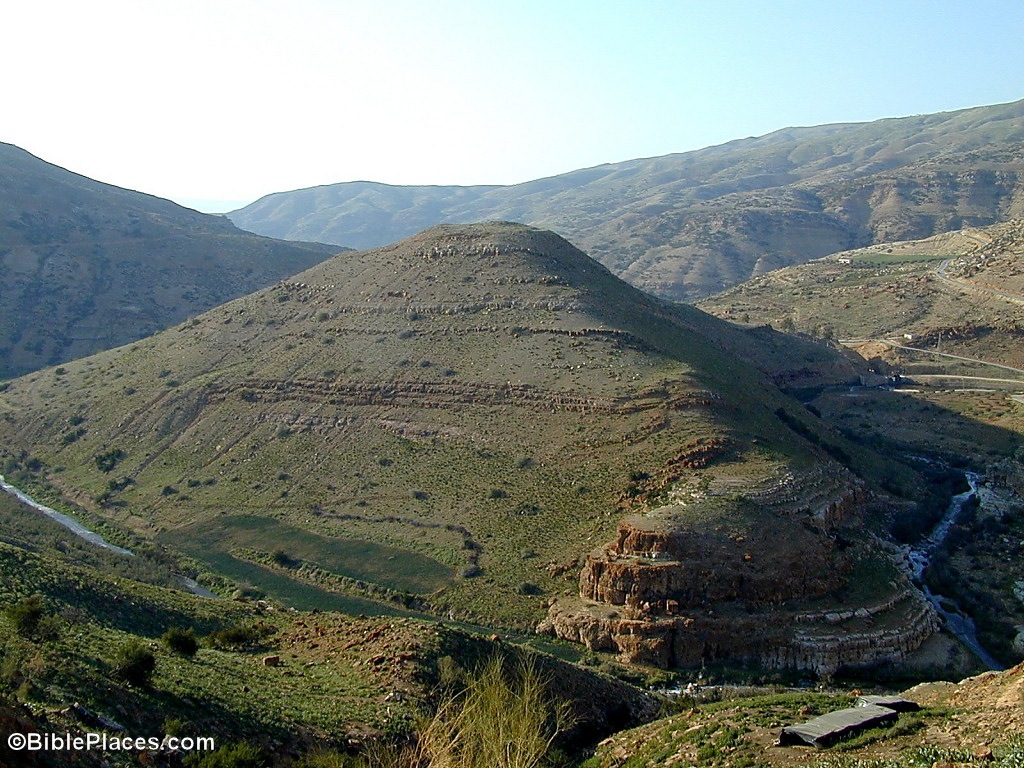
Penuel from southeast, tb031701999
Tall adh-Dhahab West, identified by some as biblical Mahanaim and by others (including myself) as Penuel
Share:

Because the biblical dates in the Bible suggest that the Exodus occurred in the mid-15th century, some surmise that Hatshepsut might be the princess mentioned in the Bible.  In any case, she is a very important and interesting figure.  From the Associated Press:

Months after Egypt boldly announced that archaeologists had identified a mummy as the most powerful queen of her time, scientists in a museum basement are still analyzing DNA from the bald, 3,500-year-old corpse to try to back up the claim aired on TV. Progress is slow. So far, results indicate the linen-wrapped mummy is most likely, but not conclusively, the female pharaoh Queen Hatshepsut, who ruled for 20 years in the 15th century B.C. Running its own ancient-DNA lab is a major step forward for Egypt, which for decades has seen foreigners take most of the credit for major discoveries here. It’s time Egyptian scientists took charge, said Zahi Hawass, Egypt’s antiquities chief who spearheaded the quest to find Hatshepsut and build the lab. “Egyptology, for the last 200 years, it has been led by foreigners.”

The story continues here.

Share:

The Israel Antiquities Authority announced the discovery of the palace of Queen Helena of Adiabene today.  You can read about it in this Jerusalem Post article or in this AFP article.  The JPost article also has a great photo of the excavation area.  Here are some parts of the JPost article with my thoughts.

The site, which has been unearthed during a six-month ‘salvage’ excavation in the Givati parking lot just outside the Dung Gate ahead of the planned expansion of the Western Wall car park, also indicates that the ancient City of David was much larger than previously thought, said archeologist Doron Ben-Ami, who is directing the dig at the site.

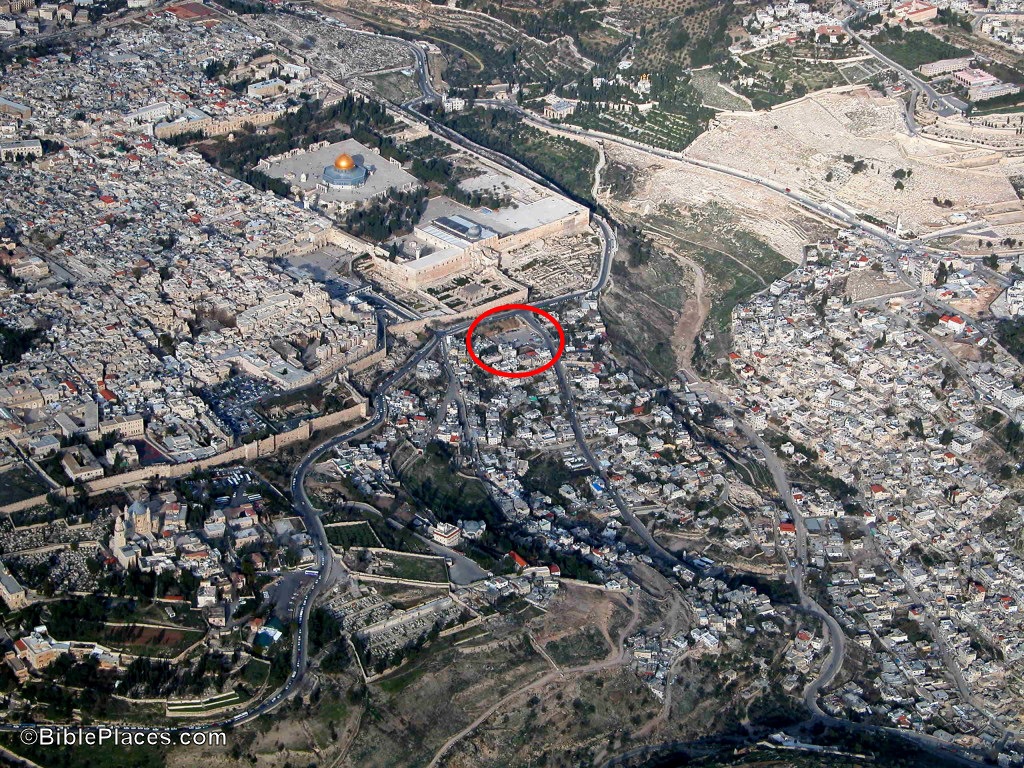
If you’ve been in Jerusalem in the last five years, you’ve seen this gaping hole just south of the Dung Gate – this is the same place.  I worked with our students as volunteers in digging here back in the fall of 2003, so it’s not exactly a new excavation as the article implies.

Temple Mount and City of David aerial from sw, tb010703234
Jerusalem from southwest; excavation area circled

That the “City of David was much larger than previously thought” doesn’t make any sense to me. 

The City of David has always been understood to be bordered by the Kidron Valley on the east and the Central Valley on the west and neither of those have moved in the last six months.  Nobody has doubted that there was construction in this area in the 1st century A.D., especially given the Crowfoot expedition in the 1920s.

The “monumental” edifice, which was destroyed by the Romans when they demolished the Second Temple in 70 CE, was dated to the end of the Second Temple Period by pottery and stone vessels, as well as an assortment of coins from that time, Ben-Ami said.

When we were there, we were digging in the Late Roman and Byzantine periods, and I’ve never been part of a dig where we found more coins than this one. 

According to the director of the dig, the elaborate edifice, which is an anomaly in the landscape of the Lower City at the end of the Second Temple period – which was marked with modest buildings – was probably a palace built by Queen Helena, a wealthy Iraqi aristocrat who converted to Judaism and moved to Jerusalem with her sons.

The problem with this statement is that very little digging has been done on the crest of the City of David (as opposed to the eastern slope), and there was much destruction in later periods.  So there isn’t much to compare with.  If all they have is a magnificent building, I’d say it could be Helena’s and it could be someone else’s.

Helena is an interesting individual.  Her tomb in Jerusalem was the second most magnificent one in the ancient world (and it’s still impressive, although difficult to visit because of poor management by the French government; cf. Ant. 20.4.3).  Josephus wrote that Helena built three palaces in the Lower City (one for herself, one for her son and one for her mother-in-law; Wars 4.9.11; 5.6.1), which is (I think) the only basis for the identification of this building as hers by the archaeologist.

Though contemporary with the book of Acts, Helena is not mentioned in the New Testament. 

Josephus connects her with the famine mentioned in Acts 11:28, indicating that she bought large quantities of food from Egypt to feed the people of Jerusalem (Ant. 20.2.3ff.).

The archeologists carrying out the dig have not yet found any inscription to identify the building they uncovered, but the excavation director said that there was a “high probability” that the site was indeed the 2,000-year-old palace of Queen Helena.  “We need more evidence to decide, but almost everything fits,” Ben-Ami said.

This identification could well be, but there’s no evidence for it given in this article.  I would think the identification would be stronger if:

1) more of the City of David had been excavated, thus excluding other sites;

2) we had more knowledge of what else was in the City of David in the 1st century; all we really know is that these palaces were here, but it’s doubtful that these occupied the entire area;

3) finds from the building were of Mesopotamian origin (Adiabene was a province in northern Mesopotamia).

The well-preserved structure being uncovered in the ongoing excavation is an impressive architectural complex that includes massive foundations; walls, some of which are preserved to a height in excess of five meters and built of stones that weigh hundreds of kilograms; halls that are preserved to a height of at least two stories; a basement level that was covered with vaults; remains of polychrome frescoes, water installations and ritual baths.

This is great, but there were many impressive buildings in first century Jerusalem, so this alone is not sufficient to prove the identification.

Those interested in Jewish evangelism and conversion in the New Testament period would find Helena’s story worth studying.  For a start, take a look at the articles in Anchor Bible Dictionary on Proselyte and Circumcision.

Update: The JPost has a one-minute video of the excavations with an archaeologist talking about the discovery.  HT: Joe Lauer.

Update (12/7): InfoLive.tv has a 2-minute video, and this Arutz-7 article has numerous photos which show the well-preserved walls and some of the artifacts discovered.  The story is also covered by Reuters, Haaretz, and the AP.

Share:

April D. DeConick says that National Geographic got it all wrong in their interpretation of the Gospel of Judas.  And, what do you know, but their strange choices created the story.  DeConick goes further than explaining the translation errors, but she also shows why scholarship should not be done this way – in a closet by a few scholars who sign non-disclosure agreements before a major press conference designed to generate boatloads of money.

Amid much publicity last year, the National Geographic Society announced that a lost 3rd-century religious text had been found, the Gospel of Judas Iscariot. The shocker: Judas didn’t betray Jesus. Instead, Jesus asked Judas, his most trusted and beloved disciple, to hand him over to be killed. Judas’s reward? Ascent to heaven and exaltation above the other disciples.
It was a great story. Unfortunately, after re-translating the society’s transcription of the Coptic text, I have found that the actual meaning is vastly different. While National Geographic’s translation supported the provocative interpretation of Judas as a hero, a more careful reading makes clear that Judas is not only no hero, he is a demon.
Several of the translation choices made by the society’s scholars fall well outside the commonly accepted practices in the field. For example, in one instance the National Geographic transcription refers to Judas as a “daimon,” which the society’s experts have translated as “spirit.” Actually, the universally accepted word for “spirit” is “pneuma ” — in Gnostic literature “daimon” is always taken to mean “demon.”
Likewise, Judas is not set apart “for” the holy generation, as the National Geographic translation says, he is separated “from” it. He does not receive the mysteries of the kingdom because “it is possible for him to go there.” He receives them because Jesus tells him that he can’t go there, and Jesus doesn’t want Judas to betray him out of ignorance. Jesus wants him informed, so that the demonic Judas can suffer all that he deserves.
Perhaps the most egregious mistake I found was a single alteration made to the original Coptic. According to the National Geographic translation, Judas’s ascent to the holy generation would be cursed. But it’s clear from the transcription that the scholars altered the Coptic original, which eliminated a negative from the original sentence. In fact, the original states that Judas will “not ascend to the holy generation.” To its credit, National Geographic has acknowledged this mistake, albeit far too late to change the public misconception.

The rest is here and it is worth reading.

UPDATE (12/8): One of the NG translators responds in a letter to the NYT.

HT: Joe Lauer

Share:

Yesterday the Jerusalem Post finally reported on the discovery of “Nehemiah’s wall” first announced several weeks ago.  Today the AP has a report.  Most of the material is similar to what was reported before, but the Jerusalem Post says that not only the tower but the wall as a whole is from the time of Nehemiah.  That would be a significant development, because the wall is large and easily visible to tourists.  The AP version quotes two scholars with different views on Mazar’s conclusion.  Stern’s expertise is Persian period.

Ephraim Stern, professor emeritus of archaeology at Hebrew University and chairman of the state of Israel archaeological council, corroborated Mazar’s claim. “The material she showed me is from the Persian period,” the period of Nehemiah, he said. “I can sign on the date of the material she found.”
Another scholar disputed the significance of the discovery.
Israel Finkelstein, professor of archaeology at Tel Aviv University, called the discovery “an interesting find,” but said the pottery and other remains do not indicate that the wall was built in the time of Nehemiah. Because the debris was not connected to a floor or other structural part of the wall, the wall could have been built later, Finkelstein said.
“The wall could have been built, theoretically, in the Ottoman period,” he said. “It’s not later than the pottery — that’s all we know.”

You can read the full story here.

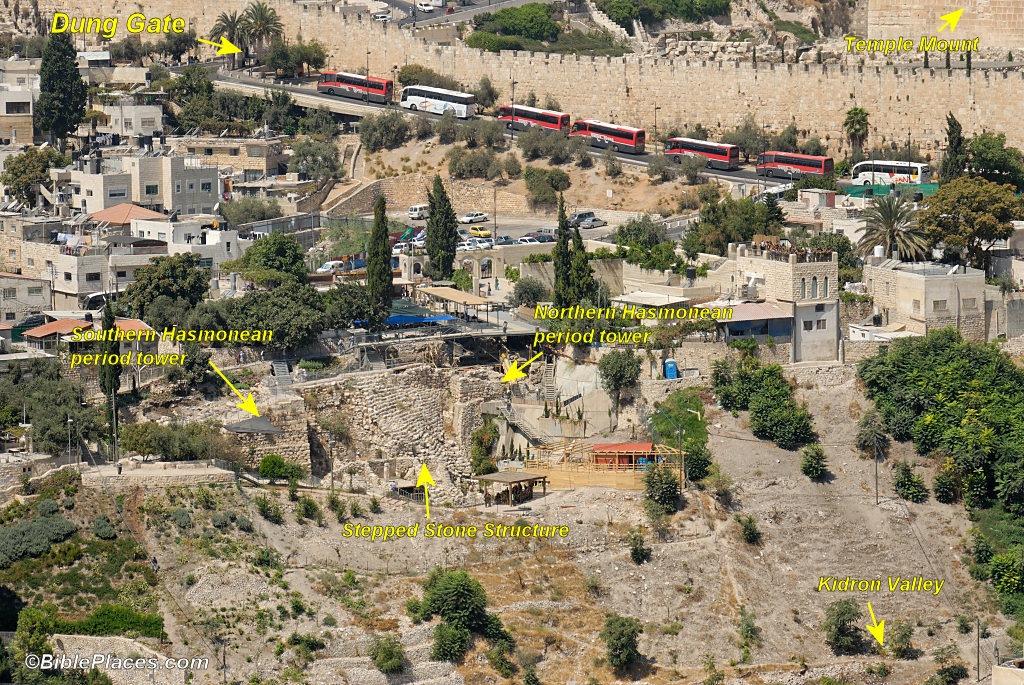
First Wall and Palace of David excavation area, tb102306083
Wall (center foreground and below wooden staircase) dated by Eilat Mazar to Nehemiah’s time
City of David Area G from southeast, tb091306302labeled

On the picture above, the wall redated to Nehemiah’s time is in between the “Southern Hasmonean period tower” and “Northern Hasmonean period tower,” behind the “Stepped Stone Structure.”

Share:

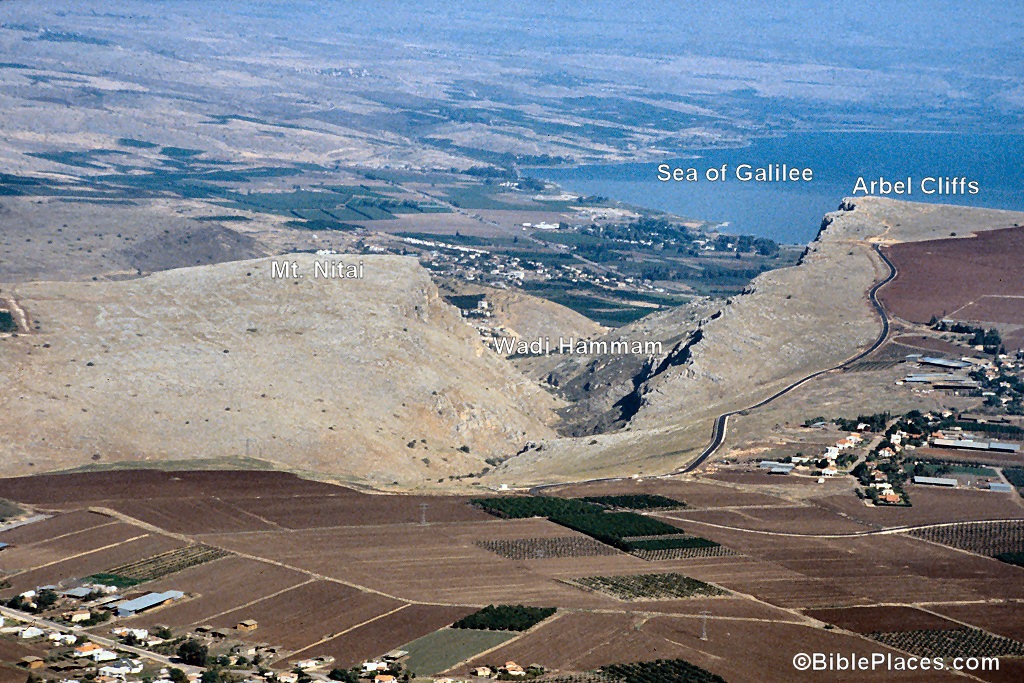
Hebrew University announced the discovery of an ancient synagogue this week.  Dozens of Galilean synagogues from the Roman and Byzantine (Talmudic) periods have been discovered, including ones not far from this one at Capernaum, Arbel, and Hammath Tiberias.  Wadi Hamam is located at the base of the Arbel cliffs, and is the location of the end of “the hike” if you’ve ever climbed down. 

Students with me last year who hiked from Khirbet Kana (biblical Cana) to Magdala probably passed right over the remains described below.  From the Hebrew University website:

Remains of an ancient synagogue from the Roman-Byzantine era have been revealed in excavations carried out in the Arbel National Park in the Galilee under the auspices of the Hebrew University of Jerusalem.
The excavations, in the Khirbet Wadi Hamam, were led by Dr. Uzi Leibner of the Hebrew University’s Institute of Archaeology and Scholion – Interdisciplinary Research Center in Jewish Studies.
Dr. Leibner said that the synagogue’s design is a good example of the eastern Roman architectural tradition. A unique feature of the synagogue is the design of its mosaic floor, he said.

Arbel and Valley of Doves aerial from southwest, 123-05tb
Area of discovery from southwest

The synagogue ruins are located at the foot of the Mt. Nitai cliffs overlooking the Sea of Galilee, amidst the remains of a large Jewish village from the Roman-Byzantine period. The first season of excavations there have revealed the northern part of the synagogue, with two rows of benches along the walls. The building is constructed of basalt and chalk stone and made use of elements from an earlier structure on the site….
The excavators were surprised to find in the eastern aisle of the synagogue a mosaic decoration which to date has no parallels — not in other synagogues, nor in art in Israel in general from the Roman-Byzantine period. The mosaic is made of tiny stones (four mm. in size) in a variety of colors. The scene depicted is that of a series of woodworkers who are holding various tools of their trade. Near these workers is seen a monumental structure which they are apparently building. According to Dr. Leibner, since Biblical scenes are commonly found in synagogue art, it is possible that what we see in this case is the building of the Temple, or Noah’s ark, or the tower of Babel. The mosaic floor has been removed from the excavation site and its now in the process of restoration.

The rest of the story and a photo of the mosaic floor may be found here.

Share: