Leen Ritmeyer has posted his thoughts on exactly what wall has been uncovered in the illegal excavations.  Most scholars of his caliber wouldn’t take the time to explain things so clearly for us mere mortals.  Thank you, Leen.  Read it here. Arutz-7 gives the take of another archaeologist on what has been revealed:

Gideon Charlap, a top Jerusalem architect and Temple Mount expert, told Arutz-7 what he saw when he visited the Temple Mount on Tuesday: “The Arabs there are digging a deep north-to-south trench, up to a meter [1.1 yards] deep.  It is being dug in the area that served during Holy Temple times as the Ezrat Nashim [the area known as the Women’s Courtyard, though it was not reserved only for women -ed.].  The trench passes through three east-to-west walls, according to my calculations – walls that probably served as separations for the Temple’s offices and the like.  This means that the destruction is tremendous…”

The award for the Joke of the Day goes to Mufti Mohammed Hussein, the top Muslim cleric in Jerusalem.  “We don’t harm the antiquities, we are the ones who are taking care of the antiquities, unlike others who destroy them,” he said. Jerusalem archaeologist Eilat Mazar:

“No other country in the world would allow such grave damage to its most precious archaeological treasures,” Mazar said

I wonder if there are any parallels to this situation.  What other country would not be screaming bloody murder at such a situation? Dr. Eilat Mazar:

Anyone can realize that remnants of both the First and Second Temples are there, and can guess what damage is being done by the tractor.  The most precious findings are just rolling around there and are available to be found – and instead they have a tractor there!  If I would try to work with a tractor at one of my digs, the Antiquities Authority would stop me immediately!  With a tractor, it’s impossible to make any type of careful examination of the earth and pieces being dug up.

Imagine if Ben-Tor brought a tractor to speed things up at Hazor, or if Maeir used one at Gath.  Can you not imagine that the IAA would shut the dig down in seconds?  But not here, at the most important archaeological site in the country.  And why not?  Politics.  It’s much easier to sacrifice thousands of years of history for the sake of a few minutes of peace. This would all be so much simpler if we took the viewpoint of Palestinian worshipper Ismael Ramadan.

“I grew up and I see [with] my eyes and I see this is [a] mosque. I don’t see [a] temple,” he said. Like many Palestinians, he believes the temples never existed. “It’s not true,” he said.  “No Temple.”

Gabriel Barkay has been sifting debris from the last major illegal excavation on the Temple Mount, and some of the discoveries were announced yesterday at the eighth annual City of David archaeological conference.

The project, now in its third year, entails scrutinizing truckloads of earth removed by the Waqf in 1999. Among the ancient finds were numerous stone tiles intended for flooring, some of which have been identified as designed for use in the Roman-era mosaic work known as opus sectile, in which colorful tiles were cut into shapes and fitted into geometric patterns. “The discovery of stone tiles used in opus sectile flooring in [earth from] the Temple Mount is one of the most important discoveries of the dirt-sifting work,” Barkai said, “and it might aid in reconstructing the appearance and character of the Temple’s outer courtyard.”

Share:

This could be a very important discovery (or it could not), but I doubt we will ever know.  First the story from a couple of sources and then a few comments of my own.

From AFP:

Remains of the Jewish second temple may have been found during work to lay pipes at the Al-Aqsa mosque compound in east Jerusalem, Israeli television reported Thursday.
Israeli television broadcast footage of a mechanical digger at the site which Israeli archaeologists visited on Thursday.
Gaby Barkai, an archaeologist from Bar Ilan University, urged the Israeli government to stop the pipework after the discovery of what he said is “a massive seven metre-long wall.”
Television said the pipework carried out by the office of Muslim religious affairs, or Waqf, is about 1.5 metres deep and about 100 metres long.

From Arutz-7:

Top Israeli archaeologists held an emergency press conference on Thursday, warning that a Second Temple courtyard wall is in danger of being destroyed by the Arab excavations there….
Dr. Gavriel Barkai opened by saying, “A month and a half ago, the Muslim Waqf [religious trust] began digging a trench more than 400 meters [1,300 feet] long – the largest such work ever carried out on the Temple Mount… These are criminal acts that have no place in a cultured country.”
“Some man-worked stones have been found in the trench, as well as remnants of a wall that according to all our estimations, are from a structure in one of the outer courtyards in the Holy Temple.  Such important work is being done without the supervision of the Antiquities Authority.”
“The archaeological damage is many times worse,” Mazar said, “in light of the fact that the ground level is only slightly above the original Temple Mount platform.  And in fact, the bedrock has been uncovered in some places – meaning that earth that has been in place for many centuries, even possibly since the First Temple, has been removed.”

My reaction is that this could be something significant, or it could not.  What Mazar says is correct, that present ground level of the Temple Mount is generally very close to ancient ground level.  But it’s possible that there was construction in this area in the intervening 1,900 years since the Second Temple was destroyed in A.D. 70.  But it is absolutely critical that the wall (and everything else underground) be studied carefully, so that a proper assessment can be made.  The finds underground are important, whether they’re from the Second Temple, or from an 8th-century Muslim structure, or something else.  Unfortunately, it appears that we will never know because what is being dug up is being destroyed, and then it will be re-buried.

Temple Mount aerial from se2, tb q010703
Temple Mount from southeast

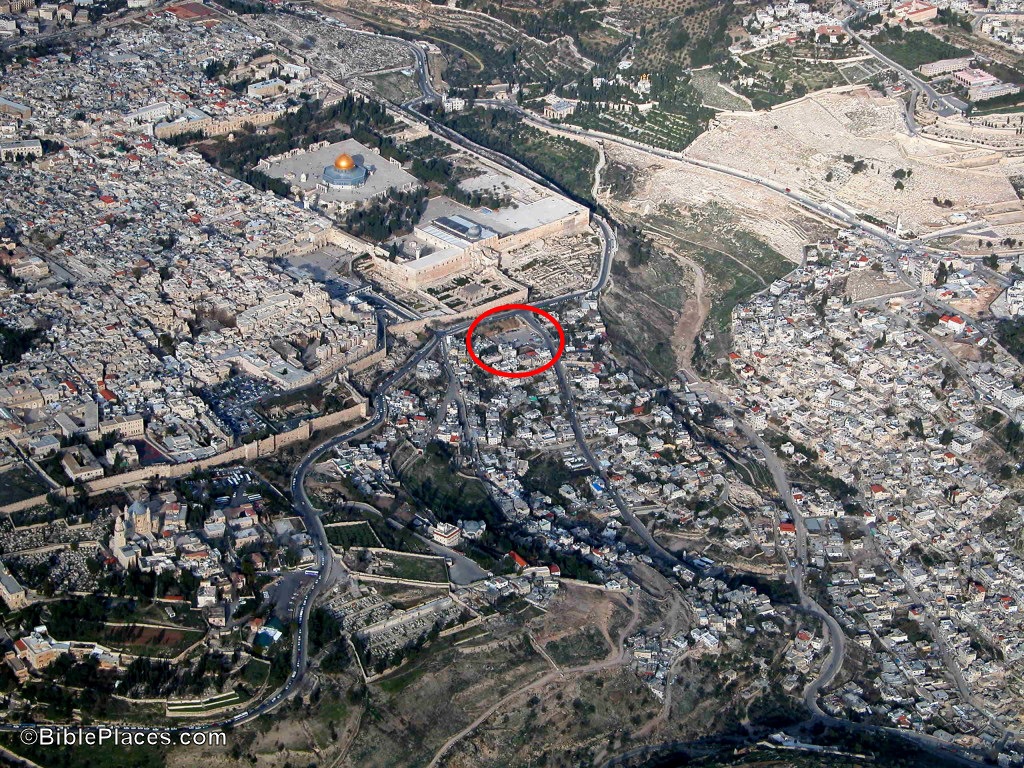
If this is a wall of the Second Temple, this would be very significant.  But further clarification is needed.  There are lots of walls “of the Second Temple.”  Most readers would probably assume that this is a wall of the  actual building itself, into which priests went to offer incense (such as Zechariah in Luke 1).  But this is certainly not the case, based on the location of the trench, which you can see in the top photo of this page.  Rather this is the area (so we believe) of the courts of the Temple, such as the Court of the Women and Court of the Gentiles. 

What exactly has been found is not clear.  Barkay calls it “a massive seven metre-long wall.”  This may be a misquote, because on the face of it it makes no sense.  That a wall is 20 feet long is not unusual; even average ancient houses had walls this long.  You wouldn’t necessarily describe it as “massive,” unless you knew something about its width.  And perhaps Barkay does but he isn’t quoted on that.  I’m suspicious though because the width of the trench appears to be no more than 3 feet wide (according to photos at the previous link).  In short, it’s not clear exactly what has been found. 

Barkay clearly wants to get attention with his statement, and I hope he gets it.  It’s, however, incorrect that this is “the largest such work ever carried out on the Temple Mount.”  The excavation of the massive entrance to the underground el-Marwani Mosque (in so-called Solomon’s Stables) in the late 1990s was much bigger.  Barkay knows that, as he is the archaeologist in charge of sifting all of the debris that was discarded.  On the other hand, this trench is much more centrally located that the other dig, and thus more likely to reveal ancient items of interest.

BTW, I know that many people don’t know the personalities in this discussion, and it’s harder to evaluate statements when you don’t know the person making the statement.  I’ve known him for 15 years, and in my view, Barkay is the best of the best.

Leen Ritmeyer hasn’t posted anything on this specific discovery, but he likely will, and it will be worth reading.

UPDATE: On further reflection, it is possible that a 7-meter wall was discovered in a 3-foot trench, if the trench made a cross-section of the wall and exposed faces on either side.  But that raises another question: what is a 7-meter (22 foot) wall doing on the Temple Mount?  As difficult as relations were between Jews and Gentiles, it’s hard to imagine a wall of that thickness separating the courtyards. 

Perhaps it’s a foundation of a building.  In any case, careful archaeological excavation must be done. 

And it won’t be, because the Muslim authorities are afraid of history being uncovered on the Temple Mount.  I don’t say that because of hearsay; I’ve experienced that reality in person.

Share:

Today’s Haaretz has an interesting article on the flooding of the coastal plain of Israel in the Early Bronze Age.  The dating in the article is a little bit confusing, as it never gives an absolute date, just 5,500 years ago, and 3500 B.C. is usually assigned to the Chalcolithic period (cf. Mazar’s dating: 4300-3300 B.C.).

The concentration of population, commerce and trade in Israel’s coastal plain is not a phenomenon unique to our era. Even before the events the Bible describes in the Land of Israel, during the early first Bronze Age, 5,500 years ago, numerous communities dotted the coastal strip, from the vicinity of Gaza to the Galilee. The first royal dynasties appeared around that time in Egypt, and clay vessels uncovered in southern coastal communities indicate that the area (apparently under Egyptian control) served as an important trade route for the Egyptians.
And then, 5,500 years ago, say the archaeologists, there was a dramatic change. The coastal region was almost completely abandoned while concurrently in other areas an urban revolution was underway, with large fortified cities being built. After the era of urban, commercial prosperity, for almost a thousand years, the coastal plain mostly contained but a few small and scattered communities.
“The phenomenon is amazing,” says archaeologist Dr. Avraham Faust, director of Bar-Ilan University’s Institute of Archaeology. “There was a fairly large population in the coastal plain, and at the end of a relatively short process it emptied almost completely. In the alluvial areas, nearly all of the communities disappeared. The Egyptians also abandoned the coastal plain and trade no longer passed that way.”
Faust adds: “The key question that engaged us is why? What caused the community to disappear?” His research with Dr. Yosef Ashkenazy, a climate researcher at Ben-Gurion University of the Negev, suggests a comprehensive explanation of the phenomenon: The Canaanite coastal settlements were abandoned in the face of environmental change. Increased precipitation led to the flooding of parts of the coastal plain and to a rise in the level of groundwater, which eventually resulted in the spread of swamps, and that apparently caused the residents to leave the area.

You can read the rest here.  The Hebrew version has a couple of photos.

HT: Joseph I. Lauer

Share:

Archaeologists working at Hippos (Susita) on the eastern side of the Sea of Galilee have uncovered the footprint of the sandal of a Roman soldier.  From the story in Haaretz:

The discovery of the print made by a hobnailed sandal, the kind used by the Roman legions during the time when Rome ruled the region, led to the presumption that legionnaires or former legionnaires participated in the construction of walls such as the one in which the footprint was found…. Prior to this finding, the sandal prints of Roman legionnaires had been discovered only in Hadrian’s Wall in Britain.

The story is brief and worth reading for more details, but one note for those who know the Bible better than the geography of the Bible: the reason that Hippos (Susita) is not mentioned in the New Testament is that it was one of the cities of the (largely Gentile) Decapolis, and Jesus’ ministry was to the Jewish people.  There were a couple of occasions when Jesus visited the Decapolis, but it appears that these were not for the purpose of ministry.  One example is the story of Jesus casting the demons into the swine (Mark 5:1-20).  This event occurred as Jesus was trying to get away from the crowds, not do more ministry.  The presence of pigs makes sense as well given that this was in an area controlled by Gentiles.  Unfortunately many scholars have really flubbed the location of this miracle.  If it was where they say (at Gergesa), then Hippos would have been mentioned by some of the gospel writers, instead of Gadara and Gerasa.  But that is a subject for another day.  All can agree that this discovery at Hippos is fascinating and instructive.

Share:

In my opinion, one of the most interesting cities historically in Israel is Tiberias.  It might surprise some then that all I ever do with students in Tiberias is buy them lunch.  Until recently, there have not been significant ancient discoveries to visit.  Current excavations should change this in the coming years, as the results of these projects are opened to the public.  One such discovery was announced this week: a 4th or early 5th century church.  This was the time period when Tiberias was a thriving center of Jewish learning, as the so-called “Jerusalem Talmud” was being written/codified in the city at this time.  Discoveries like this could help us to better understand the relationship between Jews and Christians in the Byzantine/Talmudic period.

The church’s remains were discovered adjacent to ancient public buildings among them a basilica, bathhouse, streets and shops that were exposed at the site in the past. Dr. Moshe Hartal and Edna Amos, the directors of the excavation on behalf of the Antiquities Authority, stated that this is the most ancient church to be uncovered in Tiberias and the only one that has been found in the center of the city.
According to Dr. Hartal, from the year 427 CE the Church issued a decree prohibiting the placement of crosses in mosaic floors in order to prevent them from being stepped on. “The presence of so many crosses in the floors of the church that was exposed here thus confirms the church dates to the period prior to the ban,” he said.
In addition, the remains of a Jewish neighborhood that dates to the tenth-eleventh centuries were discovered in the excavations. These remains extend up to the foot of the cliff in the high part of the city, in an area that was probably residential in nature.
“The discovery of the remains of the church in the middle of the ancient city, like that of the Jewish neighborhood and the magnificent city that existed in Tiberias more than one thousand years ago, greatly contributes to our understanding of the town planning, its scope and it structures,” archaeologists on behalf of the Antiquities Authority said.

The story in the “Scoop” has more information, including a photograph and partial translation of an inscription in the mosaic floor.

Tiberias new excavations in progress, tb032705506
Recent excavations in Tiberias
Share:

This story in The Times looks very interesting.  It’s another one of those occasions when the discovery is made long after the excavators leave the field.

The British Museum yesterday hailed a discovery within a modest clay tablet in its collection as a breakthrough for biblical archaeology – dramatic proof of the accuracy of the Old Testament.
The cuneiform inscription in a tablet dating from 595BC has been deciphered for the first time – revealing a reference to an official at the court of Nebuchadnezzar, king of Babylon, that proves the historical existence of a figure mentioned in the Book of Jeremiah.
This is rare evidence in a nonbiblical source of a real person, other than kings, featured in the Bible.
The tablet names a Babylonian officer called Nebo-Sarsekim, who according to Jeremiah xxxix was present in 587BC when Nebuchadnezzar “marched against Jerusalem with his whole army and laid siege to it”.

The rest of the story is here.  I’ve been working for some years on a list of extrabiblical references to biblical people.  I’m not ready to share it, but I can tell you that it is long.

The stupid quote of the story goes to renowned scholar Geza Vermes, who said, according to the reporter, “the Biblical story is not altogether invented.”  My response: there is not a fraction of evidence that it is invented at all.  Many scholars have many theories, but these are possible only because of the lack of evidence.  The more evidence, the less room for scholarly ideas about the invention of the Bible.  This observation is not based upon the above story, but upon years of study in the land of Israel.  The liberal case gets weaker the more I know.

Share: