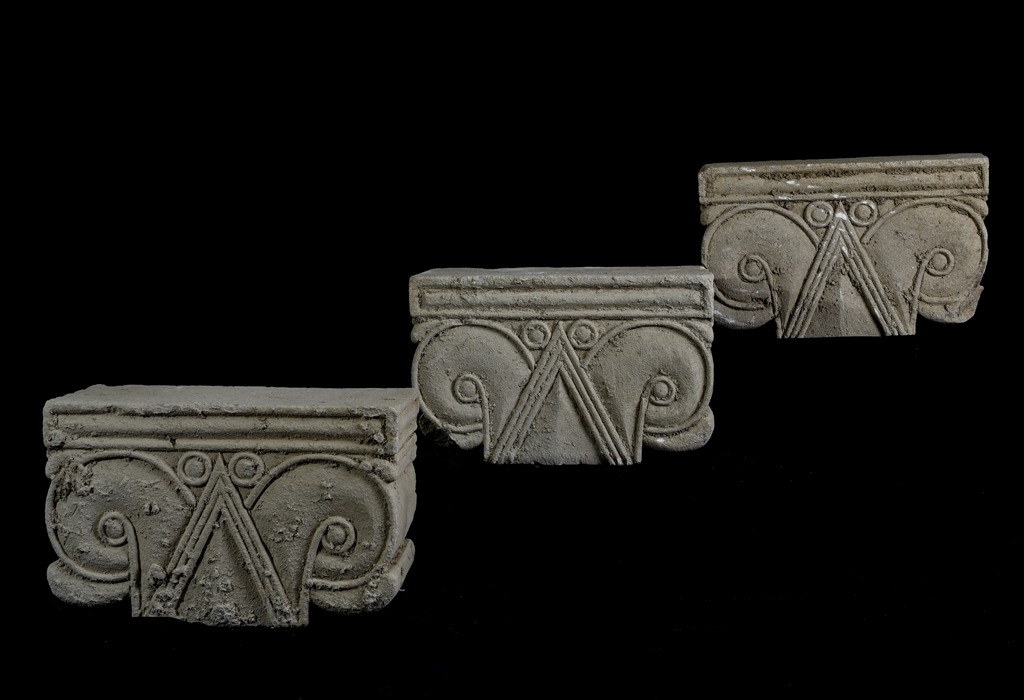
A scholarly study uses radiocarbon dating to determine that “Wilson’s Arch was initiated by Herod the Great and enlarged during the Roman Procurators, such as Pontius Pilatus, in a range of 70 years, rather than 700 years, as previously discussed by scholars. The theater-like structure is dated to the days of Emperor Hadrian and left unfinished before 132–136 AD.”

A 1,800-year-old fountainhead in the shape of a face was uncovered by chance by a visitor at the Tzipori [Sepphoris] National Park in the Galilee.”

Rami Arav discusses his excavations at et-Tell and a newly discovered moon god stele (Haaretz premium).

Excavations will not be possible at el-Araj (Bethsaida?) this summer because of the high water level. The article includes many photos.

NPR has a story on the Israeli and Jordanian sides of the tourist site for Jesus’s baptism, including a discussion of creating a new “soft crossing” to allow tourists to enter Jordan from the Israeli side.

A new study of the DNA of 35 fragments from the Dead Sea Scrolls is providing insight into the diverse origins of the parchments.

Mark Vitalis Hoffman has published an interesting article on “Jesus and Jerusalem and the ‘Things That Make for Peace.” He has also created a video to supplement the article.

Gabriel Barkay is on The Book and the Spade this week talking about the archaeology of Jerusalem’s Temple Mount.

Israel’s Good Name had a productive trip scouting out the birds and fish at the Beit Zayit Reservoir west of Jerusalem.

A Jerusalem Post piece looks at the resumption of tourism in Israel and the safety measures being put in place.

From boom to bust: with tourism in Israel all but gone, tour guides are considering their options.

The Winter 2019 issue of the ACOR Newsletter is now available (high-res; low-res).

The Bible and Interpretation provides a selection about ancient Moab and the Mesha Stele from the new book by Burton MacDonald.

Gulf News has a write-up on artifacts from Saudi Arabia that are featured in the traveling “Roads of Arabia” exhibit.

Smithsonian magazine has a long, well-illustrated piece on archaeological work in and around Aigai, Philip II’s capital of Macedon. A massive new museum is scheduled to open in January.

The latest historical city travel guide by the British Museum is of Athens in the 5th century BC.

Some stories on re-opening: excavations in Turkey, Vatican Museums, Rome’s Colosseum, Pompeii, Al Ula, Israel’s museums, the Temple Mount.

Two Asian lion cubs were recently born at the Jerusalem Biblical Zoo.

HT: Joseph Lauer, Chris McKinny, Agade, Keith Keyser, Steven Anderson, Charles Savelle, Explorator

“A six year old hiking with his family [at Tel Jemmah] . . . discovered a one-of-a-kind, 3,500-year-old depiction of a naked, humiliated Canaanite prisoner and his victorious warden.”

A new study of organic material on the Iron Age altars from the shrine at Arad indicates that frankincense and cannabis were burned on them in ancient times.

A well-preserved Roman mosaic floor from the 3rd century AD has been discovered in a vineyard in northern Italy.

Archaeologists have discovered a well-preserved 3rd century AD Roman ship in Serbia.

A recent review of Egyptian antiquities in Scotland has identified more than 14,000 objects.

The latest post on the ASOR Blog is about the Egyptians’ views of foreigners.

A Jewish leader in Tehran denies that a traditional tomb of Esther and Mordecai was set on fire. The article in a regime-approved newspaper includes other interesting background about the shrine.

Mark Wilson reflects on Paul’s imprisonments in light of his current confinement in Turkey.

A Times of Israel article describes two new documentaries on the Church of the Holy Sepulcher. In one, a priest explains how the “holy fire” is lit with a lighter.

“Following an extreme and unusually long heatwave last week, Israel on Sunday was hit by showers and unseasonably cold temperatures.”

Museums reopening in Italy will use “chaperones” and vibrating necklaces to ensure people don’t get too close to each other.

Now on pre-pub for Logos: A Christian’s Guide to Evidence for the Bible: 101 Proofs from History and Archaeology, by J. Daniel Hays ($19).

Ferrell Jenkins dug up a great photo to illustrate Isaiah 1:18.

HT: Agade, Ted Weis, Arne Halbakken, Keith Keyser, Explorator

“A singular two-millennia-old subterranean system of three rooms has been uncovered near the Western Wall. The three-room complex — painstakingly chiseled by hand out of bedrock prior to the fall of Jerusalem in 70 CE — is the first evidence of everyday life gone underground in the ancient city.” There’s a nice 3-minute video in English here.

An intact terracotta sarcophagus dating from the second century AD has been unearthed alongside the archaeological site of Ostia Antica” near Rome.

Researchers have found that early Iron Age Nubia utilized bitumen from the Dead Sea in funeral preparations.

An incredible, undisturbed tomb probably dating back to the Punic period has been found in Tarxien” on the island of Malta.

Eberhard Zangger and Rita Gautschy argue that a monumental depiction of the Hittite pantheon in the rock sanctuary of Yazılıkaya near Hattusha actually served as an ancient calendar based on celestial events.

A study of a trash pit in Beth-Yerah/Philoteria provides insights into the diet of the inhabitants in the 2nd century BC.

The founders of Hobby Lobby are suing Christie’s auction house for selling it a stolen copy of the Gilgamesh Dream Tablet.

Some of the lectures from the Bar Ilan archaeology series have been recorded and are available online.

HT: Agade, Keith Keyser, Arne Halbakken

For only the 4th time, a Bar Kochba coin has been found in Jerusalem, possibly brought there by a Roman soldier. This article has nice photos, and this article has a short video.

The Jerusalem Post surveys how archaeology in Israel has been affected by governmental actions in response to COVID-19.

El-Araj, a good candidate for Bethsaida, has been flooded by this winter’s rains and the rise of the Sea of Galilee.

Critics are claiming that construction by the Palestinian Authority is destroying remains at Tel Aroma, the northernmost Hasmonean fortress in Samaria.

“Exploratory drilling has started just outside the Old City for a project to extend the Tel Aviv-Jerusalem fast rail to the Old City’s Dung Gate — the main entrance to the Western Wall.”

The Greek Orthodox Church of Jerusalem has filed a lawsuit demanding closure of Ein Yael outdoor museum.

Four fragments of Dead Sea Scroll fragments that were thought to be blank are not.

A new excavation at Petra will focus on the lower part of the Treasury as well as nearby tombs and facades.

A new burial chamber has been discovered at the mummification workshop complex of the 26th Dynasty at Saqqara.”

“A stone chest excavated by archaeologists near Deir el-Bahari and the temple of Hatshepsut could lead archaeologists . . . to a royal tomb.”

Egypt’s decision to move ancient objects from their original setting in Luxor to Cairo’s Tahrir Square is stirring controversy.

“The excavation team working on the site of the ancient city of Patara, near the Mediterranean resort city of Antalya, has unearthed a new inscription in the ancient theater.”

“A small sinkhole that appeared next to the Pantheon in Rome has enabled archaeologists to examine the original Roman paving that was laid when the Pantheon was built by Marcus Agrippa around 27-25 BC.”

The traditional tomb of Esther and Mordechai in Hamadan, Iran, was set afire yesterday.

David Moster has created a new video on “Biblical Pandemics.”

The Temple Mount Sifting Project Symposium on May 24 features eight lectures via Zoom on the archaeology of Jerusalem and the Temple Mount. Registration is required.

Francis I. Andersen died recently. His breadth of publications is remarkable.

Thomas O. Lambdin died on May 8.

HT: Agade, Ted Weis, Joseph Lauer, Explorator, BibleX

Ecbatana tomb of Esther and Mordecai, tb0510183126

Traditional tomb of Esther and Mordecai in Hamadan (biblical Ecbatana) before attack

A team excavating Khirbet a-Ra‘i (the alleged Ziklag) in January and February discovered “a rare ‘smiting god’ figurine, a bronze calf figurine, two seals and decorated Canaanite and Philistine pottery from the 12th Century BCE.”

With everyone home, antiquities thieves are having a field day in Judea and Samaria.

With the Israel Museum closed, the Dead Sea Scrolls are now safely stored “behind five locked doors in a humidity and temperature-controlled vault at the Shrine of the Book.”

Owen Jairus reports on discoveries made in the Nazareth Archaeological Project, as recently published by its director Ken Dark.

The summer season at Tell es-Safi/Gath has been cancelled. Other excavations have apparently cancelled as well, though I haven’t yet seen those notices.

The Temple Mount Sifting Project has unveiled a new virtual exhibition.

The Palestine Open Maps project has just launched, and it is based on the 1940s survey maps from the British Mandate.

On Kindle for $2.99: Jesus and the Eyewitnesses: The Gospels as Eyewitness Testimony, by Richard Bauckham.

Hisham’s Delights is a new digital cookbook from the kitchen of the Albright Institute.

HT: Agade, Ted Weis, Joseph Lauer

Archaeologists from Hebrew University excavating at Lachish have uncovered a temple from the Canaanite period. The full study is published in Levant, and the university has issued a press release, portions of which are excerpted here.

In a study published last month in Levant, [Yosef] Garfinkel and his co-authors revealed, for the first time ever, extensive ruins of a Canaanite temple dating to the 12th century BCE that they uncovered in National Park Tel Lachish, a large Bronze Age-era settlement near the present-day Israeli city of Kiryat Gat…

The layout of the temple is similar to other Canaanite temples in northern Israel, among them Nablus, Megiddo and Hazor.  The front of the compound is marked by two columns and two towers leading to a large hall.  The inner sanctum has four supporting columns and several unhewn “standing stones” that may have served as representations of temple gods.  The Lachish temple is more square in shape and has several side rooms, typical of later temples including Solomon’s Temple.

In addition to these archaeological ruins, the team unearthed a trove of artifacts including, bronze cauldrons, Hathor-inspired jewellery, daggers and axe-heads adorned with bird images, scarabs, and a gold-plated bottle inscribed with the name Ramses II, one of Egypt’s most powerful pharaohs.  Near the temple’s holy of holies, the team found two bronze figurines.  Unlike the winged cherubs in Solomon’s Temple, the Lachish figurines were armed “smiting gods”.

Of particular interest was a pottery sherd engraved with ancient Canaanite script.  There, the letter “samek” appears, marked by an elongated vertical line crossed by three perpendicular shorter lines.  This makes it the oldest known example of the letter and a unique specimen for the study of ancient alphabets.

The story is currently being reported by Jewish Press and Arutz-7, with more surely to follow.

HT: Joseph Lauer

Temple at Tel Lachish_Courtesy of the Fourth Expedition to LachishJPG

Temple at Tel Lachish, courtesy of the Fourth Expedition to Lachish

Plan of the North-East Temple_Credit J. Rosenberg.

Plan of the North-East Temple, by J. Rosenberg

Letter samek, 2nd row on right, inscribed on storage jar_Credit T. Rogovski

Letter samek, 2nd row on right, inscribed on storage jar; photo by T. Rogovski

Pottery uncovered in Temple_Credit C. Amit_IAA

Pottery uncovered in temple, photo by C. Amit, IAA