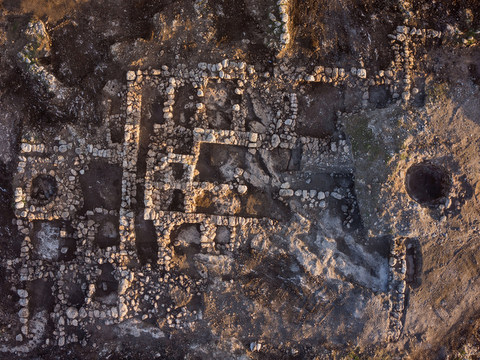
In construction work south of the Israeli city of Beit Shemesh, archaeologists recently discovered a large monastery dating from the Byzantine period.  From the Jerusalem Post:

According to a joint statement issued by the excavation’s co-directors, Irene Zilberbod and Tehila Libman, an archaeological survey conducted along the hills south of Beit Shemesh brought the findings to light several weeks ago. “Blocked cisterns, a cave opening and the tops of several walls were visible on the surface,” the archeologists said. “These clues to the world hidden underground resulted in an extensive archaeological excavation there that exposed prosperous life dating to the Byzantine period, which was previously unknown.” Zilberbod and Libman said the compound is surrounded by an outer wall and is divided on the inside into two regions, including an industrial area and an activity and residential area. Additionally, an “unusually large press in a rare state of preservation that was used to produce olive oil was exposed in the industrial area, as well as a large winepress revealed outside the built compound consisted of two treading floors from which the grape must flowed to a large collecting vat.” Despite not finding a church or inscription of any kind indicating religious worship, the excavation’s co-directors said they still believe the site served as a monastery. “It is true we did not find a church at the site… or any other unequivocal evidence of religious worship; nevertheless, the impressive construction, the dating to the Byzantine period, the magnificent mosaic floors, window and roof tile artifacts, as well as the agricultural-industrial installations inside the dwelling compound, are all known to us from numerous other contemporary monasteries,” they said. Based on that criterion, the archeologists noted it is possible to reconstruct a scenario in which monks resided in a monastery that they established, made their living from the agricultural installations, and dwelled in the rooms and carried out their religious activities.

The full story is here. The IAA press release is here.

The largest ancient tomb ever discovered in Greece dates to the time of Alexander the Great and is located near Amphipolis. Archaeologists are hoping that the tomb is intact.

Beth Alpert Nakhai is leading a Survey on Field Safety and needs you to answer a few questions.

Another good one from Wayne Stiles: 3 Golan Heights Sites with Odd Names and Curious Histories.

Clyde Billington is on the Book and the Spade discussing the latest discoveries at Huqoq and the shovel survey at Khirbet el-Araj.

Construction begins next month on the yet-unnamed Bible museum being built by Steve Green in Washington, DC.

There are now more private museums than public in Turkey.

Ferrell Jenkins describes his balloon ride over Cappadocia. And a separate post includes a spectacular photo.

BibleX shares a quote on the importance of biblical geography from an older commentary on Joshua.

(Alas, the anticipated survey of Palestine east of the Jordan was never completed.)

Olof Pedersén has created a set of more than 2,500 ANE Placemarks for Google Earth.
This list of “12 must-see secular destinations” in Israel may give you ideas for your next trip.

On sale for Kindle: All the Names in the Bible ($3.99) and The Secret of the Talpiot Tomb ($2.99).

Here’s a new book you might find valuable, co-written by a Christian and agnostic to give an objective perspective: The Context of Christ: The History and Politics of Judea and Rome, 100 BC – AD 33 ($2.99).

HT: Agade

SourceFlix has produced a short video illustrating Psalm 23.

Wayne Stiles has everything you want to know about Timna Park, including photos, a time-lapse video, Google Street View, and a map.

“Researchers from the Hebrew University of Jerusalem have discovered the deepest cave in Israel, reaching a depth of 187 meters below ground.”

The Getty Thesaurus of Geographic Names is now online for free.

If you’re thinking about visiting the Pergamum Museum in Berlin anytime soon, read Ferrell Jenkins’ recent post.

A copper awl discovered not far from Beth Shean is now believed to be the oldest metal object known from the Middle East. The University of Haifa press release is online here.

“The Iraqi National Museum inaugurated two renovated halls adorned with life-size stone statues on Thursday.”

The new editors of BASOR have penned an inaugural letter describing their plans and offering an invitation.

Jordan’s Tourism Board has launched a new online chat service.

HT: Joseph Lauer, Jack Sasson, Charles Savelle, A.D. Riddle

Anna Moseley Gissing writes about three lessons she learned from archaeology about the spiritual life.


Haaretz reports that the appointment of Israel’s new antiquities chief is embroiled in politics.

Should the Vatican return the menorah from the Jerusalem Temple? Steven Fine assigned his class the task of refuting the notion that the Vatican has it.

Greek archaeologists excavating a fourth-century BC tomb at Amphipolis have made an “extremely important find.”


Camels Mummification existed in Egypt 1,500 years earlier than scientists have long believed.

The Egyptian government has asked the Ashmolean museum to lend it the personal collection of Howard Carter.

Brian Daniels discusses Preserving Culture in War on this week’s broadcast of The Book and the Spade.

What is the relationship between the archaeology of Jerusalem and the Book of Mormon? SourceFlix has produced a new video that answers this question.

Wayne Stiles describes two oases along the shore of the Dead Sea. (Can you guess which ones they are? Neither one ends with “Gedi.”) He includes photos, a video, and a map.

HT: Joseph Lauer, Jack Sasson

Arch of Titus Temple treasures scene left, tb112105077
Triumphal procession depicted on the Arch of Titus in Rome
Photo from Pictorial Library of Bible Lands, volume 15

A ceramic money box filled with 114 bronze coins from “Year Four” of the First Jewish Revolt was discovered recently in excavations along the Jerusalem-Tel Aviv Highway. From the Israel Antiquities Authority:

According to Pablo Betzer and Eyal Marco, excavation directors on behalf of the Israel Antiquities Authority, “The hoard, which appears to have been buried several months prior to the fall of Jerusalem, provides us with a glimpse into the lives of Jews living on the outskirts of Jerusalem at the end of the rebellion. Evidently someone here feared the end was approaching and hid his property, perhaps in the hope of collecting it later when calm was restored to the region”. All of the coins are stamped on one side with a chalice and the Hebrew inscription “To the Redemption of Zion” and on the other side with a motif that includes a bundle of lulav between two etrogs. Around this is the Hebrew inscription “Year Four”, that is, the fourth year of the Great Revolt of the Jews against the Romans (69/70 CE).
The hoard was concealed in the corner of a room, perhaps inside a wall niche or buried in the floor. Two other rooms and a courtyard belonging to the same building were exposed during the course of the archaeological excavation. The structure was built in the first century BCE and was destroyed in 69 or 70 CE when the Romans were suppressing the Great Revolt.  Early in the second century CE part of the building was reinhabited for a brief period, which culminated in the destruction of the Jewish settlement in Judea as a result of the Bar Kokhba rebellion. This is attested to by three complete jars that were discovered embedded in the courtyard floor.

The full story is here. The story is also reported by Arutz-7 and The Times of Israel.

HT: Joseph Lauer

1
Hoard of coins in situ
2
Pablo Betzer, IAA District Archaeologist for Judah, with a coin from the Year Four of the Great Revolt.
3
All photos courtesy of the Israel Antiquities Authority

A new museum has opened at Hisham’s palace (Khirbet al-Mafjar) in Jericho.

A temple to the Urartian god Haldi has been discovered in northern Iraq.

A painting from the tomb of a priest in the Old Kingdom was discovered near the Giza pyramids.

You can read an update on the recent developments at the Temple Mount Sifting Project. The summary includes a series of photos of various sets of objects found.

The Tel Burna team ended their season by taking photos from a helicopter drone. The post shows the whole process.

Roman roads and milestones in Judaea and Palaestina are the focus of a new website produced by the Kinneret College on the Sea of Galilee and the Israeli Milestone Committee.

Raphael Golb will spend two months in the slammer for his crimes of criminal impersonation and forgery.

“The Archaeology of Music” is the subject on this week’s episode of The Book and the Spade.

Biblical Archaeology Society has a summer sale, including the entire BAR Archive on DVD for $99.95.

HT: Jack Sasson, Ted Weis

Hisham's palace gate from east, tb051106670
Hisham’s palace gate
Photo from Samaria and the Center