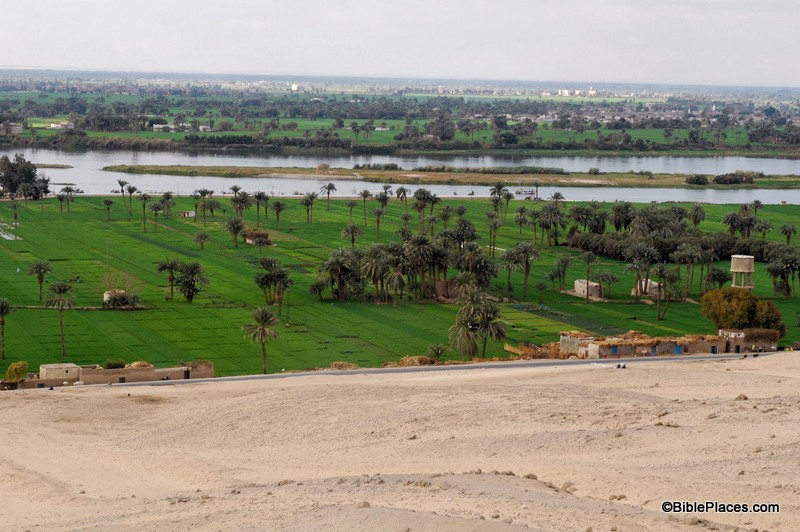
The archaeological site on Mount Gerizim has re-opened, 12 years after political conditions hindered tourists from visiting the area.

A new drainage system in Giza has some hydrologists concerned that the erosion of bedrock could cause the Sphinx to collapse.

A complaint has been lodged with Israeli police over the building material and scaffolding placed on the “rock” of the Dome of the Rock.

The Holyland Magazine, designed especially for North American evangelicals, is now online. Earlier editions are also available.

Several readers have asked recently about the “HT” that is often at the end of a post. Wikipedia provides a concise explanation:

In the 2000s, the term “hat tip” (often abbreviated to “HT” or “h/t”) rose to prominence in the blogosphere to acknowledge someone who has made a significant contribution toward an effort, or someone who drew attention to something new or interesting. It is considered good netiquette when sharing a link or news item to give a hat tip to the person from whom you learned of the item.

HT: Jack Sasson, Joseph Lauer

Mount Gerizim summit remains south of Byzantine church, tb031807246
Archaeological site on Mount Gerizim, looking north
Share:

In excavations beginning at Abel Beth Maacah this summer, Robert Mullins expects to find a very large citadel at the northern end of the site and possibly an Assyrian siege ramp.

Now online: A lecture by Sy Gitin on “Ekron of the Philistines: From Sea Peoples to Olive Oil Industrialists.”

A 3D model of the Giza pyramids and necropolis was unveiled this week at Boston’s Museum of Fine Arts.

An investigation into the eBay sale of stones from the Western Wall determined that the seller was offering only gravel.

A medieval “monk’s mill” near Sepphoris was vandalized last week.

Can the Dead Sea be saved? A $4 million project, financed by the EU, is being launched this weekend to draw up a plan to make the area a UNESCO Biosphere Reserve.

What is ORBIS? “The Stanford Geospatial Network Model of the Roman World reconstructs the time cost and financial expense associated with a wide range of different types of travel in antiquity. The model is based on a simplified version of the giant network of cities, roads, rivers and sea lanes that framed movement across the Roman Empire. It broadly reflects conditions around 200 CE but also covers a few sites and roads created in late antiquity.” Very impressive.

If you like to be the very first to know, here’s your chance.

HT: Wayne Stiles, Luke Chandler, BibleX, Jack Sasson, Joseph Lauer

Dead Sea shoreline with salt crystals, tb022806387

Dead Sea shoreline
Share:

A local imitation of an Athenian tetradrachma was discovered on the surface of Tel Azekah recently. Excavations begin at the site in July.

The Egyptian government has announced that “a big archaeological slab dating back to the era of Ramesses III” was found at the Karnak Temple.

Last week I was looking down on Tel Jokneam (Yokneam) from Muhraqa on Mount Carmel and wondering what was going on there. Joe Yudin has the answer: “Tel Yokneam is in the midst of a vast restoration project by the local communities’ schoolchildren in conjunction with the Antiquities Authority and the National Parks Authority.”

Wayne Stiles: “Perhaps because of the atrocities of Manasseh, Jesus used the Hinnom Valley as an illustration of eternal torment (Matthew 18:9).” Stiles compares the redemption of the evil king with the transformation of the valley today.

Ferrell Jenkins is posting photos of his current tour in western Turkey and Greece, including Smyrna, Pergamum, and more.

I like the photo of the Hidden Waterfall at En Gedi now posted at The Bible and Interpretation.

Aren Maeir was interviewed on the LandMinds program (part 1, part 2, part 3, part 4).

As a follow-up to the recent post on Esther in the Dead Sea Scrolls, it may be noted that only 1 manuscript (4Q118) with 4 complete words is preserved of the much longer 1-2 Chronicles (ABD 1:995).

HT: Joseph Lauer, Jack Sasson

Hinnom Valley from east, tb091306311

Hinnom Valley from the east
Share:

A unique discovery in Jerusalem a couple of weeks ago was surprisingly carried by only one news source—Israel Hayom. Joseph Lauer saw the report and passed it on.

An Egyptian scarab, dating back to the 13th century B.C.E. (the era when some scholars speculate the Exodus may have occurred) was uncovered on Thursday at an excavation sponsored by the Israel Antiquities Authority at the City of David National Park.
The seal is about a centimeter and a half in length and was used to stamp documents.
It bears the name, in Egyptian hieroglyphic writing, of the sun god Amon-Ra, one of Egypt’s most important deities. It is made of soft gray stone and also bears the imprint of a duck, which was apparently one of the sun god’s symbols.
[…]
“This is the first time we’ve found a scarab of this kind in the City of David,” said archaeologist Eli Shukrun, who is directing the dig along with Dr. Joe Uziel.

The full story, with a photo, is here. I wonder why the Israel Antiquities Authority didn’t report this.

Perhaps they had already prepared their Passover story (the recovery of Egyptian coffins) and didn’t want to save it for next year. I’m curious too where they discovered the scarab. I’ll be in the City of David next week and post what I learn.

UPDATE: Aren Maeir has corrected me in the comments below. This is not the first Egyptian scarab found in the City of David. I misread Shukrun’s quote: it’s the first scarab of this kind that he has found in the City of David. The post above has been changed accordingly. My apologies for the error.

City of David sign, tb051908123

Sign at entrance to City of David National Park
Share:

Hundreds of pilgrims celebrated Palm Sunday in Jerusalem.

Wayne Stiles visits the Jerusalem of Hezekiah’s time and writes, “I have a faith rooted in history—not mystery. The words on the pages of Scripture are supported by simple elements we can dig out of the ground. They prove nothing, but they support it all.”

The Israel Museum has joined the Google Art Project and “online users will be able to view high-resolution images of 520 pieces from the museum’s collection.” That future tense should be changed to present, as you can see the images here. Beautiful.

A restaurant in Capernaum has been accused of dumping raw sewage into the Sea of Galilee. “This is one of the most serious cases of coastal environmental damage that the Kinneret has encountered thus far,” said a prosecutor.

Cyprus and Israel are collaborating to form a database for archaeology. There is more in common between the pasts of the two countries than many people know. The article does not explain the reason for why this cooperation is occurring only now: a downturn in the relations between Israel and Turkey.

The Mughrabi Bridge saga continues with Israel’s Supreme Court ruling that planning committees have to consider the women’s prayer area as well as security issues in their decisions. An Islamic petitioner claims that the Western Wall plaza falls under the authority of the Waqf. Jordan’s crown prince made a surprise visit to the Temple Mount today to see the Mughrabi Gate.

Turkey is asking for the return of artifacts from the J. Paul Getty Museum, the Metropolitan Museum of Art in New York City, the Cleveland Museum of Art and Harvard University’s Dumbarton Oaks Research Library and Collection. “‘Turkey is not trying to start a fight,’ said Murat Suslu, Turkey’s director general for cultural heritage and museums. ‘We are trying to develop…cooperation.’”

The Israel Antiquities Authority recently recovered the covers of two sarcophagi smuggled out of Egypt.

For one week, the Teaching Company is offering a free video lecture by John R. Hale, “Central Turkey—Ankara, Konya, Cappadocia.”

HT: Joseph Lauer, Jack Sasson

Kourion theater and coast, tb030405137

Theater of Kourion, Cyprus
Share:

I am going to forego a roundup of the Talpiot tomb(s) at this point, instead pointing you to Paleobabble’s “State of the Question,” Jack Poirier’s rebuttal of the name statistics, James Tabor’s colored drawing of the “fish,” and Robert Cargill’s case that the image was photoshopped. I’m not aware of any scholar who didn’t publish a book on the subject within the last week that subscribes to the fish/Jonah interpretation.

The first three chapters of Lois Tverberg’s Walking in the Dust of Rabbi Jesus are available to read online.

While the snow in Jerusalem was pretty, and the Sea of Galilee rose more than a foot, the weekend storms caused about $8 million in damage to agriculture in Israel.

The “All Out Adventure” column this week describes hikes in the lower and upper sections of Nahal David.

Finding a place to volunteer to excavate in the spring is next to impossible, but Tel Burna is accepting volunteers the week of March 18-22.

Ferrell Jenkins has the latest on discoveries at the Colossi of Memnon. For additional photos, see the Luxor Times.

Luxor Times also reports on the discovery of the name of a king from the 17th Dynasty. While it is the first artifact related to the king, it is not the first time we’ve known of him.

Wayne Stiles has a post for the first day of the Insights for Living tour. (Unfortunately, they seem to have rejected my proposal that Herod Agrippa was struck down not in the theater of Caesarea, but in the amphitheater.)

More than 2,400 years ago, the Lord delivered the Jewish people from evil men in Persia. The remembrance of that deliverance begins tonight. Current threats from modern Persia (Iran) should
keep the celebration sober. Happy Purim!

Share: