Gordon Govier lists his top 10 discoveries in biblical archaeology in 2016.

The Biblical Archaeology Society has selected its top 10 biblical archaeology discoveries of the year.

LandMinds has a one-hour video podcast discussing the list.

Haaretz provides a list of the best archaeological finds in Israel in 2016.

Live Science suggests the 9 biggest archaeology findings of 2016. And they identify 5 big archaeology stories to watch for in 2017.

Brandon Marlon writes about 18 interesting sites that most tourists to Israel miss.

ASOR is offering a free e-book of the “5 Most Popular Biblical Archaeology Articles from The Ancient Near East Today” to subscribers to the weekly newsletter.

Recent excavations in Paphos, Cyprus, have discovered fortifications and a thick layer of crushed murex shells. “Team leader Maria Iacovou noted that this is the first time that archaeological evidence for the production of the highly valued purple dye from murex shells has been found in
Cyprus.”

A marble sculpture of a Roman noblewoman was discovered by a farmer in Crete following a recent storm.

Twelve tombs from the 18th Dynasty have been discovered in Gebel el Silsila.

A study of a toy Roman chariot reveals that ancient charioteers affixed an iron strip to the right wheel in order to improve their chances of winning.

As tourism in Egypt continues its lull, officials are trying new ways to attract visitors.

There is only one archaeobotanist in Egypt, but he is hoping this will change.

Ongoing work at Laodicea has uncovered the sacred agora.

This May: Archaeology and History of Lydia: From the Early Lydian Period to the Late Antiquity (8th century B.C.-6th Century A.D.): An International Symposium.

Robert Alter will be lecturing in Nashville on January 30.

The Anglo-Israel Archaeological Society has a lecture series scheduled for the coming months.

HT: Ted Weis, Agade, Joseph Lauer, Explorator, Paleojudaica

Share:

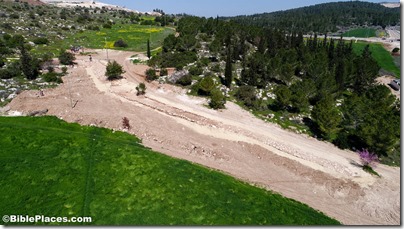
“Siloam Street,” now dubbed “Pilgrims Way,” leading from the Pool of Siloam to the Temple Mount, was inaugurated recently.

Excavations begin this summer at Kiriath Jearim and applications for volunteers are being accepted.

Carl Rasmussen recently took the “Behind the Scenes of the Western Wall” in Jerusalem tour and shares some photos.

The Roman milestones on display along Highway 38 (the “Diagonal Route” in the Shephelah) have unfortunately been moved to KKL-JNF’s Givat Yeshayahu offices.

The 2016 issue of ‘Atiqot has been released.

The Fall 2016 issue of the electronic newsletter DigSight has been published.

Restoration work on the Church of the Nativity in Bethlehem is nearly halfway done.

Archaeologists will begin using robotic submarines in excavations of Atlit-Yam.

Who are the Christians in Israel today?

Islamic guards attempted to evict Gabriel Barkay for saying the words “Temple Mount” on the Temple Mount.

Reuters has created a photo story on the Sea of Galilee.

Wayne Stiles has written a great post on the many interesting sites in the Golan Heights.

The Atlanta Jewish Times has a story about the Biblical History Center in LaGrange, Georgia, and a second story about its founder, James Fleming.

“Ancient Jerusalem in VR” is now available on Google Play ($1.99)and the Apple store ($2.99). You can find some screenshots and videos here. Note: the support website is down at this writing.

You can now experience Petra with a 360º experience for Google Cardboard

HT: Ted Weis, Agade, Joseph Lauer, Charles Savelle, Explorator, Pat McCarthy, Paleojudaica

Share:

Archaeologists have discovered the Roman theater at the site of Hippos.

Excavations of the Crusader-era Montfort Castle in Galilee have discovered game pieces, belt buckles, pig bones, and much more.

Analysis of organic remains from a 10th B.C. gatehouse complex in the Timna Valley suggests that food and supplies were brought in from a long distance.

Engravings of an ancient menorah and cross were found inside a cave in the Judean Shephelah.

A gang of antiquities thieves was caught illegally digging at a site near the Golani Junction in the Galilee. A 3-minute video (in Hebrew) is online.

What are the origins of tomb raider curses?

Three scientists from Beersheba’s Ben Gurion University have used NASA data to date the “sun standing still” to an eclipse in 1207 BC.

A life-size CAVEkiosk (“cave automated virtual environment”) recently opened at UCSD will allow scholars to study 3-D data from at-risk sites.

The Israel Museum has announced that Eran Neuman will succeed James S. Snyder as director.

Wayne Stiles explains why God made the Israelites rest the land every seven years and what that means today.

Colin Hemer’s The Book of Acts in the Setting of Hellenistic History is available in Logos this month for $1.99.

HT: Agade, Joseph Lauer, Ted Weis

Share:

A stone bowl inscribed with the name “Hyrcanus” was discovered in the City of David. Since the name was common in the Hasmonean period, it is not clear if it belonged to one of the two rulers with this name. High-res images are available here.

A bronze coin with the image of Antiochus Epiphanes was discovered during maintenance work in the Citadel of David Museum in Jerusalem.

Mary Shepperson, a free-lance archaeologist working on five projects in Iraq, describes work in the new excavations of Charax Spasinou.

Archaeologists have discovered a large “lost city” about 150 miles north of Athens.

The Center for Ancient Middle Eastern Landscapes (CAMEL Lab) at the Oriental Institute of the
University of Chicago would like to announce that a substantial subset of its digital holdings of maps and geospatial data are now available for online public search and download.”

The Temple Mount Sifting Project is asking readers to Name That Find!

The IAA has completed a detailed survey of the village of Lifta ahead of its planned replacement by a new neighborhood.

Before and after photos reveals the significant war damage in the Syrian city of Aleppo.

Ferrell Jenkins recounts his 2002 visit to Aleppo and its museum.

New research suggests some ancient Egyptians believed a deceased woman had to briefly become male in the afterlife in order to be reborn. Reader Ted Weis notes that this theory corresponds with saying #114 in the Gospel of Thomas.

Egypt is trying to stop the auctioning of Egyptian relics around the world.

A stolen relief of Queen Hatshepsut has been restored to Egypt.

Bricks of ancient Babylon have been used in rebuilding houses in the area.

The Tower identifies “seven fascinating discoveries Israeli archaeologists made in 2016.”
Kudos to Dr. Chris McKinny!

Carl Rasmussen describes an “unknown” Christmas site near Bethlehem.

We wish all of our readers a Merry Christmas and Happy Hanukkah! We’ll be traveling for several weeks and roundups will return when we do.

HT: Joseph Lauer, Agade, Charles Savelle, Ted Weis

Share:

Haaretz reports on the discovery of new fragments of Dead Sea Scrolls.

New fragments of the Dead Sea Scrolls have been found in the Cave of the Skulls by the Dead Sea in Israel, in a salvation excavation by Israeli authorities. The pieces are small and the writing on them is too faded to make out without advanced analysis. At this stage the archaeologists aren’t even sure if they’re written in ancient Hebrew, Aramaic or another language. “The most important thing that can come out of these fragments is if we can connect them with other documents that were looted from the Judean Desert, and that have no known provenance," says Dr. Uri Davidovich of the Hebrew University of Jerusalem, among the scientists investigating the caves. […] The latest finds, two papyri fragments about two by two centimeters with writing and several fragments without discernible letters, were made during a three-week salvage excavation in the Cave of the Skulls this May and June by a joint expedition of the Israel Antiquities Authority and the Hebrew University of Jerusalem. The excavations were led by Uri Davidovich and Roi Porat of the Hebrew University, together with Amir Ganor and Eitan Klein from the IAA.

Read the full story here.

Share:

If you’re interested in excavating in Israel next year and need a scholarship, the Tel Burna team has compiled a list of opportunities.

A new exhibit on Khirbet el-Maqatir opens next month at the University of Pikeville.

Translation is the focus of an exhibit showing through March, 2017 at the Museum of European and Mediterranean Civilisations (MUCEM) in Marseille, France.

An Iranian archaeologist who has cataloged nearly 50,000 ancient paintings and engravings across Iran, many featuring the ibex deer, is hoping newfound access to the Western resources will reveal more insight into these works.

The British Museum has finished phase one to digitize their collection of Hebrew MSS.

K. Lawson Younger explains why he wrote a book on the Arameans.

Richard Averbeck has started a series of posts at the Carl F. H. Henry Center’s blog on Gen 1. The first and second posts are about the comparative method.

The ASOR Blog has a photo update on Nimrud following its liberation from ISIS.

HT: Ted Weis, A.D. Riddle

Share: