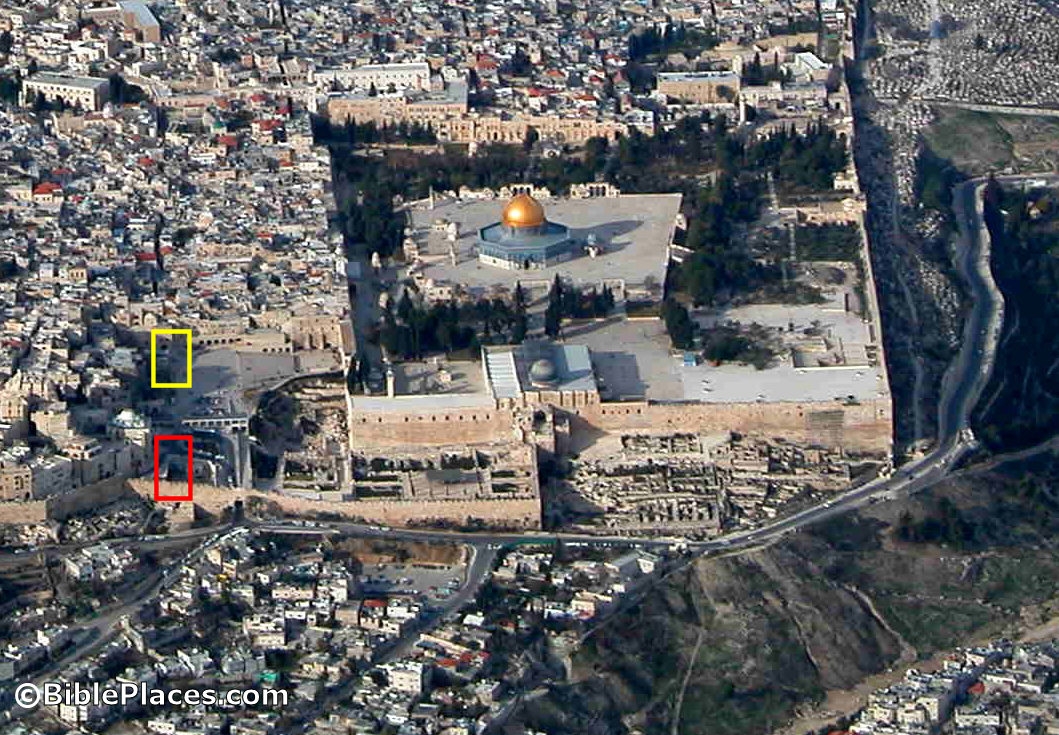
On Sunday the Mughrabi bridge was closed. Hamas called the closure a “declaration of religious war.”  The mayor of Jerusalem called the bridge “ugly and dangerous.” Today the bridge was re-opened with a fire truck standing by.

Gordon Franz has written an detailed guide to the “Dead Sea Scrolls: Life and Faith in Biblical Times” exhibit in New York City. He has made it available for free on his blog.

The Jerusalem Post has a story and video about the solid gold menorah on display in the Jewish Quarter.

One government committee approved the construction of a hotel complex in the Timna Valley, but an Israeli cabinet minister has vowed to stop it.

It could take 100 years to restore Israel’s rivers, according to the State Comptroller. The report looks at 31 of the country’s major rivers and streams.

The Herodium reminds Wayne Stiles of the Christmas story that never appears on Christmas cards.

Antiquities thieves plundering a second-century site near Shaar HaGai (Bab el-Wad) have been arrested.

The ASOR Blog has links to news in the broader world of archaeology.

The latest issue of DigSight is online.

The Megiddo Expedition is recruiting volunteers for the 2012 excavation.

HT: Joseph Lauer

Several weeks ago I mentioned briefly the preliminary report from the first four seasons of the Gezer excavations of Ortiz and Wolff (2006-2009). As it may be easy to skip reading a lengthy online report, I thought I would return to it and note the conclusions here, in easier-to-read bullet-point fashion:

“Major results from the first four excavation seasons include:

  • the exposure of the Middle Bronze Age glacis;
  • the discovery of a Late Bronze Age stratum, consisting of several wall fragments and a large pillar base that probably indicates the presence of a major public structure;
  • the clarification of the Iron Age fortification systems;
  • the distinguishing of three major architectural strata from Iron II;
  • a large Israelite four-room house and three public buildings that were destroyed in the eighth century BCE, probably as a result of Tiglath Pileser III’s campaign in the region;
  • and the excavation of three Hellenistic building complexes.”

Not mentioned in the conclusion, but potentially quite significant with regard to the date of the Solomonic gate and its associated level is the discovery of a stamp.

Several storage-jar stoppers/plugs were discovered in the deep contemporary construction backfill within one of the chambers created by this system. One of these stoppers bore an Egyptian stamp typical of the so-called ‘Early Iron Age Mass-Produced Seals’ (EIAMS) series, dated by some scholars from the twelfth/eleventh to the early tenth centuries BCE, and by others, to the mid-tenth century BCE, thus dating the glacis and retaining wall system to late Iron I or early Iron II.

Something major was clearly going on at Gezer in the Iron Age before the 9th century. As noted before, Sam Wolff has written that the team is a season or two away from floor levels associated with the (Solomonic) six-chambered gate.

ABR is putting the word out for volunteers to join them for the 10th season of excavations at Khirbet el-Maqatir, a possible location of Joshua’s Ai.

IBEX students discovered a beautiful seal this week in excavations at Tel Burna (Libnah?).

Excavations have resumed in Egypt at Tell el-Amarna.

One place that most tourists to Israel never visit is the southern wilderness where the Israelites wandered. Wayne Stiles gives his readers a good feel for the landscape, with several scenic photographs, in his weekly column at the Jerusalem Post.

CITYsights takes viewers on a four-minute video tour of the Herodium in search of Herod’s tomb.

Satellite imagery is being used to identify ancient settlements in the Libyan desert.

Elsewhere in Libya, thieves drilled through a concrete ceiling in the National Commercial Bank and carried off the Treasure of Benghazi. An expert described the loss as “one of the greatest thefts in archaeological history.”

Carl Rasmussen has been uploading photos from his excellent Zondervan Atlas of the Bible to the Holy Land Photos website where they can be downloaded for free.

The Book and the Spade radio program features an interview with Eilat Mazar (and a forthcoming profile in Christianity Today). To listen, go here.

A hyena was caught in an illegal trap near Modiin (about halfway between Jerusalem and Tel Aviv). Aren Maeir has the details, a video and some advice.

Now that it has been admitted to UNESCO, the PA is going to sue Israel “for systematically destroying and forging Arab and Islamic culture in Jerusalem.”

It’s been a year now since the American consulate in Jerusalem relocated from East Jerusalem, but since I missed it, someone else may have also. If you lose your passport or need a birth certificate, you’ll need to head to the new facility in Arnona, south of the Old City not far from Ramat Rahel.

Friday (11/11/11) is the last day to vote for the Dead Sea as one of the New 7 Wonders of Nature. The lowest and saltiest body of water on earth is in the top ten but the Israeli Tourism Ministry is asking everyone to vote.

HT: Jack Sasson, Joseph Lauer

The most dramatic discovery from the first season of excavations at Khirbet Summeily is a unique sculpted animal head. Archaeologists are not sure if the head is of a sheep or a lion, but they say that it is the first of this type they have seen.

Excavations of the site this summer also uncovered an Egyptian scarab, stone figurines, a collection of loomweights, as well as the remains of several buildings. Khirbet Summeily is located near the border of ancient Israel and Philistia, 3 miles (4 km) west of Tell el-Hesi and about 5 miles (8 km) southwest of Qiryat Gat.

Tim Frank has posted the full press release and photograph from Mississippi State University. You may want to check out Frank’s blog “Archaeology and the Bible” while you’re at it, including a recent series of posts on “Life in the Holy Land,” surveying the remarkable work of Gustav Dalman (until now available only in German and Hebrew).

Blog readers may recall Daughter of Lachish, a captivating work of historical fiction written by Frank and published earlier this year by Wipf and Stock (now available from Amazon).

The earthquake in eastern Turkey prompts Gordon Govier to look at the country’s relationship with foreign archaeological expeditions in Christianity Today. Sites mentioned include Antioch of Pisidia, Colossae, Hierapolis, Laodicea, and Tel Tayinat. He also provides some statistics.

[Mark] Wilson said that in 1990, the total number of excavations was 38. Last year more than 200 excavations took place, according to Turkish newspaper Hurriyet.
However, Hurriyet reports that the Turkish Culture and Tourism Ministry has begun cancelling excavation permits for some foreign archaeologists and turning the permits over to Turkish archaeologists. Ministry head Ertuğrul Günay said many foreigners simply weren’t in the country enough. “If they don’t work on it, they should hand it over.”
“The government’s goal is to have universities in each of Turkey’s provinces, and an archaeology department in each of these universities,” said Wilson. This means the number of archaeologists is expanding rapidly. Foreign archeologists now run less than 25 percent of Turkey’s 200 current digs.

One statistic that I doubt is Wilson’s claim that “two-thirds of the New Testament was written either in Turkey or to churches or people in Turkey.” I count 1 long (Revelation) and 7 short books written primarily to people in Turkey (Galatians, Ephesians, Colossians, 1-2 Timothy, Philemon, 1-2 Peter). I count 1 book likely written from Turkey (1 Corinthians). If one includes John’s other four books (the gospel and 1-3 John), that boosts the word count considerably. But without the three longest books in the NT (Matthew, Luke, Acts), as well as the longer letters of Romans and 2 Corinthians, I think the truth may be closer to one-third.

Read the whole article here.

UPDATE: Using word counts from the Greek New Testament (NA27) compiled here, I’ve determined that using the most generous collection listed above (13 books), 34.1% of the NT was written to/from a site in Turkey.

HT: A.D. Riddle

Tom Powers has posted today his experience in traveling through the drainage channel up from the City of David to the street below Robinson’s Arch. You’ll need to go there for the dozen photos and a step-by-step description, and I’ll encourage you to do that with a couple of sections from his conclusion:

MY TAKE on the experience:  It’s hard to see this underground route turning into a major tourist draw on the order of Hezekiah’s Tunnel. I see it being more for the hard-core afficionado (like me). For one thing, after the initial novelty of traversing an ancient sewer wears off, it gets a bit, well… tedious – it’s 650 meters from Siloam up to the Davidson exit!…. I anticipated entitling this post “Final Section…” but it turns out there is obviously more to come in terms of opening these underground spaces. First, where the present route makes its final jog to the east to run along the foundation courses of the Temple Mount, the cleared drain channel continues straight ahead, northward, but is still blocked/gated. However, a friend of mine (who shall remain nameless) said he found the way open a few weeks ago — and follwed it. He went quite a ways, he said, until there was no more lighting and he had to turn around; he estimated he might have been under the Western Wall prayer area….

I appreciate Tom’s careful work to allow all of us to “visit” this newly opened excavation in Jerusalem.