Off the top of my head, I cannot think of more appealing places to excavate than the beach or Tel Dan. Summers can be hot in Israel and Jordan and instead of baking at Tel Rehov or Feinan, you can excavate at Ashkelon, with its cool ocean breezes, or at Tel Dan, a lush garden “which lacks nothing whatsoever” (Judg 18:7).

While the registration window is quickly closing for this season’s dig at Dan, there is still time to get in at the site where the famous Tel Dan Inscription was found and where the high place of Jeroboam still stands.

The official website lists the Goals of the 2012 season:

1. We will continue digging in Area B, into the early Iron Age levels (circa 1200-1000 BCE), to flesh out the architectural plans and to facilitate spatial analysis of houses and neighborhoods, to understand lifestyle, economy, social identity (ethnicity) and political organization.  We are especially interested in retrieving carbonized grain from the Strata V and IVA destruction levels and to submit them for C14 dating (we have dates from wood, but the wood might already have been old when the town was destroyed).
2. We will continue digging in the new area in the center of the site, Area L, in the 8th cent. BCE levels destroyed in an earthquake.  What does a town look, one minute before disaster strikes?  How to people react to such a catastrophe? We will also be emphasizing “household archaeology” here. Is the earthquake mentioned in the book of Amos (Chapter 1)?
3. We will continue working in the area outside the city gate, Area A, in an attempt to date and understand the phantom gate of the Iron Age.  Was it constructed in the 10th century BCE, the 9th century or even later?  Will we find more pieces of the famous victory inscription of Tel Dan?

You can download an application here.

HT: Alexander Schick

Dan Iron Age gate with plaza and ruler's podium, tb052907083

Iron Age gate at Tel Dan
Share:

Gordon Franz was at today’s press conference and has written a short piece on the experience and his amazement at some of the responses he has read. He writes:

I was at the press conference at Discovery Times Square on Tuesday, February 28, 2012 for the unveiling of the new book The Jesus Discovery by James Tabor and Simcha Jacobovici.

I am not a supporter of Simcha’s ideas, in fact, I have critiqued some of them on my website (see the Cracked Pot Archaeology section at www.lifeandland.org). But what I have found amusing is the misstatements and misunderstanding on some of the blogs by leading scholars. First of all, you should get the book and read it before you comment, or at least look at the pictures! It will save you some embarrassment.

Simcha had an exact replica of both ossuaries in question made by the museum staff at Discovery Times Square. This was accomplished by the measurements and photographs taken with the impressive robotic arm. I am grateful for Walter Klassmen for showing me how it worked. This tool will have many applications in the archaeology of Israel and Simcha should be commended for working closely with this expert to produce such a valuable tool.

The first thing that struck me on the ossuary is the orientation of the “fish.” On all the blogs and news articles I have read, the picture of the “fish” is facing the wrong way. Sometimes it is horizontal, either facing left or right, and made to look like a swimming fish. Or the “fish” has the round ball (Jonah, according to Simcha) facing upwards, thus making the “fish” look like a funerary monument.

Usually pictures of Absalom’s Pillar are shown to bolster the case for this view. The fact of the matter is that the “fish” is facing down! So we should orient the picture correctly before we continue the discussion.

My initial impression is that the “fish” looks like an ornamental glass vessel, perhaps a pitcher or flask of some sort. The Ennion vessel found by Prof. Avigad in the Jewish Quarter comes to mind (page 108 in Discovering Jerusalem). Perhaps some glass expert might suggest a better parallel from this period than the Ennion vessel, but this is worthy of consideration.
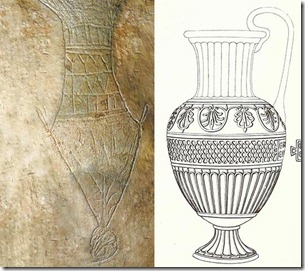
jonah-fish-ossuary-jacobovici-haaretz-avigad

Ossuary etching compared with Ennion pitcher, both from Jerusalem. Left image: Associated Producers Ltd./Haaretz; Right: Avigad, Discovering Jerusalem, p. 108.
Share:

Foundation Stone has posted a three-part interview from their LandMinds radio show with the UCSD professor who is excavating copper mines in the Arabah south of the Dead Sea.

“There is no Turning Back!”  Prof. Thomas Levy, UCSD, says the trowel and a good eye are no longer enough in the field. Tom rode the wave of an immense California investment in technology applied to Hirbet en-Nahas in Jordan.
The kicker is, unexpectedly, his excavations showed a rise of copper industrial production in the 10th and 9th centuries BCE, with a falling off in the 8th. This may be in conflict  with the Low Chronology, requiring a new look at the textual and archaeological interface, about which he has written and edited a book. 
Everyone is talking about his work and its implications – hear Prof Levy himself! (Barnea overloaded his circuits here in the late night Skype recording, he was so fascinated, pardon him…).

You can access the mp3 files via these direct links: Part 1, Part 2, Part 3.

LandMinds also has a facebook page.

HT: Jack Sasson

Khirbet en-Nahas Area S, Iron Age four-room workshop, view north, df080207013

Four-room workshop, Khirbet en-Nahas
Share:

For several years now, Brian Janeway has reported on major presentations and discussions at the Annual Meetings of the American Schools of Oriental Research in order to engage the armchair archaeologist who is unable to travel to the November conference. He has now posted his review at the website of the Associates for Biblical Research, summarizing sessions on the Philistines, the state of biblical archaeology, the Conquest narratives, biblical meals, Caesarea, and the wine of Jesus.

One subject of particular interest is Joshua’s conquest and how this is interpreted by one self-identified “maximalist.”

Perhaps it was fitting then, that Dr. Daniel Browning from William Carey University, following in the Rainey tradition, mounted a spirited critique of the findings of Dr. Bryant Wood in “Hazor versus Jericho and Ai: Dealing with Mixed Archaeological Data in Evaluating the Joshua Narrative.” Coming from a scholar who styled himself a “maximalist” regarding the Biblical text, the paper was both surprising and disappointing—the former for its contemptuous dismissal of any “maximalist” (literal) reading of Joshua—and the latter for its utter lack of reference to physical evidence presented by Wood and others. All attempts by evangelicals to interpret the data (at Jericho, Ai, and Hazor) differently than Kenyon and others are reduced to “tactics,” all of which fail on the level of presupposition—failing to see the text as a theological and not a historical one. The real key to understanding Jericho and Ai is in the figures of Rahab and Achan, who are juxtaposed to drive the underlying theological agenda. Only at Hazor can archaeological finds be made to fit the conquest narrative. In singling out Bryant Wood, Browning’s failure to cite the ceramic and stratigraphic basis of Wood’s thesis is intellectually dishonest. His largely literary approach deserves a learned archaeological response, which was not provided in San Francisco. Perhaps it is time for Dr. Wood to mount a defense of his own at the next ASOR Meetings? 

In my opinion, it is an elementary error to assume that literary artistry precludes accurate historical recording.

Janeway’s full report is here.

Jericho, Tell es-Sultan from east panorama, tb05110682p

Jericho (Tell es-Sultan) from the east
Share:

When one looks at the amount of information preserved in the archaeological record in the city of Jerusalem, a pattern emerges where a period of abundant evidence is followed by one with minimal data. What can archaeology tell us about Jerusalem in the Late Bronze or Persian periods? Not very much, especially by comparison with the eras that precede and follow. Historical documentation, such as the Amarna Letters and the books of Ezra and Nehemiah, attest to flourishing life in the city in these periods, but the archaeological evidence is quite limited. One might simplify the record as follows:

  • Middle Bronze: Abundance
  • Late Bronze-Iron I: Minimal
  • Iron II: Abundance
  • Persian-Hellenistic: Minimal
  • Hasmonean-Herodian: Abundance
  • Late Roman: Minimal
  • Byzantine: Abundance

One of the reasons for this situation is that later builders apparently destroyed and re-used much of the material from the previous period. Thus the Hasmoneans rebuilt along Nehemiah’s (Persian) walls and David reused existing Jebusite structures.

The Late Roman period (AD 70-330) is one of those for which less archaeological information exists.

But excavations in the last decade have made significant progress in revealing more about the city between the destruction of the Second Temple and the arrival of the Byzantines. Nir Hasson has written an interesting article on Jerusalem in the Late Roman period, noting in particular four discoveries from this period (emphasis added below).

In the rear section of the Western Wall plaza, in the spot where the Western Wall Heritage Foundation intends to erect a large building that it calls “the Core House,” Antiquities Authority researcher Shlomit Wexler-Bedolah discovered an ornate and broad Roman street, complete with shops on each side. This is the eastern cardo, along whose path Hagai Street would later be paved.
Three hundred meters to the south, another Antiquities Authority researcher, Dr. Doron Ben-Ami, discovered the place where the Roman street apparently ended. The corner of the street is adjacent to the Givati parking lot at the top of the Silwan valley – the spot where the Elad organization intends to build a large visitors center. In a large rescue excavation at this location in recent years, Ben-Ami exposed a large, fancy Roman villa unlike any other structure from its time in the entire country. He estimates that the villa he uncovered was the home of the regional governor or some other central authority.
In another excavation, in the tunnel under the Western Wall, Wexler-Bedolah and archaeologist Alexander Onn re-estimated the dating of a large bridge leading to the Temple Mount. As with other ancient monuments this too turned out to be of Roman origin and not from the Second Temple period. Another example is the Roman bathhouse and swimming pool discovered by Sion a year and a half ago. “It’s a tremendous spa, a country club,” Sion says, comparing the bathhouse to similar facilities found in other parts of the Roman Empire.

The rest of the article describes other discoveries in the greater Jerusalem area and it discusses the implications of this new information, including what it means for the alleged abandonment of the Temple Mount during these years. If you’re interested in the history of Jerusalem, this is worth reading.

HT: Joseph Lauer

Valley Cardo excavations near Western Wall, tb010312457

Eastern Cardo near Western Wall
Share:

In 1995, the construction of a visitor center above the Gihon Spring was halted with the discovery of some massive Middle Bronze towers. Today the ugly shell of the building hovers over the site with no apparent intention of ever being completed.

Yesterday the Jerusalem District Planning and Construction Committee approved the plan for another visitor center for the City of David, this one located in the former Givati parking lot below Dung Gate (aerial photo here). This is the same area where archaeologists have claimed to have excavated the palace of Queen Helene of Adiabene. Haaretz reports:

The new visitors’ center is to be built above the Givati parking lot and will be called the Mercaz Kedem (Kedem Center). The building will be built on stilts and beneath it there will be an area where visitors can view recently discovered archeological findings. The Elad organization promoted the plan and it obtained the support of Jerusalem Mayor Nir Barkat, who appeared before the district committee earlier today to voice his support.
The Israel Antiquities Authority’s Jerusalem District director, Dr. Yuval Baruch, also expressed support for the plan, despite the presence of archeological findings under the building. “This is one of the most important projects in Jerusalem in recent generations. It would be impossible to find a serious archeologist with a bad word to say about the conduct of the excavations,” said Baruch. “The building as it stands is approved by the Israel Antiquities Authority and was presented to the authority in dozens of meetings.
All of the changes the Antiquities Authority requested were included in Arie Rahamimov’s plan: the number of parking spaces was reduced, and the height of the building was limited so it would not overshadow the height of the Old City wall (the difference is one meter). There is an important link here between the Ophel Garden, the City of David and the Western Wall and the creation of a direct link between the sites. We led the way to this result.”
The building, designed by architect Arie Rahamimov, will also include a parking lot for the use of visitors to the City of David, exhibition space and classrooms and on the roof, there are plans to build a plaza and observation deck overlooking Silwan and the Old City walls.

The full article includes an artist’s rendering of the new complex.
HT: Joseph Lauer
Central Valley excavations, tb010910230Givati Parking Lot Excavations, January 2010
Central Valley excavations, tb123011044Givati Parking Lot Excavations, January 2012
Share: