The Easter story for “60 Minutes” this year is about the bonebox inscribed with “James, son of Joseph, brother of Jesus.” The 13-minute video segment and a written transcript is available online.
In terms of production, the video is outstanding. They have beautiful footage, dramatic interviews, and a clear storyline. This 13-minute story will make understandable to millions what five years of scholarly debate has not. But I’d recommend watching this for entertainment value than for factual analysis. There are many problems with this “reporting.”
The first issue is the lack of scholarly testimony. Only a few scholars are interviewed and only one is allowed to give his verdict about inscription’s authenticity. Witherington and the Pfanns are quoted only about the excitement and possible value of the inscription. Silberman gets double the airtime, and his statements about authenticity (or lack thereof) seem to be carefully crafted for dramatic effect. The story does not give the background for any of these individuals, so it’s worth noting that Silberman is not an archaeologist nor a paleographer. He is a popular writer about biblical and archaeological subjects. He has co-written several books claiming that the Bible is a fraud, so it’s not surprising that he thinks that an inscription that supports the Bible is also a fraud. Unfortunately none of the scholars who specialize in this area were interviewed (or included), and most of them think the inscription is likely authentic.
While the story’s title would have you believe that this is a story about the James Ossuary, only the first half of the story discusses the bonebox. From that point on, the producers try to condemn the ossuary using guilt by association. This is the only way they can make the story work, because most scholars think the inscription is authentic. The argument against the inscription is that
1) the ossuary came from the collection of Oded Golan;
2) Golan had tools that could be used for making forgeries;
3) an Egyptian claims that he made other forgeries for Golan (but not this one).
What they insinuate and omit is more significant than what they report.
1) Did Golan forge the inscription or did the Egyptian? It doesn’t matter, as long as they can create doubt in the viewer’s mind.
2) Is Golan and/or the Egyptian capable of creating such a perfect inscription? Most scholars say they could not. 60 Minutes misleads by quoting a policeman who says that the Egyptian is a skilled craftsman. They don’t quote Ada Yardeni who says that if Golan faked it, “he’s a genius. But I don’t believe it.”
3) There is no mention of the old photograph that Golan has of the ossuary with the inscription. The authenticity of the photograph is disputed, but if authentic, it is compelling evidence that the inscription was not forged.
4) Did Golan pass a polygraph? I don’t know, but it seems like a simple test that would be of relevance.
5) Why is such an open-and-shut case taking the Israeli police more than three years in court?
6) Was the inscription forged or only part of the inscription? Like several components of the story, they want to have it both ways.
In 13 minutes, one cannot expect all of the evidence to be presented, but it is noteworthy that CBS has given us a glimpse of the prosecution’s case rather than an even-handed treatment. Even the multiple uses of an interview with Golan is intended to support their case. I haven’t read of anybody who supports or trusts Golan. He certainly doesn’t exude credibility on screen. But the issue isn’t about him. Even if he forged 1,000 pieces, that doesn’t prove that the ossuary inscription is fake.
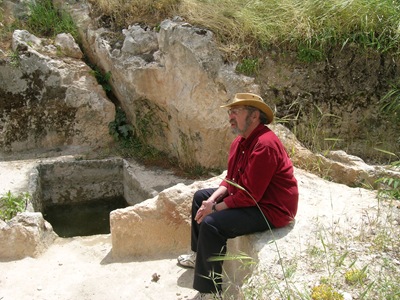
Sitting on a toilet doesn’t prove that it is fake either. Maybe it is, but it is certainly better to analyze the artifact itself rather than its circumstances. But this they do not do. The fact is that many scholars believe that the entire inscription is very likely authentic, including Ada Yardeni, Bezalel Porten, Gabriel Barkay, and Andre Lemaire. The inclusion of the toilet photograph and the failure to include even one specialist of ancient inscriptions proves that this story is about entertainment and not facts.
One final note: Forgery of antiquities and looting of antiquities are major problems in Israel and around the world. These crimes should be prosecuted aggressively. But when a majority of the specialists believe an alleged forgery to be authentic, it is time to pursue other cases.