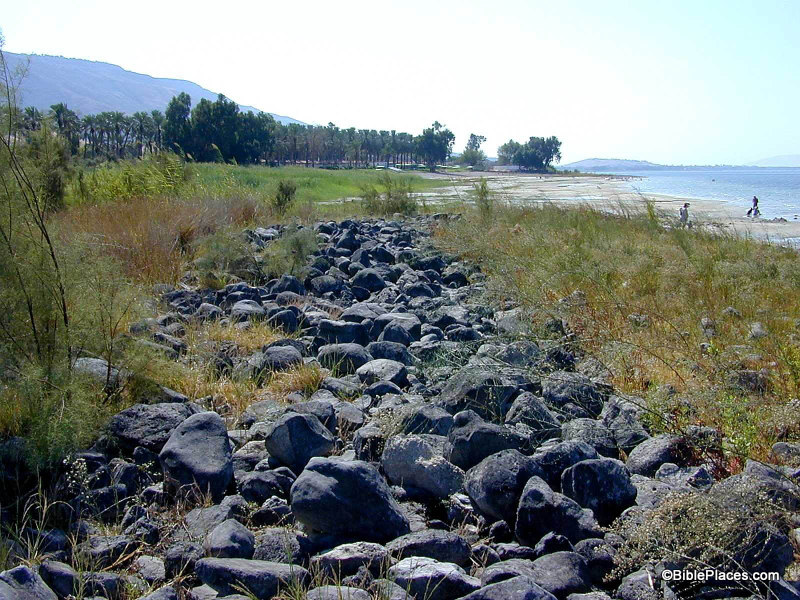
Ken Dark recently lectured at the University of Edinburgh on the archaeology of Nazareth and the Plain of Gennesaret (Ginosar). Summaries of these lectures are available online.

While I find highly dubious his suggestion that there was “no road between Nazareth and Sepphoris”—what sort of physical evidence would you expect to find for a road from an agricultural village of a few hundred people?—I am very interested in his claim to have discovered a “very large, but previously-unrecognised, Late Hellenistic, Roman-period, and later, settlement” between Magdala and Kibbutz Ginosar. He suggests that the site may be the Dalmanutha of Mark 8:10.

“About four thousand men were present. And having sent them away, he got into the boat with his disciples and went to the region of Dalmanutha. The Pharisees came and began to question Jesus. To test him, they asked him for a sign from heaven.” (Mark 8:9–11)

Because the parallel account in Matthew 15:38–16:1 has “vicinity of Magadan,” some scholars believe that Dalmanutha was another name for Magadan/Magdala. Mendel Nun has proposed that Dalmanutha be identified with a small anchorage north of Magdala (Anchor Bible Dictionary 2:4). Dalmanutha may not be a proper name but simply the Aramaic word for harbor.

You can read the lecture summaries and see the bibliographic details at the blog of the Centre for the Study of Christian Origins.

HT: Charles Savelle

Plain of Gennesaret from Arbel, tb032507715
Plain of Gennesaret (Ginosar) from Arbel. Is this the region of Dalmanutha?
Photo from the Pictorial Library of Bible Lands
Share:

Matti Friedman posts new photos and information about the royal (proto-Aeolic) capital discovered in a water tunnel not far from Bethlehem.

The first official Israeli exhibit in the Louvre is the Lod Mosaic. It opens tomorrow and runs through August 19.

Wayne Stiles explains why Nazareth Village is not just another tourist trap.

The Jewish Voice suggests 13 Must-See Museums in Israel.

Jerusalem Experience has a new video of the Pools of Bethesda.

All of the articles of the latest issue of Atiqot are now online.

Ferrell Jenkins recommends the new Satellite Bible Atlas for tours anywhere in Israel.

Rockefeller Museum entrance, tb042403209
The Rockefeller Museum in Jerusalem
Photo from the Pictorial Library, volume 3
Share:

A rare film from 1913 shows footage of Jerusalem and the train ride up from Jaffa. Footage of prayers at the Western Wall are shown at about the 4-minute mark. (The audio is in Hebrew.)

Leen Ritmeyer explains why he disagrees with the belief that the Shushan Gate had to be directly opposite the entrance to the Temple.

Wayne Stiles has an excellent post on the City of David and its significance in history. If you haven’t seen the new 3-D film shown at the City of David Visitor’s Center, you can watch it here.

An ultra-marathoner has completed the 600-mile Israel Trail in just 15 days.

Despite warnings that it will lead to a sharp drop in tourism, the Israeli government has approved adding an 18% tax (VAT) on services to non-Israelis.

Highlight Israel shares a 30-second time-lapse video of the sun setting over the Old City of Jerusalem.

Menachem Kaiser praises the Israel Museum’s exhibit of King Herod for not only representing his great buildings but for revealing the man himself.

The 2012 Bethsaida field report is now online. Figure 2 is a scarab dated to the 8th century and possibly connected with Israel’s royal house. Previous field reports are available here.

Geza Vermes died this week. Mark Goodacre reflects on his legacy.

One of the best Bible collections in the world opened Thursday evening in Dallas. The Museum of

Biblical Art houses the new Charles C. Ryrie Library with more than 100 rare Bibles, including the

Wycliffe New Testament (1430), Tyndale’s Pentateuch (1530), Bomberg’s Biblia Hebraica (1521),
the Complutensian Polyglot (1520), and the “Wicked Bible” (1631).

HT: Judi King, Mark Hoffman

Bomberg-Biblia-Hebraica-1521-Ryrie-Library-tb050911847
Biblia Hebraica, published by Daniel Bomberg in 1521, now on display in the Charles C. Ryrie Library.
Share:

Mount Arbel does indeed provide a panorama of Jesus’ ministry. Wayne Stiles shares photos and a video. I certainly agree with his conclusion: “No visit to Mount Arbel is ever long enough. It remains one of the most beautiful, inspiring, and instructive sites in Israel.”

Exploring Bible Lands marvels at the many biblical events that occurred within the frame of one photo of Jezreel and the Harod Valley. (By the way, you can get that photo and a thousand others for pennies each here.)

Ferrell Jenkins visits the Beit Sturman Museum at Ein Harod and describes its large collection of Roman milestones.

The highest and lowest places of dry ground on the planet are being united by an exchange of stones from Mount Everest and the Dead Sea.

The Gabriel Stone goes on display today at the Israel Museum.

The pyramid complex of Dashur is being threated by looting and construction.

The website of the University of Pennsylvania Museum of Archaeology and Anthropology is reviewed in the CSA Newsletter.

Archaeology programs from the BBC are now online for free viewing.

The recent back-and-forth between Turkish and German authorities over the return of antiquities is reviewed in DW.

HT: Jack Sasson

Dashur Red Pyramid with Bent Pyramid, tb110400454
The Red and Bent Pyramids of Dashur
Photo from the Pictorial Library of Bible Lands
Share:

A sonar survey has identified a large stone structure on the floor of the Sea of Galilee. It may be related to the contemporary third-millennium BC site of nearby Beth Yerah (Khirbet Kerak). The scientific article includes illustrations.

Archaeologists have discovered a port on the Red Sea from the time of Pharaoh Cheops.

Admission to the Israel Museum is free on Independence Day, April 16.

Sharks are rare in the Mediterranean Sea but not in the Red Sea. One came close to swimmers in Eilat last week.

Gannon University in Erie, Pennsylvania, has inaugurated its Archaeology Museum Gallery.

If Israel was ever mapped out on the game of Monopoly, Megiddo would be Boardwalk.

Kyle Pope has written a good article on “The Hinnom Valley and Jesus’ Teaching on Final Punishment.” Barry Britnell shares a photo of the valley.

Details for volunteers for this summer’s dig at Tel Burna are now available. Apply before May 1.
zmetro has four 360-degree panoramas of Laodicea. The excavators and restorers are making great progress at the site.

HT: Charles Savelle, Tony Lawrence, Jack Sasson, Joseph Lauer

ijna12005-fig-0004
Stone structure under the Sea of Galilee 
Illustration by Shmuel Marco
Share:

Several significant excavation reports will be published in the next couple of months and Eisenbrauns is offering major discounts on pre-orders.

Megiddo V: The 2004-2008 Seasons

Gezer VII: The Middle Bronze and Later Fortifications in Fields II, IV, and VIII

Sepphoris I: The Pottery from Ancient Sepphoris
MegiddoVcover.indd
With the ongoing debate over the chronology of the Iron Age II, the Megiddo volumes may receive the most attention from scholars.

Eisenbrauns has a number of other excavation reports on sale, including volumes on Bab edh-Dhra, Lahav (volumes I-II), Tell el-
Hesi (volumes II-V), Gezer (volumes I-III, V), and Dothan. For those interested in a popular work, the Timnah volume is now marked down 50% (to $15).

There doesn’t seem to be a direct link to the sale page, so go to the home page, read about their phenomenal new “Online/Offline
Backup Service” (announced on April 1), and follow the link to the sale from there.

A couple of recently published excavation reports are reviewed in the current issue of Biblical Archaeology Review. In the article now available online, William G. Dever reviews Ashkelon 3: The Seventh Century B.C. and Hazor: The 1990–2009 Excavations: The Iron Age.

Share: