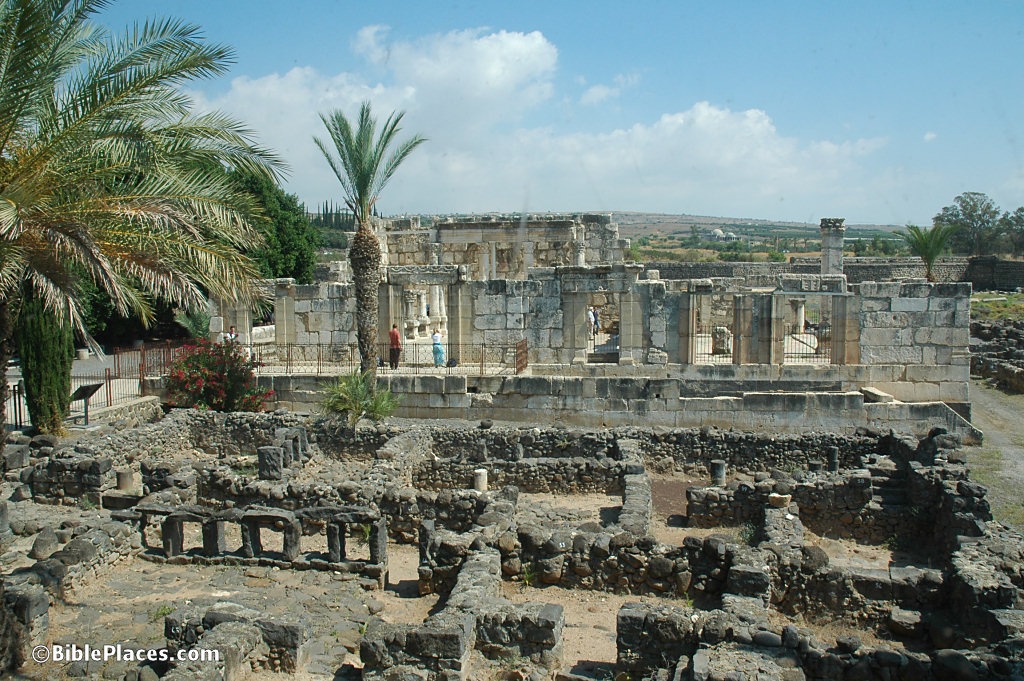
Today visitors to Capernaum are impressed by the white limestone remains of an ancient synagogue. 

Archaeological excavations indicate that this synagogue was built over the remains of an earlier synagogue dating from the time of Jesus.  Thus we can say with some measure of confidence that this is the place where Jesus healed the demon-possessed man (Mark 1:21-28) and preached the sermon on the bread of life (John 6:25-59).

Capernaum synagogue from Peter's house, tb060105618

Capernaum synagogue, view from Peter’s house, present day

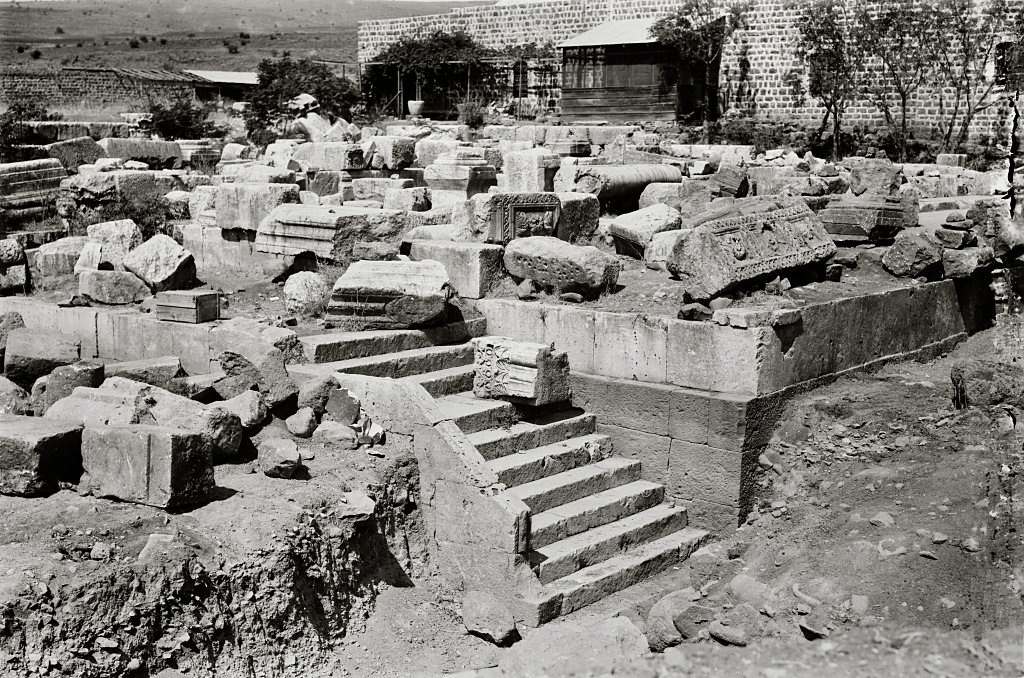
Visitors may not be aware that the synagogue did not survive in this condition since ancient times. 

The photograph below shows what the synagogue looked like in the early 1900s.  The staircase in the foreground of the photo below is on the far right (middle) of the photo above.

Capernaum, ruins of synagogue, mat10654sr

Capernaum synagogue, early 1900s

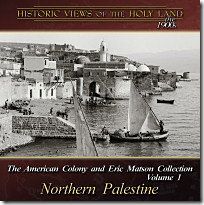
The second photograph is one of 600 high-resolution images in the new Northern Palestine CD, volume 1 of The American Colony and Eric Matson Collection. Photo: Library of Congress, LC-matpc-10654.

The University of Haifa has announced some discoveries from its 2009 season of excavations at Hippos/Sussita, reported in a press release (Hebrew) and in an English article in Ha’aretz

Remains of an ancient cult to the goddess of love have come to light in the southern Golan Heights site of Susita.
At the site, on a 350 meter-high-plateau overlooking the eastern shore of Lake Kinneret, archaeologists found a cache of three figurines of Aphrodite (whom the Romans called Venus), dating back about 1,500 years. The figurines, made of clay, are about 30 centimeters tall. They depict the nude goddess standing, with her right hand covering her private parts – a type of statue scholars call “modest Venus.”

I’m personally more interested in another find, described at the conclusion of the article:

Another special find at Susita is an odeon – a small, roofed theater-like structure with seats for about 600 people, uncovered for the first time in Israel, according to the excavators. They said such structures were fairly common in the Roman period and were used for the reading of poetry and musical presentations to a select audience, in contrast to theaters, which could seat around 4,000 people.

The claim that this is the first odeon discovered in Israel is not true; another has been excavated at Aphek/Antipatris (NEAEH 1: 71, with photo).

The press release includes several photos.

HT: Joe Lauer

I am very excited to announce the release of a new photo collection from BiblePlaces.com and LifeintheHolyLand.com.  The American Colony and Eric Matson Collection includes more than 4,000 high-resolution photographs taken by professional photographers living in Jerusalem from 1898 until the 1940s.  I’ve worked with a team for the last five years organizing and improving this collection so that the photos are the highest quality, accurately identified, carefully organized, and elucidated by observations of well-known 19th-century explorers.

The collection spans 8 CD volumes and is being released one volume a month beginning this week. 

Volume 1 is “Northern Palestine,” and it includes 600 photos organized in the following categories:

  • Acco (11 photos)
  • Benjamin (43 photos)
  • Caesarea (31 photos)
  • Caesarea Philippi (14 photos)Northern Palestine CD cover
  • Ephraim and Manasseh (34 photos)
  • Galilee Hill Country (20 photos)
  • Haifa (27 photos)
  • Huleh Basin (12 photos)
  • Jaffa (51 photos)
  • Jezreel Valley (47 photos)
  • Mount Carmel (15 photos)
  • Mount Hermon (20 photos)
  • Mount Tabor (12 photos)
  • Nazareth (32 photos)
  • Samaria city (19 photos)
  • Sea of Galilee (41 photos)
  • Sea of Galilee, Capernaum (31 photos)
  • Sea of Galilee, Tabgha (15 photos)
  • Sea of Galilee, Tiberias (39 photos) – free PowerPoint here
  • Sharon Plain (17 photos)
  • Shechem area (22 photos)
  • Tel Aviv (43 photos)

All images are included in high-resolution jpg format as well as in annotated PowerPoint files.  The cost for the CD is now only $20, with free shipping in the U.S.  While volumes 2-8 are not yet available individually, the complete collection is available in DVD format for $99.


I believe this is the finest collection of historic photographs of the Middle East available anywhere in any format.

You can read more about the collection here:

Volume 1: Northern Palestine

Complete Collection: Volumes 1-8

As with everything we do, the goal is your complete satisfaction.  If you don’t like it or need it, return it for a full refund.  If you do like it, we would really appreciate it if you’d pass the word on.  Review copies are available by request.

I plan to post on this blog some interesting images from the CD over the next few weeks.

Nazareth and Mt Tabor, mat05532 Nazareth with Mount Tabor in the distance
Date: between 1900-1920

Aviva Bar-Am has written an informative article about ancient Jezreel and its modern counterparts in the Jerusalem Post.  The first half discusses the battles around the village in 1948 and the kibbutz that was established there.  The second half describes the biblical and archaeological significance, including this part:

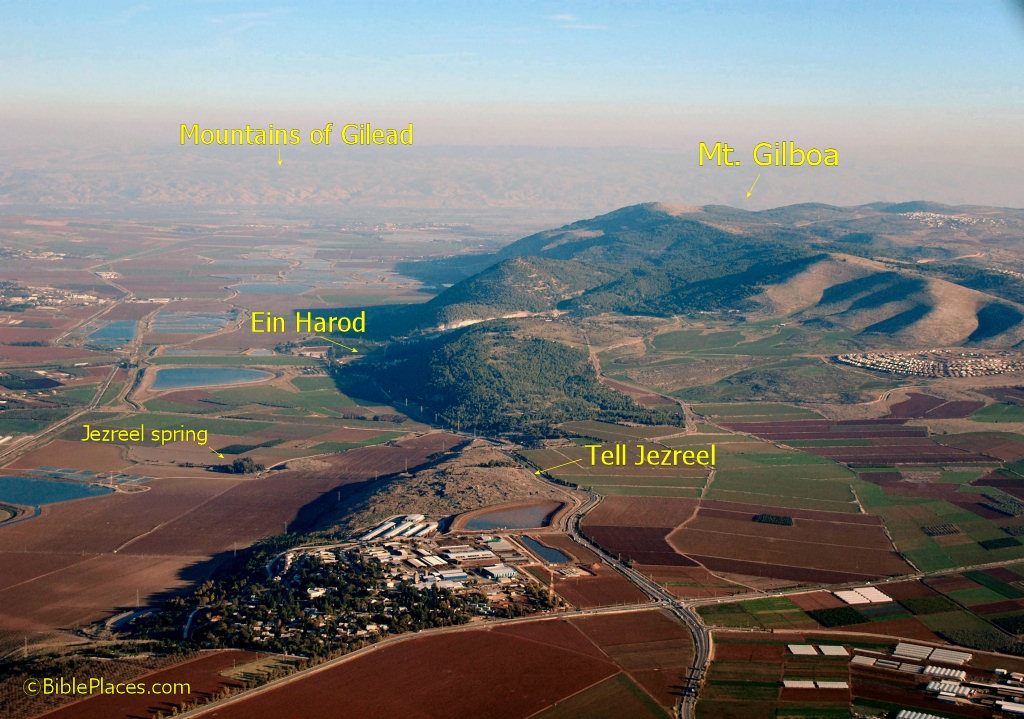
Although archeologists have uncovered portions of a tower, found the city gate and dug to the bottom of the moat, the biblical Jezreel is overgrown with weeds and there isn’t much to see (I am also not sure how safe it is – there are open pits). It is much more fun to spend time at the tel’s excellent recreation site, centered by a striking monument to Palmah troops who fell here in 1948. From the heights of the tel you have a fantastic view of the Harod and Beit She’an valleys. Enjoy the shade produced by the fruit trees in the lovely reconstruction of Naboth’s plot.
You can also follow a lovely biblical trail on the northern edge of the mountain down the slope for about 35 minutes (allow about 50 minutes for walking back up). A delightful surprise awaits you at the bottom: the Jezreel Spring. It is one of 48 freshwater, full springs that lie under the mountain, the result of geological changes that occurred when the Syrian African Rift raised Mount Gilboa and lowered the valley.
Before you jump into the inviting pool, set within a grove of eucalyptus trees, look for a shaft a few meters from the end of the trail. It leads underground to a tunnel which you and your kids can enter (with a flashlight!), walk through water and end up on the other side of the road in a canal that leads directly to the pool.
The spring, of course, is mentioned in the Bible (isn’t everything in this region?) “The Philistines gathered all their forces at Aphek, and Israel camped by the spring in Jezreel…” [I Samuel 29:1].

The full article is here.

HT: Joe Lauer

Harod Valley, Mt Gilboa, Jezreel aerial fr w, tb121704019 captions Tell Jezreel and Mount Gilboa from west

Eric Cline writes on the ANE-2 list:

The co-directors of the Kabri Archaeological Project (KAP) would like to announce that a pdf of the preliminary results from the 2009 excavation season is now available at:
http://digkabri.files.wordpress.com/2008/10/preliminary-report-on-the-results-of-the-2009-excavation-season-at-tel-kabri.pdf If the direct link does not work for some reason, please go to http://digkabri.wordpress.com/, click on "2009 Season," and then click on the link there to download the pdf. Links to the results of previous seasons (2005, 2006, 2007, and 2008) are also listed at http://digkabri.wordpress.com/, under the "Previous Results" link
KAP Publications which have already appeared are: E.H. Cline and A. Yasur-Landau, "Poetry in Motion: Canaanite Rulership and Aegean Narrative at Kabri," in EPOS: Reconsidering Greek Epic and Aegean Bronze Age Archaeology: 157-165, S.P. Morris and R. Laffineur, eds. Aegaeum 28. Liège: Université de Liège. 2007. A. Yasur-Landau, E.H. Cline, and G.A. Pierce, "Middle Bronze Age Settlement Patterns in the Western Galilee, Israel," Journal of Field Archaeology 33/1 (2008) 59-83.

The report’s abstract reads:

The 2009 excavations at Tel Kabri, the capital of a Middle Bronze Age Canaanite kingdom located in the western Galilee region of modern Israel, lasted from 21 June to 30 July 2009. A highlight of the season was the discovery of numerous fragments of painted plaster, from both a previously-unknown Minoan-style wall fresco with figural representations and a second Aegean-style painted floor.

This article will set some to thinking about how their tour itineraries will change.  Others will wonder how this might play into the fulfillment of the “battle of Armageddon.”  From the Jerusalem Post:

A battle is raging over the pending construction of a new international airport in Megiddo, in the Jezreel Valley.
According to the Transportation Ministry, the number of people flying to and from Israel annually is expected to double, from 15 million to 30 million, in the next 20 years, creating urgent necessity for a new airport. The regional council in Megiddo, however, vehemently opposes the initiative.
“It [the airport] is absolutely absurd and does not serve the national interest of the State of Israel, which is the preservation of open areas, including the preservation of the significant agricultural land reserves of the Jezreel Valley, tourism development and rural areas with ecological environmental sensitivity,” the Megiddo regional council said in a statement this week.
Though officials say the airport would undoubtedly increase tourism to the area, local authorities, residents and environmental organizations are actively opposing its construction. Yoel Sigal, the strategic planner for the Megiddo Municipality, is leading the campaign against the project.
“The selling of the Jezreel Valley” represents one of the worst elements of Israeli development policy, he said on Tuesday. Under the National Development Plan, the valley is defined as an area for farming. If the region became an urban center, it would effectively merge Afula, Nazareth and Haifa and would destroy one of the most important agricultural zones of the country, he said.
Furthermore, the airport project would reduce agricultural output and add to the country’s increasing dependency on imported field crops.
Previous transportation minister Shaul Mofaz appointed former OC air force Maj.-Gen. (res.) Herzl Bodinger to head a committee on the future of air transport in Israel. The Bodinger Committee’s recommendation to build an international airport in Megiddo was approved by the cabinet on February 1.
The 400-dunam (40 hectare) airport site, which is 60 km. away from Ben-Gurion Airport, is projected to cost $35 million. It is not at the same location as the existing Megiddo Airport, which handles local traffic.

Continue reading here.

Megiddo and Jezreel Valley aerial from west, tb121704968

Megiddo and Jezreel Valley, view to northeast