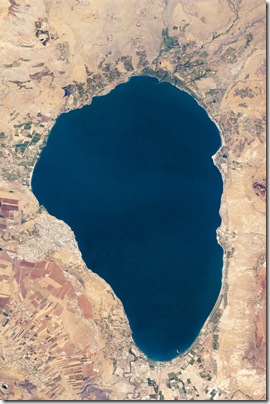
One of my favorite places in Israel is not visited by most tourists.  (Come to think of it, that’s true of most of my favorite places.)  I like tells and I love panoramic vistas.  But I also love to sit back, put my feet in the Sea of Galilee, and relax.  Give me a book or give my kids a raft and it’s all the better.  I’ve probably watched the sun set over the Sea of Galilee from here more than 200 times.

En Gev holiday village from Sea of Galilee, tb101105949ddd En Gev Holiday Village

The place is En Gev, and it hasn’t always been a beautiful holiday resort.  In biblical times, people were settled on the tell in the middle of today’s kibbutz.  Some have identified it as “Lower Aphek.” 

In the 1930s, courageous Jewish pioneers settled this uninhabited area with a “tower and stockade.” 

The compound became a kibbutz, and from 1948 to 1967 residents lived below the Syrian-controlled mountains of the Golan Heights.  Shelling was frequent and bomb shelters became bedrooms.  Since 1967, Israel has controlled the Golan Heights and Kibbutz En Gev has developed a flourishing tourist industry, including the holiday village, tourist boats, and fish restaurant. 

Ein Gev lookout tower with sea beyond, mat03684

En Gev settlement with watchtower. Date of photograph: 1934-39

As you drive along the eastern shore of the Sea of Galilee today, there is relatively little development.  One reason for that is the hostile conditions until 1967 and the uncertainty since then of the Golan Heights’ future. 

The second photograph is one of 600 high-resolution images in the newly released Northern Palestine CD, volume 1 of The American Colony and Eric Matson Collection. Photo: Library of Congress, LC-matpc-03684.

Share:

The Israel Antiquities Authority has announced, with a rather mild headline, the discovery of a synagogue at Magdala (Migdal) dating from 50 B.C. to A.D. 100. I would consider this big news, even though, as far as I can tell, no one is reporting it yet (except Joe Lauer, who always seems to know everything first).

Magdala was the home of Mary Magdalene, one of Jesus’ disciples. That, together with the fact that its location was near the center of Jesus’ ministry (Capernaum, Chorazin, Gennesaret, etc.), makes it quite likely that Jesus visited Magdala. Matthew records that “Jesus went through all the towns and villages, teaching in their synagogues,” and I see no reason that Magdala would be excluded (Matt 9:35; cf. 4:23). Thus it is likely, in my opinion, that Jesus visited this synagogue.
Magdala from above, tb052000203 Magdala from above

This is not the same thing as saying, as they did last year, that “archaeologists have discovered vases of perfumed ointment which may have been used by Mary Magdalene to anoint the feet of Jesus.” 

This is not the first synagogue excavated that Jesus visited. He almost certainly was in (an earlier version) of the Capernaum synagogue, may have been in the Chorazin synagogue (though there is a dating problem), and could have been in the Gamla synagogue. We know of other 1st century synagogues, but it is most unlikely that Jesus visited those at Herodium and Masada, particularly since they were constructed after his death.

The discovery is most significant to me because it puts Magdala “on the map,” so to speak. Before this synagogue was found, visitors would only zip by the site on the highway while a rushed tour guide cried out, “there is Magda…well, too late. It was behind those trees and next to the ferris wheel.” More intrepid explorers could do no better than stand at a fence and look at a few old walls. 

Hopefully these new excavations will give the world a chance to see a portion of this ancient town.

The IAA has three high-res photos you can download (zip file), and the press release begins as follows:

A synagogue from the Second Temple period (50 BCE-100 CE) was exposed in archaeological excavations the Israel Antiquities Authority is conducting at a site slated for the construction of a hotel on Migdal beach, in an area owned by the Ark New Gate Company. In the middle of the synagogue is a stone that is engraved with a seven-branched menorah (candelabrum), the likes of which have never been seen. The excavations were directed by archaeologists Dina Avshalom-Gorni and Arfan Najar of the Israel Antiquities Authority.
The main hall of synagogue is c. 120 square meters in area and its stone benches, which served as seats for the worshippers, were built up against the walls of the hall. Its floor was made of mosaic and its walls were treated with colored plaster (frescos). A square stone, the top and four sides of which are adorned with reliefs, was discovered in the hall. The stone is engraved with a seven-branched menorah set atop a pedestal with a triangular base, which is flanked on either side by an amphora (jars).
According to the excavation director, Dina Avshalom-Gorni of the Israel Antiquities Authority, “We are dealing with an exciting and unique find. This is the first time that a menorah decoration has been discovered from the days when the Second Temple was still standing. This is the first menorah to be discovered in a Jewish context and that dates to the Second Temple period/beginning of the Early Roman period. We can assume that the engraving that appears on the stone, which the Israel Antiquities Authority uncovered, was done by an artist who saw the seven-branched menorah with his own eyes in the Temple in Jerusalem. The synagogue that was uncovered joins just six other synagogues in the world that are known to date to the Second Temple period”.

The full release is here. I don’t know enough yet to comment on the relationship of this newly excavated building to another previously excavated at Magdala which was identified (with controversy) as a synagogue. From the photos and the decoration, there should be little debate as to the function of this building.

Magdala from north, mat07447 Magdala from the north, early 1900s

This photograph is one of 600 high-resolution images in the newly released Northern Palestine CD, volume 1 of The American Colony and Eric Matson Collection. Photo: Library of Congress, LC-matpc-07447 (but currently misidentified there).

Share:

A PhD student has discovered a fragment of Codex Sinaiticus under the binding of an 18th-century book. The parchment contains part of Joshua 1:10 and dates to A.D. 350.

Azusa Pacific University has purchased five Dead Sea Scrolls fragments from a book dealer in southern California. “This acquisition will set Azusa Pacific University apart from all other Christian institutions of higher education in the world,” said Paul Gray, vice provost for graduate programs and research and dean of the University Libraries. As an educator, I think this is a publicity stunt which will do little more than give them bragging rights for recruiting. How about this as an idea for setting apart a school and improving education: build an extension campus for your students in Israel.

CNN carries the story of the Middle Bronze passageway discovered in Jerusalem, together with a 2.5 minute video that includes interviews with archaeologists Reich and Shukrun.

A carved stone with Egyptian signs from the First Dynasty has been discovered at Tel Bet Yerah (Khirbet Kerak) on the southwestern shoreline of the Sea of Galilee (photos here).

HT: Joe Lauer and Ferrell Jenkins

UPDATE (9/11): NPR has a 4-minute radio interview of Ronny Reich (with written transcript)

Share:

Today visitors to Capernaum are impressed by the white limestone remains of an ancient synagogue. 

Archaeological excavations indicate that this synagogue was built over the remains of an earlier synagogue dating from the time of Jesus.  Thus we can say with some measure of confidence that this is the place where Jesus healed the demon-possessed man (Mark 1:21-28) and preached the sermon on the bread of life (John 6:25-59).

Capernaum synagogue from Peter's house, tb060105618

Capernaum synagogue, view from Peter’s house, present day

Visitors may not be aware that the synagogue did not survive in this condition since ancient times. 

The photograph below shows what the synagogue looked like in the early 1900s.  The staircase in the foreground of the photo below is on the far right (middle) of the photo above.

Capernaum, ruins of synagogue, mat10654sr

Capernaum synagogue, early 1900s

The second photograph is one of 600 high-resolution images in the new Northern Palestine CD, volume 1 of The American Colony and Eric Matson Collection. Photo: Library of Congress, LC-matpc-10654.

Share:

The University of Haifa has announced some discoveries from its 2009 season of excavations at Hippos/Sussita, reported in a press release (Hebrew) and in an English article in Ha’aretz

Remains of an ancient cult to the goddess of love have come to light in the southern Golan Heights site of Susita.
At the site, on a 350 meter-high-plateau overlooking the eastern shore of Lake Kinneret, archaeologists found a cache of three figurines of Aphrodite (whom the Romans called Venus), dating back about 1,500 years. The figurines, made of clay, are about 30 centimeters tall. They depict the nude goddess standing, with her right hand covering her private parts – a type of statue scholars call “modest Venus.”

I’m personally more interested in another find, described at the conclusion of the article:

Another special find at Susita is an odeon – a small, roofed theater-like structure with seats for about 600 people, uncovered for the first time in Israel, according to the excavators. They said such structures were fairly common in the Roman period and were used for the reading of poetry and musical presentations to a select audience, in contrast to theaters, which could seat around 4,000 people.

The claim that this is the first odeon discovered in Israel is not true; another has been excavated at Aphek/Antipatris (NEAEH 1: 71, with photo).

The press release includes several photos.

HT: Joe Lauer

Share:

I am very excited to announce the release of a new photo collection from BiblePlaces.com and LifeintheHolyLand.com.  The American Colony and Eric Matson Collection includes more than 4,000 high-resolution photographs taken by professional photographers living in Jerusalem from 1898 until the 1940s.  I’ve worked with a team for the last five years organizing and improving this collection so that the photos are the highest quality, accurately identified, carefully organized, and elucidated by observations of well-known 19th-century explorers.

The collection spans 8 CD volumes and is being released one volume a month beginning this week. 

Volume 1 is “Northern Palestine,” and it includes 600 photos organized in the following categories:

  • Acco (11 photos)
  • Benjamin (43 photos)
  • Caesarea (31 photos)
  • Caesarea Philippi (14 photos)Northern Palestine CD cover
  • Ephraim and Manasseh (34 photos)
  • Galilee Hill Country (20 photos)
  • Haifa (27 photos)
  • Huleh Basin (12 photos)
  • Jaffa (51 photos)
  • Jezreel Valley (47 photos)
  • Mount Carmel (15 photos)
  • Mount Hermon (20 photos)
  • Mount Tabor (12 photos)
  • Nazareth (32 photos)
  • Samaria city (19 photos)
  • Sea of Galilee (41 photos)
  • Sea of Galilee, Capernaum (31 photos)
  • Sea of Galilee, Tabgha (15 photos)
  • Sea of Galilee, Tiberias (39 photos) – free PowerPoint here
  • Sharon Plain (17 photos)
  • Shechem area (22 photos)
  • Tel Aviv (43 photos)

All images are included in high-resolution jpg format as well as in annotated PowerPoint files.  The cost for the CD is now only $20, with free shipping in the U.S.  While volumes 2-8 are not yet available individually, the complete collection is available in DVD format for $99.


I believe this is the finest collection of historic photographs of the Middle East available anywhere in any format.

You can read more about the collection here:

Volume 1: Northern Palestine

Complete Collection: Volumes 1-8

As with everything we do, the goal is your complete satisfaction.  If you don’t like it or need it, return it for a full refund.  If you do like it, we would really appreciate it if you’d pass the word on.  Review copies are available by request.

I plan to post on this blog some interesting images from the CD over the next few weeks.

Nazareth and Mt Tabor, mat05532 Nazareth with Mount Tabor in the distance
Date: between 1900-1920
Share: