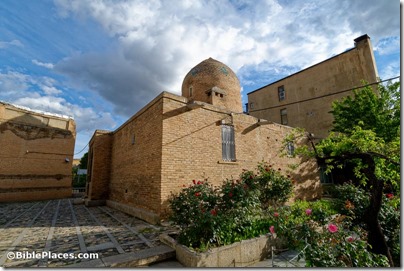
Aaron’s tomb in Jordan will re-open to Israeli tourists after the site was closed following a group that allegedly prayed there.

A researcher claims that the world’s oldest chess piece was discovered in Jordan.

Sara Toth Stub explains what happened to Petra after it was abandoned by the Nabateans.

It’s not clear where Egyptians came up with five million African sacred ibises, but a DNA study shows that they were not raised in breeding farms.

Archaeologists have discovered five lion mummies in excavations in Saqqara.

3-D scans of the bust of Nefertiti are now available online.

The Ilisu dam will soon flood Hasankeyf, one of the oldest known and continuously inhabited settlements in the world.

The Central Baths at Pompeii have now been opened to tourists.

A reconstruction of the god Moloch is part of an exhibit on Carthage in Rome.

Cyrus, king of Persia, is the latest subject in Bryan Windle’s series of bioarchaeographies.

Save the date: the annual conference of the Institute of Biblical Context, now redubbed the Infusion Bible Conference, will be held on June 8 to 10, 2020 in west Michigan. The topic is “Paul and His Roman World.”

Gift subscriptions are now available for Walking the Bible Lands.

HT: Agade, Joseph Lauer, Explorator, Keith Keyser

Share:

There will be no roundup next weekend, but if you’re at ETS or SBL, stop by the BiblePlaces booth and say hello to me, A.D., Kris, Chris, and Christian. Kaelyn, Charity, Caden, and Mark will be around as well. I’ll be presenting a couple of papers at ETS, so you’re invited to attend if you’re interested in the archaeology of Esther or the chronology of David. The complete program is online here.

Meg Ramey describes her walk along the route from Troas to Assos, following in Paul’s footsteps.

Professor Aykut Çınaroğlu has been buried in the cemetery next to his excavation site of Alacahöyük, according to his request in his will.

Climbing the pyramids and other “thuggish acts toward Egyptian antiquities” are now illegal and will result in imprisonment or a fine.

Three shipwrecks from ancient and mediaeval times and large sections of their cargoes have been discovered off the small Aegean island of Kasos.”

Excavations on the Greek islet of Chryssi south of Crete have uncovered large quantities of murex shells.

Lucas Grimsley writes about his experience in excavating in Cyprus.

Brent Davis talks about the challenges of trying to crack Linear A.
“Entering Early Christianity via Pompeii” is a resource from The University of Manchester to provide a “virtual guide to the world of the New Testament.” It looks interesting.

St John Simpson of the British Museum explains how they work with law enforcement to fight antiquities looting.

The Jerusalem Post explains the significance of the Washington Pentateuch.

“The National Library of Israel (NLI) and Google have announced that 120,000 books from the library’s collection will be uploaded to Google Books for the first time as part of their collaboration.”

The Gustav Jeeninga Museum of Bible and Near Eastern Studies at Anderson University is being re-opened after being re-located.

The NY Times has a story on this week’s re-opening of the University of Pennsylvania Museum of Anthropology and Archaeology.

New book: The History and Archaeology of Phoenicia, by Helene Sader ($50).

Eisenbrauns has a sale of 40-50% off selected festschriften.

HT: Agade, Charles Savelle, Keith Keyser, Explorator

Share:

Leen Ritmeyer has written an informative and well-illustrated post on the significance of Shiloh and the recent excavations. Ritmeyer’s reconstruction drawings are available for purchase in his image library, including his new drawing of Shiloh.

A government committee in Jerusalem has authorized the construction of a cable car to the Dung Gate.

A $37 million visitors’ center has been opened at the Huleh Valley Nature Reserve.

Anthony Ferguson shares 5 surprising details about the discovery of the Dead Sea Scrolls from Weston Fields’ history.

“The only project agreed on by Israel and Jordan that could possibly, in the foreseeable future, help save the Dead Sea from further shrinkage is stuck in a byzantine web of politics, bilateral tensions and Israeli foot-dragging.” This is a well-researched article on a subject frequently in the news.

Excavations have resumed at Tell Ziraa in Jordan, with the recent discovery of an Iron Age house with several dozen loom weights.

Colin Cornell considers whether the Jews living in Elephantine worshipped a goddess in addition to Yahweh.

Egyptian authorities have announced the discovery of a cemetery in Ismailia that dates to the Roman, Greek, and pre-dynastic eras.

The October issue of the Newsletter of the Egyptian Ministry of Antiquities is online.

History Magazine has the story of how Howard Carter almost missed King Tut’s tomb.

Two vast reproduction Assyrian statues were unveiled in Iraq on Thursday as part of a project designed to restore the cultural heritage of Mosul.”

Wayne Stiles explains the significance of the Arch of Titus and the relevance of an olive tree planted beside it.

“A team of international scholars versed in culinary history, food chemistry and cuneiform studies has been recreating dishes from the world’s oldest-known recipes.”

In a 10-minute video, David McClister explains who Flavius Josephus was.

On sale for Kindle:

Tim Bulkeley has died. He began his biblioblog in 2004 and was a regular encouragement to me over the years. He will be missed.

HT: Agade, Charles Savelle, Keith Keyser

Share:

The Tel Moza website gives details for joining the spring excavation as well as background about recent discoveries.

A family volunteering at an excavation in Lower Galilee discovered remains of an iron industry from the 6th century AD.
 
Some of the latest discoveries from Shiloh are described in a somewhat disjointed article in the Jerusalem Post.
 
The “Tomb of the Kings” in Jerusalem has been reopened to visitors (again) by France, which owns the site. Access is allowed only to the outer courtyard.
 
Naama Sukenik explains how new technology is being used to provide insights into counterfeiting dyes in the ancient textile industry.
 
Mark Barnes looks at the significance of the Mount of Olives in the Bible, including some interesting comparisons and contrasts between David’s and Jesus’s time there.
 
Who is Gallio and why is he so important to New Testament history? Bryan Windle explains in a well-illustrated article.
 
The “world’s oldest natural pearl” has been discovered in excavations on an island near Abu Dhabi.
 

“Ancient Assyrian stone tablets represent the oldest known reports of auroras, dating to more than 2,500 years ago.”

“Life at the Dead Sea” is a new exhibit about the cultural history of the lowest place on the planet that recently opened at the State Museum of Archaeology Chemnitz.

An exhibit of Egypt’s southern neighbor, “Ancient Nubia Now,” is on display until January 2020 at the Museum of Fine Arts in Boston.

Sculptures from the Torlonia Collection will go on public display for the first time ever at the Capitoline Museums in Rome beginning in March.
 
The Washington Pentateuch is going on display at the Museum of the Bible.
 
The archaeological museum in Basra is adding English labels in hopes of welcoming more international visitors.
 
Jaafar Jotheri provides an overview of excavations in Iraq in the last year.
 
A conference will be held at the Louvre on November 25 on Tappeh Sialk: A Key Site for the Archaeology of Iran.
 
Farrell Monaco will be lecturing on “Dining with the Romans” at the Walters Art Museum on November 10.
 
4,500 tourists watched the sun illuminate the face of Ramses II in the temple of Abu Simbel.
 
Wayne Stiles is leading a tour of Israel (and pre-tour to Egypt) in October 2020.
 
There will be no roundup next weekend.
 
HT: Ted Weis, Mike Harney, Joseph Lauer, Keith Keyser

Share:

Wayne Stiles just walked the last five miles of the Appian Way into Rome, and he shares his experiences along with a video. Only one section was a hair-raising experience!

A preliminary report from the Swedish excavations at Hala Sultan Tekke in Cyprus is now online.

Israeli security inspectors discovered 69 coins from the time of Alexander the Great being smuggled from Gaza into Israel. But one expert suggests the coins are fake.

The Summer Session program of the American School of Classical Studies at Athens is now accepting applications. Scholarships are available.

Why do newspapers write dishonest headlines like this? “A Chance Discovery Changes Everything We Know About Biblical Israel.” Shame on Haaretz.

The lectures are in Hebrew, but you may find the topic list to be of interest for this year’s “New Discoveries and Insights” conference at Tel Aviv University.

The schedule is now online for next week’s Annual Conference, “New Studies in the Archaeology of Jerusalem and its Region.”

The final list of speakers and their topics for the 22nd Annual Bible and Archaeology Fest is now posted.

Yahoo Groups is shutting down. This will affect lists such as Explorator and ANE-2.

The En-Gedi Resource Center website has a new home, with new organization and a “Hebraic Studies” search bar to make it easier to find what you’re looking for.

Carl Rasmussen shares a number of photos of Göbekli Tepe.

John DeLancey is blogging each day on his tour of Greece, Rome, and Pompeii, now wrapping it up on Day 13.

Ferrell Jenkins explains why a photo he took of the cedars of Lebanon in 2002 is one of his favorites.

Bryan Windle has put together another great archaeological biography, this one on King Nebuchadnezzar.

HT: Ted Weis, Keith Keyser, Agade

Share:

Amanda Borschel-Dan of The Times of Israel provides a valuable summary of the Siloam Street/Stepped Street/Pilgrim’s Path that has been in the news for the last decade or so. One particular point of interest: the street will not be fully opened to the public for a few more years, because it is still being excavated 7am to 10pm every day.

“Archaeologists have uncovered a well-preserved fresco of two fighting gladiators in the ancient Roman city of Pompeii.” Very nice.

“Scientists report that they may have found the earliest written record of a solar storm in ancient Assyrian tablets.”

Egypt announced the discovery of 20 well-preserved wooden coffins in Luxor.

“Archeologists working in Luxor’s “Valley of the Monkeys” have discovered an “ancient ‘industrial area’ once used to produce decorative items, furniture and pottery for royal tombs.”

The Egyptian Exploration Society has formally accused Oxford professor Dirk Obbink of stealing and selling papyri fragments from the Oxyrhynchus collection.

With Saudi Arabia opening up for tourism, tour agencies are quick to create tours to scam evangelicals.

The Arab World Institute in Paris is presenting an exhibition highlighting the pre-Islamic history of the Al ‘Ula region in Northwest Saudi Arabia.

Tim Frank’s “Visualizing Food Storage in Ancient Houses” article includes a number of video visualizations from sites like Izbet Sartah, Tel Batash, and Beersheba. These could be quite useful.

A new record has been set in the “world’s oldest marathon,” a race from Aphek to Shiloh.

Wildlife inspectors spotted ten bottlenose dolphins off the coast of Israel and have posted footage.

Only 30-40 acacia gazelles survive in Israel, and rangers recently discovered a fawn had been born.

“Cruise passengers held their breath as a 22.5 meter wide cruise liner became the largest boat to pass through Greece’s narrow Corinth Canal.” There are some nice pictures.

HT: Ted Weis, Keith Keyser, Agade, David Padfield

Share: