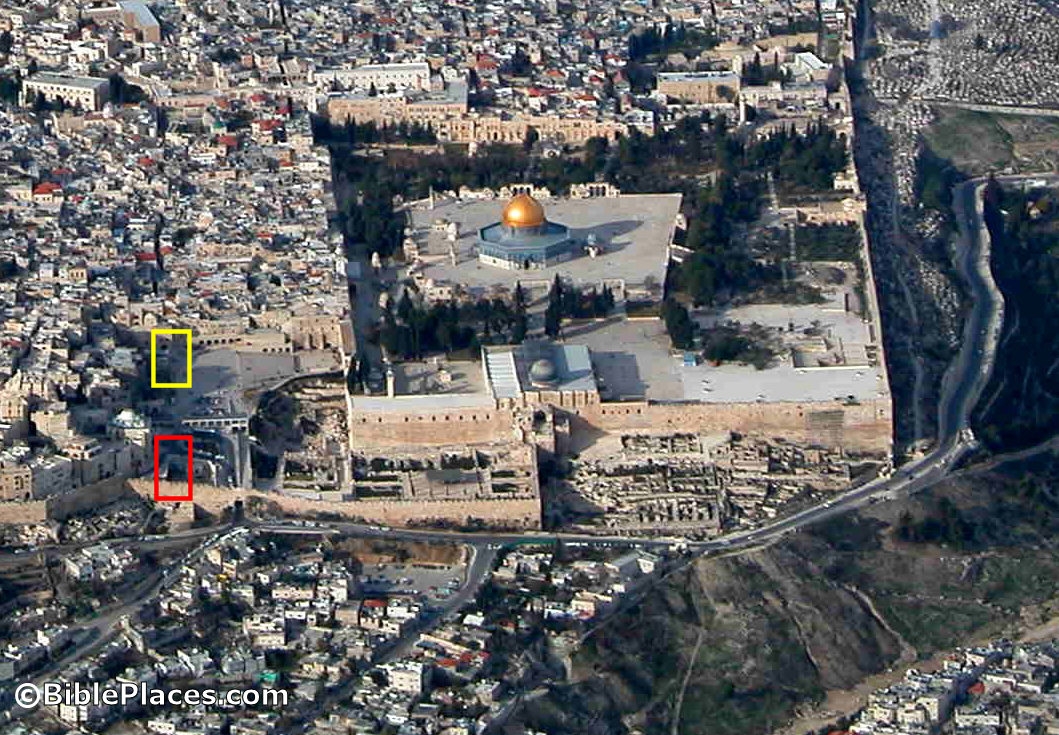
Gordon Govier has an excellent article on Eilat Mazar and her work in Jerusalem over the last 20 years. Though sympathetic to this secular defender of the Bible, Govier cites some of her detractors and describes the latest twist.

According to provisional results, the Dead Sea did not receive enough votes to be named one of the New 7 Wonders of Nature.

Donald Brake is writing a series of articles on the life of Jesus in the Holy Land. This week’s article in the Washington Times explains how one can evaluate the accuracy of tradition, specifically in connection with the Church of the Nativity in Bethlehem.

Joe Yudin has a good column this week on Mount Gilboa, though I cannot agree that the witch knew the future.

This week’s radio program LandMinds with Barnea and David features interviews with the president of ASOR Tim Harrison, Yisrael “Winky” Medad, and Israel Finkelstein.

Forward reviews the Dead Sea Scroll exhibit currently in New York City.

Dan Bahat explains the political nature of archaeology in an interview with the Canadian Jewish News.

The Hagia Sophia may become a mosque again.

Every day 35,000 tons of raw sewage flow down the Kidron Valley from Jerusalem, according to a video report in the Jerusalem Post.

Israeli scientists are growing trees in the Arabah in order to improve the environment.

The Biblical Archaeology Society has announced its 2011 Publication Awards Winners for Best Scholarly Book on Archaeology, Best Popular Book on Archaeology, Best Book Relating to the Hebrew Bible, and Best Book Relating to the New Testament.

HT: Jack Sasson, Joseph Lauer

Share:

Ancient Israel: Highlights from the Collections of the Oriental Institute University of Chicago is a new 127-page publication written by Gabrielle Vera Novacek and illustrated with 66 beautiful photographs and diagrams. The book is available for pre-order from Amazon or as a free download (pdf).

Six lectures in Hebrew are now online from the 12th Studies of Ancient Jerusalem conference held in September in the City of David. The speakers included Israel Finkelstein, Ronny Reich, Gabriel Barkay, Asher Grossberg, Eli Shukron, and Yosef Garfinkel.

“Libya’s famed ancient Roman sites, including the sprawling seaside ruins of Leptis Magna, were spared damage by NATO during the recent airstrikes, says a London-based Libyan archaeologist.”

Muslims continue to bury their dead next to the eastern wall of the Temple Mount, according to the Committee to Prevent the Destruction of Temple Mount Antiquities.

The head of the Supreme Committee of the Grand Egyptian Museum was fired this week.

“Ultra-Orthodox young men curse and spit at Christian clergymen in the streets of Jerusalem’s Old City as a matter of routine.” Last week a judge ruled in favor of an Armenian seminary student who fought back.

HT: Daniel Wright, Jack Sasson, ANE-2, AWOL

Share:

Joseph Patrich provides a great survey of what we know about Caesarea Maritima from archaeological excavations.

Ferrell Jenkins has written a couple of illustrated posts on Saint Catherine’s Monastery in the Sinai Peninsula.

The IAA has more information about the Byzantine prayer box discovered in the City of David (aka
“Walls around Jerusalem” National Park).

The West Semitic Research Project has made three RTI images available to BAR readers to view without requiring registration. (Background here.)

Wayne Stiles transports his readers to the Mount of Beatitudes in the spring.

You can now register for the 2012 season at Gath. This is one of the most popular excavations in the world.

The ancient mikveh discovered near Zorah is the subject of a 1.5 minute video at the Jerusalem Post.

A bill submitted to Israel’s parliament “aims to preserve the Dead Sea and its internationally treasured natural resources, maintain the salty waters for the benefit of the next generation, curb the plunging water levels of the northern basin and determine new terms of management for the region, which will provide for continued reasonable extraction of minerals while protecting the ecosystems and biodiversity.”

Israel’s Knesset has refused to declassify the Temple Mount Report. “Shin Bet officials argued the report should remain confidential on the grounds its contents were sensitive and its publication could result in confrontations and geopolitical changes at the site.”

A scholar claims that the number of ancient stone wheels visible only from the sky may number more than a million. Google Earth is now being used to identify these throughout Syria, Jordan, and Saudi Arabia.

Iraq has budgeted $8.5 million to develop the infrastructure at the ancient city of Babylon.

HT: Joseph Lauer, Jack Sasson

Share:

A miniature prayer box from the 6th-7th centuries was discovered recently in the excavations in the Central Valley south of the Dung Gate of Jerusalem.

Haaretz: “The High Court of Justice yesterday criticized the agreement by which a private association, Elad, operates the City of David national park in Jerusalem, but said the agreement was legal.” One potential change to the agreement would open the site to tourists on Shabbat. The Jerusalem Post covers the story here.

A local watchman of the lower Herodium sued archaeologist Ehud Netzer days before his death.

Recent court proceedings rejected all of the plaintiff’s claims and observed that the watchman had been extorting the archaeologist for years. The article is in Hebrew, with a Google translation here.

China will help build a railway to Eilat. Israeli officials hope that this boosts tourism to the Red Sea resort city.

Time Magazine gives five reasons to visit Beirut.

“The largest collection of biblical artifacts ever displayed outside Israel” opened yesterday in New York City.

Shmuel Browns gives readers a tour of the four sites run by the East Jerusalem Development Company: Ramparts Walk, Roman Plaza, Zedekiah’s Cave, and the Davidson Archaeological Park.

Joe Yudin recommends hiking to Ein Akev in the Negev Highlands. (Am I the only one offended that the Jerusalem Post publishes material with very basic mistakes in English grammar?)

Peter Williams’ lecture on “New Evidences the Gospels Were Based on Eyewitness Accounts” primarily discusses data from recent studies of names, but he also includes a geographical section in minutes 36-42 of this Lanier Library Lecture now posted at Youtube. (He shares a photo from BiblePlaces.com, but by using a low-res web version his viewers have a hard time making out what he’s trying to show.)

HT: Joseph Lauer, Yitzhak Sapir, A.D. Riddle

Share:

In follow-ups to yesterday’s story, Nadav Shragai writes that the Mughrabi Bridge must be built. The city engineer is threatening to destroy the temporary bridge. The Muslim Waqf says that they are sovereign over all.

A preliminary report from excavations at Gezer from 2006-2009 is now online. Elsewhere excavator Sam Wolff writes that they are a season or two away from floor levels associated with the (Solomonic) six-chambered gate.

Jerusalem plans to develop an extensive archaeological site 30 feet (10 m) below the plaza at Jaffa Gate in order to share with the public a 220-foot (70-m) aqueduct, a Byzantine bathhouse, and other remains.

Haaretz’s Week’s End has an interesting article on the Cairo Geniza and ambitious plans to digitize all 350,000 fragments.

A couple of Tel Aviv archaeologists would like to move some of historic Jerusalem from the City of
David to the Rephaim Valley. Lipschits and Na’aman have proposed that the King’s Garden was located not where the Kidron and Hinnom Valleys meet but on one end of Emek Refaim Street in west Jerusalem.

The Oriental Institute in Chicago will run an exhibit entitled “Picturing the Past: Imaging and Imagining the Ancient Middle East” from February 6 to September 2, 2012.


A Biblical Chronology from Abraham to Paul is a new book by Andrew E. Steinmann. Justin Taylor has links to his OT and NT Chronologies as well as a 48-page excerpt from his book. It seems to agree with standard conservative views except that Jesus was born in 1 BC. [Note: be prepared for sticker shock. Perhaps you can ask your library to purchase a copy.]

Israel’s Ministry of Foreign Affairs has begun a list of Archaeological Excavations in 2012.

A photograph of McDonalds at Masada has prompted the site archaeologist to write an article in Haaretz. The photogapher [sic] has rejected the charges.

Thousands of people pass by the place where the ark of the covenant rested every day. Wayne Stiles explains the significance of Kiriath Jearim (and, unlike most, he gets the chronology right!).

The Big Picture celebrates Sukkot.

Israel’s prime minister and education minister are urging everyone to vote for the Dead Sea as one of the New 7 Wonders of Nature. The Dead Sea is one of 28 finalists. Voting ends on November 11.

HT: Joseph Lauer, Jack Sasson

Sunrise over Dead Sea at En Gedi, tb021906180

The Dead Sea at sunrise
Share:

The bridge from the Western Wall plaza to the Temple Mount has been in the news frequently since the collapse of the earthen embankment in 2004. Arutz-7 reports on the latest in the saga:

Jerusalem’s engineer demands that the ”Mughrabi” bridge for Jews to the Temple Mount be repaired or closed because of dangers.
The complaint of its stability could not come at a worse time for Israel. The bridge, also known as the Rambam Gate, has been a potential explosive subject involving Israel, the Palestinian Authority and Jordan.
Jerusalem engineer Shlomo Eshkol wrote a letter to the Western Wall Heritage Foundation and demanded that the safety hazard in the temporary structure be fixed within 30 days. Although “temporary,” the structure has existed for several years after the collapse of the old permanent bridge.
Eshkol said authorization for a new bridge was granted last May, but action has been stalled because all parties involved disagree over who has the authority to tear down the current bridge and finance a new one.

The story continues here. For background, see here and here.

Ramp from Western Wall prayer plaza to Temple Mount
Share: