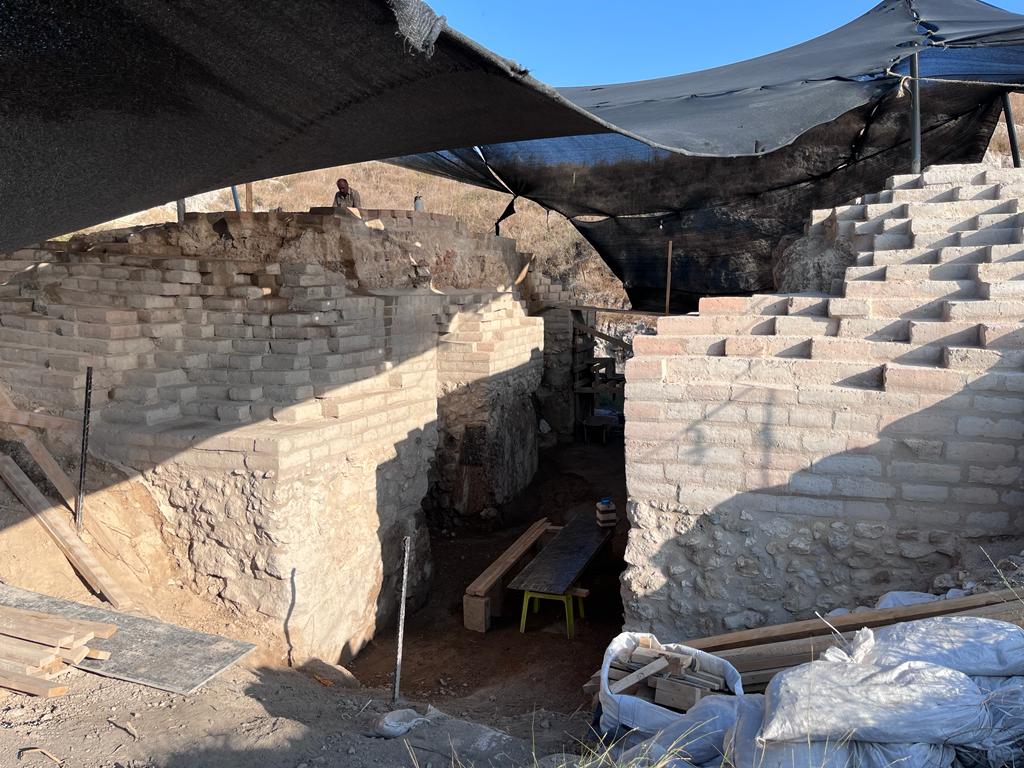
Haaretz has an update on the season at el-Araj (Bethsaida?) that just concluded. “The archaeologists are not saying they found the house of Peter. They are saying they found a Byzantine basilica that goes back earlier than thought, to the late fifth century, that was built over a ‘venerated wall’ that the builders presumably thought had belonged to the house of Peter. It didn’t, but the wall next to it may have.”

According to a new article in the latest issue of Biblical Archaeology Review written by Chris McKinny and friends, the Millo of Jerusalem was not an earth filling on the slopes of the City of David but the “Spring Tower” guarding the Gihon Spring. The full article is currently available online to all.

Leen Ritmeyer reports on some inscriptions recently discovered inside the Golden Gate in Jerusalem.

Now on Academia: Leen Ritmeyer’s article, “Imagining the Temple Known to Jesus and to Early Jews,” published in The Temple of Jerusalem: From Moses to the Messiah, edited by Steven Fine (Brill, 2011, $227).

The latest issue of Tel Aviv is now available, with several open-access articles including:

In the final episode of the Flora & Faith series, Brad Nelson goes to the wilderness and considers the role of the rotem tree in the story of Elijah. A free study guide for the entire series is also available.

Up to 50,000 bronze coins from the 4th century AD have been discovered off the coast of Sardinia. The coins are in excellent condition.

“Investigators say they have figured out how bronze statues from a shrine built 2,000 years ago in Asia Minor to venerate the emperors of Rome ended up in museums around the world.”

The second set of fully lemmatized Amarna letters has been released on Oracc. “The online edition of the Amarna Letters aims to make transliterations, translations, and glossaries of the letters and administrative texts available to both scholars and the wider public. At this time, the project comprises 305 texts.”

Jonathan Tubb, archaeologist and curator at the British Museum, died in September.

New release: Representations of Writing Materials on Roman Funerary Monuments: Text, Image, Message, edited by Tibor Grüll (Archaeopress, £16-40)

The Albright has a number of fellowships, awards, and internships available for next year. The application deadline is December 1.

This week we released two new volumes in the Photo Companion to the Bible series: Ezra and Nehemiah. These historical books have all kinds of illustrative potential, such that we have on average nearly 200 slides per chapter. They are on sale right now as a set for only $59. We are grateful for the positive response by many, including Luke Chandler, Leon Mauldin, and Charles Savelle.

HT: Agade, Arne Halbakken, G. M. Grena
A team of archaeologists “has found the oldest-known example of the use of organic red pigments to color an object—in this case, beads” discovered in a cave on Mount Carmel.

Expedition Bible tackles the question of where Jerusalem’s Temple Mount is (and where it is not). I’m glad to see them address this issue in light of much foolishness which is circulating.

The Israel Antiquities Authority presented an online lecture series this week, “We Will Not be Defeated: From Crisis to Revival in the Archaeology of the Land of Israel.” All are available on the IAA’s Facebook page:

In the newest episode in the Flora & Faith series, Brad Gray looks at the Atad tree, central to Jotham’s parable in Judges 9.

Exhibition at the Met: Maxime Du Camp’s Photographs of the Eastern Mediterranean and North Africa

Thomas West has created a list of the “25 best movies set in the ancient world.”

A statue of Cyrus the Great will be unveiled in Atlanta today.

HT: Agade, Arne Halbakken, Charles Savelle, Ted Weis, Explorator, Paleojudaica

Aren Maeir writes about the situation in Israel and how you can help.

A pair of scholars argue that “Azekah is the new name of Moresheth-Gath given to the city by Judahite rulers after taking control of the western Shephelah, not before the end of the ninth century BCE.”

“For the first time, ancient DNA has been recovered from the bodies of ancient Israelites living in the First Temple period.”

In his first Q&A, Chandler Collins answers questions about Jerusalem’s monasteries, the “palace of David,” and a proposed bema seat of Pilate.

In part 4 of the Flora and Faith series, Brad Nelson explains why Paul used the olive tree to explain the relationship between Jews and Gentiles in the church.

An article I wrote on Solomon’s coronation and coregency has been published in the Detroit Baptist Seminary Journal. I argue that there were three stages in his coronation and that there is no foundation for a two-year coregency.

Andy Naselli has collected some of the better videos of reconstructions of the tabernacle, Solomon’s temple, and Herod’s temple.

The Arch of Titus, built to celebrate the destruction of Jerusalem, was lit up this week in blue and white in solidarity with Israel.

HT: Agade, Ted Weis, Arne Halbakken, Explorator

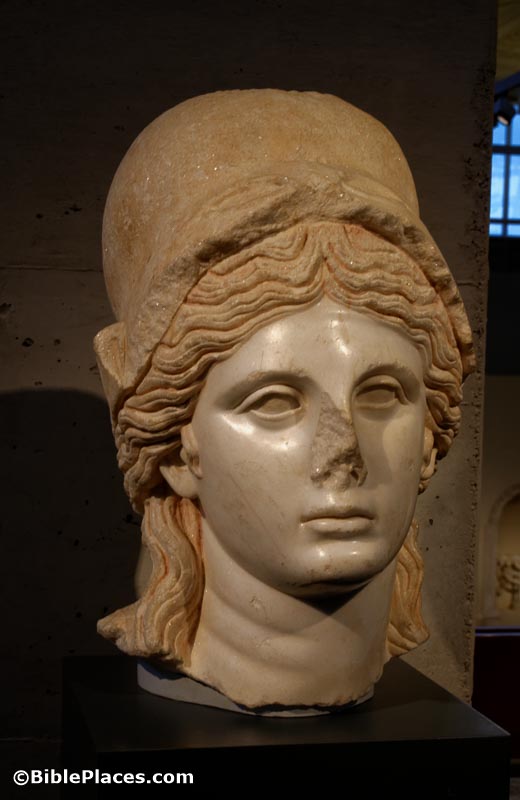
An American damaged several ancient Roman statues in the Israel Museum because they are “blasphemous” and “in violation of the Torah.” See below for a pre-attack photo of one statue (and see tomorrow’s roundup for another).

“Close to 1,000 Levites from around the world converged on Jerusalem’s southern wall near the Western Wall to partake in a momentous reenactment of the ancient Levitical choir of the Temple.” The story includes a couple of short videos.

“Some 10,000 people marched to Joshua’s Altar on Mt. Ebal on Monday to demand protection for archaeological sites in the West Bank and protest against declarations of sites in the West Bank as ‘Palestinian heritage sites.’”

Paleojudaica shows how headlines gradually sensationalized the discovery of (what is now) Alexander the Great’s escort.

A new video from Bible Scenes tours 50 different areas of the virtual 3D model of Herod’s Temple Mount. The timecodes make it easy to jump to any gate, courtyard, chamber, etc. Very impressive.

Aleteia has a list of the mosaic panels discovered in the Huqoq synagogue excavation.

An inscription discovered in Jerusalem suggests that there was a guild of artisans that called themselves the “sons of Daedalus.”

Olivier Poquillon is the new director of the École Biblique in Jerusalem.

Israel Museum Studies in Archaeology Occasional Publications 1 features an iconographic study of the fresco in the Abbey of the Tomb of Mary in the Valley of Jehoshaphat, within the socio-cultural context of Crusader Jerusalem.

The Codex Sassoon, purchased for $38 million in a recent auction, has arrived at the ANU Museum in Tel Aviv.

The Book and the Spade pulls out of the archive a 1996 interview with Anson Rainey about the House of David Inscription in context.

In celebration of his 45th wedding anniversary, Leen Ritmeyer shares how he met Kathleen and their early work together in the Byzantine monasteries in the Judean wilderness. He includes many photos and drawings.

HT: Agade, Ted Weis, Arne Halbakken, Charles Savelle, Explorator

Head of Athena from Tel Naharon, 2nd century AD; as displayed in the Israel Museum before this week’s vandalism

New excavations at Hyrcania have already turned up an inscription in Greek adapted from Psalm 86.

“A cave containing the remains of a young woman who was likely a courtesan during the Hellenistic period has been discovered near Hebron Road in Jerusalem, along with a well-preserved, rare bronze mirror.”

Gershon Galil claims that he has deciphered a fragmentary inscription from the time of Hezekiah that was discovered in Jerusalem forty years ago (Hebrew version here). (I wouldn’t recommend trusting Galil’s judgment on anything these days. So far the story is only covered by Ynet; if other outlets cover this, they will surely include responses from other scholars.)

Archaeologists have made new and interesting finds at the ancient submerged Egyptian city of Heracleion.

This one-minute video shows how cuneiform tablets were formed from clay and inscribed.

In the newest episode in the Flora & Faith series, Brad Gray explains the symbolism of the almond tree in Scripture.

The latest episode in “Faith Journeys with God in the Land” with John DeLancey was filmed at the Pool of Siloam earlier this year.

Erez Ben-Yosef was on the What Matters Now podcast to discuss his theory about the beginnings of the United Monarchy. The Times of Israel article includes a transcript.

Zoom lecture on Oct 5: “Maritime Viewscapes and the Material Religion of Levantine Seafarers,” by Aaron Brody ($13). Brody has written an article on the ASOR Blog on the same topic.

Zoom lecture on Oct 19: “Archaeology of Jesus’ Nazareth,” by Ken Dark. Registration required.

Biblical Archaeology Report has a rundown on the top three discoveries of the month.

Ferrell Jenkins shares some experiences and photos from his visits to Mount Nebo.

Sukkot, the Feast of Tabernacles, the seventh and final commemoration in the biblical calendar, begins today. TheTorah.com has an article on the etrog as the fruit of the tree of the knowledge of good and evil.

HT: Agade, Ted Weis, Joseph Lauer, Arne Halbakken

Archaeologists discovered a Second Temple period stonemason’s workshop near Jerusalem.

“A United Nations conference voted Sunday to list ruins of the ancient West Bank city of Jericho as a World Heritage Site in Palestine.”

The Temple Mount Sifting Project blog provides a glimpse into the difficulties of protecting the debris that is the focus on their study.

“The ongoing excavation of Horvat Midras/Khirbet Durusiya (Israel) provides an opportunity to study changes in the ethnic and religious makeup of a rural settlement in the ancient southern Levant.”

David Moster explains how tall the Jerusalem temple was by comparing it with other large monuments including the Dome of the Rock. He even found a classical-style building with very similar dimensions to Solomon’s temple.

Jerusalem Post: “Is the biblical ark of the covenant hidden in an Ethiopian church?”

Zoom lecture on October 24: “The Austrian Expedition to Tel Lachish 2017–2023,” by Katharina Streit and Felix Höflmayer.

Registration is open for next year’s excavation season at Shiloh.

HT: Agade, Joseph Lauer, Arne Halbakken

Middle Bronze gate at Gezer during reconstruction. Photo taken by John Black on Tuesday.