Haaretz:

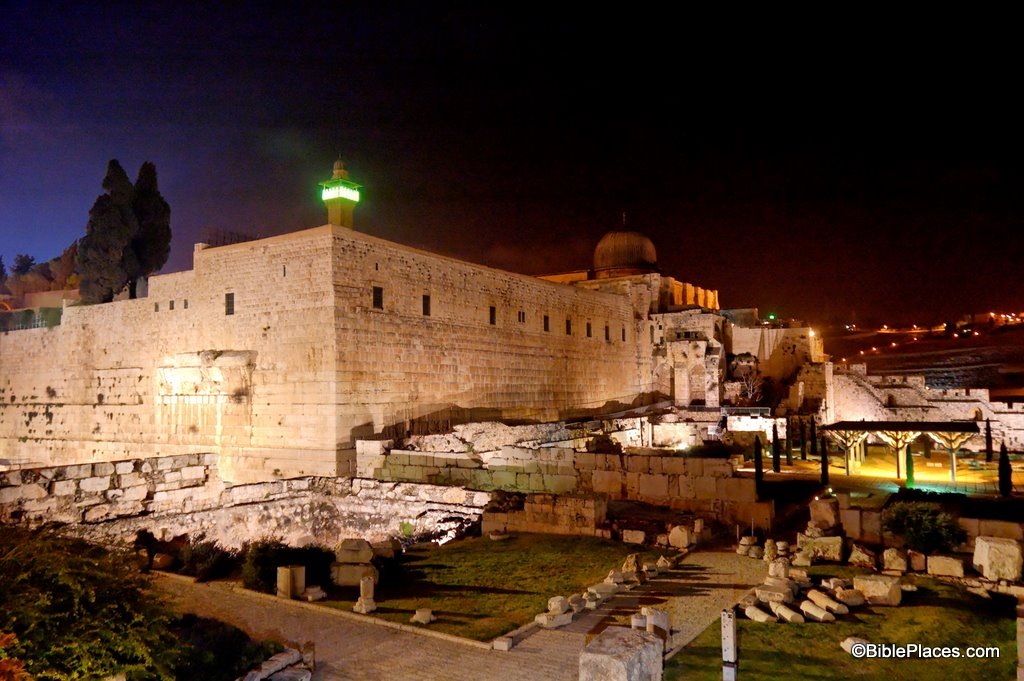
Israel’s leading ultra-Orthodox rabbis are waging a new offensive against Jews visiting Jerusalem’s Temple Mount.
Rabbis Shalom Elyashiv, Chaim Kanievsky and Ovadia Yosef sent a letter recently to Rabbi Shmuel Rabinovich, the overseer of holy places in the Western Wall complex, urging him to reiterate the religious decree signed 40 years ago by most rabbis in Israel forbidding Jews from entering the Mount.
The rabbis’ efforts follow the publication in Haaretz last month of the visit of Rabbi Moshe Tendler, the son-in-law of prominent U.S. rabbi Moshe Epstein, to the Temple Mount.
Rabbi Tendler was photographed visiting the plaza atop the Mount, where the Dome of the Rock Islamic shrine now sits, igniting a firestorm of controversy in the ultra-Orthodox community. Several other prominent ultra-Orthodox rabbis have ascended the Mount in recent years, including Rabbi Dov Kook of Tiberias, the husband of Elyashiv’s granddaughter.
The rabbis’ statement calls for a complete ban on entering any part of the Temple Mount complex for fear of compromising the “purity” of the area.
The declaration stated that “as time passed, we have lost knowledge of the precise location of the Temple, and anyone entering the Temple Mount is liable to unwittingly enter the area of the Temple and the Holy of Holies,” referring to the inner sanctuary of the Temple tabernacle.

Temple Mount entrance forbidden by rabbis sign, tb122604453

The story continues here.

HT: Joe Lauer

Share:

The Jerusalem Post reports on the legal dispute over the building next to the Upper Room.

An ancient monastery adjacent to where, according to Christian tradition, Jesus ate the Last Supper, has turned into a legal battleground for Catholics and Jews. Last week the High Court of Justice issued a temporary restraining order halting construction work by a Jewish organization in a Franciscan monastery on Jerusalem’s Mount Zion adjacent to the Cenaculum, the Latin term for the room where the Last Supper was held. The court also issued an order preventing the Jewish organization – the Institute for the Study of the Family and Family Laws in Israel – from moving people in to live in the monastery, known as the Franciscan house, just outside the Dormition Church. David Bartholdy, spokesman for Tancredi, a Catholic organization that petitioned the High Court, said the construction infringed on Christians’ freedom of worship. “This is a holy place for Christians of all denominations,” Bartholdy said in a telephone interview with The Jerusalem Post on Thursday. “Work being done there is causing serious damage to a monastery with important historical and religious value. Construction workers have already uprooted ancient floor tiling, scraped off a layer of plaster from the walls, broken down antique, chiseled doors, and all this under the supervision of the Antiquities Authority. “The construction work going on at the site raises the suspicion that someone is trying to Judaize a Catholic site and prevent freedom of religious expression.”

The story continues here.

Share:

Joe Lauer sends along a couple of articles worthy of notice. The excavations at Ramat Rahel are featured in a 3-minute video by infolive.tv.  It begins:

Deep inside of the hills of Jerusalem rests the Kibbutz of Ramat Rachel. Over the past 50 years many archaeologists have realized that hidden beneath this kibbutz are archaeological treasures beyond one’s imagination – the ruins of the palace of one of the king of Judah, along with relics from the Persian, Hellenistic and Roman era. At this site where space and time are mixed within the earth, another hidden treasure long buried underground has recently resurfaced. Just a few days ago, 15 silver coins dating from the Second Temple period were discovered inside of an ancient pot hidden in a columbarium.

The Jerusalem Post has an article on the increase of tourism to sites in east Jerusalem. 

The Company for the Development of East Jerusalem reported 28 percent growth in the number of visitors to the historical sites in and around the Old City’s walls during the first six months of 2008. “More Israelis have rediscovered Jerusalem this year and they visit it more frequently then they used to do in the past,” Gideon Shamir, the company’s director-general, told The Jerusalem Post on Tuesday. During the first half of the year, 143,967 people visited the Ophel Archeological Park, situated at the foot of the southern wall of the Temple Mount, a 24% rise over the same period in 2007, the company said. The Old City Ramparts saw 74,728 people walk on them from January to June, a up 29% from the same months in 2007. Both sections of the Promenade begin at the Jaffa Gate; one route passes through the New Gate, Herod’s Gate and the Lions’ Gate (aka St. Stephen’s Gate), and the other stretches from Jaffa Gate to Zion Gate. Since January 1, 5,549 people visited Zedekiah’s Cave, which was opened to the public in April 2007. During nine months of activity in 2007 the cave was toured by 9,356 people; visits during April to June 2008 are up 86% from the same period last year.

The article continues here.  I’m certainly happy to see these sites open again, but there has been a price.  Getting into the City of David with a group now requires an advance reservation, a fast pace to stay ahead of countless tour groups, and a wad of cash.  Zedekiah’s Cave cost $1 before it closed in 2000; now they charge $5 a person to keep the lights on and a guard at the door.

Share:

Lela Gilbert has an article in the Jerusalem Post on the recent trend of denying that a Jewish temple existed in Jerusalem.  It includes a lengthy interview with archaeologist Gabriel Barkay, and concludes:

IN SPITE of these discoveries, Temple denial remains a growing phenomenon in Europe and America, particularly in leftist intellectual circles. It is supported by the reality that there are no visible remains of the temples of Jerusalem on the Temple Mount. Barkay contends that there were remains still visible in the 1960s and 1970s, which have either been removed or covered up by gardens.
“The Islamic Wakf says, ‘We are not going to let you dig, but show us any remains of the Temple.’ You cannot have it both ways. If you don’t allow people to dig, then don’t use this absence of remains as an argument.
“Temple denial is a very tragic harnessing of politics to change history. It is not a different interpretation of historical events or archeological evidence. This is something major. I think that Temple denial is more serious and more dangerous than Holocaust denial. Why? Because for the Holocaust there are still living witnesses. There are photographs; there are archives; there are the soldiers who released the prisoners; there are testimonies from the Nazis themselves. There were trials, a whole series of them, starting with Nuremberg. There are people who survived the Holocaust still among us. Concerning the Temple, there are no people among us who remember.
“Still, [to deny the Temples], you have to dismiss the evidence of Flavius Josephus; you have to dismiss the evidence of the Mishna and of the Talmud; and you have to dismiss the writings of Roman and Greek historians who mention the Temple of Jerusalem. And you have to dismiss The Bible. That is, I think, way too much.”

Previous related post: Muslims Recognize Temple’s Existence

HT: Joe Lauer

Share:

Excavations continue at the western end of the Western Wall prayer plaza, and as the work proceeds further into the ground, the more interesting it gets (at least to those of us interested in pre-Byzantine periods).  Peter Wong from Hong Kong was at the site this week and sent me a couple of photos. 

They show a remarkable level of preservation.

IMG_5262

IMG_5268

For context, here’s a photo I took a few months ago that shows the excavation (at bottom) in relation to the prayer plaza.

Western Wall plaza excavations, tb051908178

I have not seen anything reported on this excavation recently, but when I do, I’ll make note of it.

Share:

Haaretz is reporting on the discovery of a hoard of coins at a site three miles south of ancient Jerusalem.

A few days ago, archaeologists made a most surprising find at the bottom of such a columbarium, at a site at Kibbutz Ramat Rachel near Jerusalem – a hoard of coins from the time of the destruction of the Second Temple (70 C.E.).
Late in July, archaeologists from Tel Aviv University identified, beneath the floor of the columbarium, a ceramic cooking pot from the 1st century C.E. that held 15 large gold coins. “It’s very special to find a hoard like this, and it’s very exciting,” related the director of the excavations at the site, Dr. Oded Lipschits, of TAU. “We discovered the hoard with a metal detector, and then we went down into the niche and found this small cooking pot inside it.”
What was a pot holding coins doing at the bottom of a cave used for raising pigeons? According to Lipschits, the pot was covered up in a way that indicates that it had been concealed in a hurry. “We know that coins like these were brought to the Temple,” he says. “Possibly after the Temple was destroyed there was no place to bring the coins, and since the columbarium was no longer in use, they buried the coins here. This arouses sad thoughts as we approach Tisha B’Av,” he added, referring to the Hebrew date (the ninth of Av) that traditionally marks the destruction of both the First and Second Temples.

For photos, see the Hebrew version of the article. (HT: Joe Lauer).

Unrelated to the coin discovery is discussion of the function of the building that has previously been identified as a palace of the Judean kings (something akin to Camp David in the U.S.). 

Lipschits says that one of the aims of the current dig is to clarify the purpose of this structure. “The accepted claim is that it is a palace of the kings of Judea, but I’m dubious of that. The palace lacks any Judean characteristics, and there is no reason that a royal palace would have been built here, when the City of David is not far away.”
Lipschits believes that the palace was built during the period of the Assyrian subjugation. “This entire complex is, in my opinion, an administrative center for the occupying regime, a place where agricultural produce was collected, for delivery as a tax to the Assyrians.”
During the period of the return to Zion (beginning 539 B.C.E.), the Assyrian regime was replaced by a Persian one, but the administrative center continued to operate. Many seal impressions from this period have been found, bearing the name “Pahwat Yahud,” the name of the country under this regime. The Ramat Rachel excavation is is the main accumulation in the country of impressions of this sort, and Lipschits sees this as further proof that the site was an administrative center.

There’s some confusion about this elsewhere, but I think the journalist has it correct.  What Lipschits is suggesting, contrary to his predecessors (Aharoni, Yadin, and Barkay) is that the palace was an Assyrian center, following the time of the Assyrian subjugation of Judah under Hezekiah.  While most would agree that Assyria maintained some sort of control over Judah for about 50 years after Sennacherib’s failed attempt to conquer Jerusalem, Lipschits goes farther in claiming that Ramat Rahel was an on-site command post for Assyria.  Here’s a brief summary of archaeologists’ conclusions about this important and beautiful building:

  • Yohanan Aharoni: Palace of Judean king Jehoiakim (cf. Jeremiah 22); ca. 600 B.C.
  • Yigael Yadin (never missing an opportunity to disagree with YA):  Palace of Judean queen Athaliah; ca. 840 B.C.
  • Gabriel Barkay: Palace of Judean king Hezekiah; ca. 700 B.C. (possibly built, destroyed, and rebuilt during his reign)
  • Nadav Na’aman and Oded Lipschits: Assyrian headquarters in Judah; ca. 700 B.C.

If you’re interested in more, you can start with the article by Barkay in Biblical Archaeology Review, Sept/Oct 2006, pp. 34-44.

Share: