I’ve been thinking about how to respond to the latest Palestinian violence against Israel because of the ramp removal near the Western Wall. A BBC article does a good job of explaining things and so I’m going to save some time and quote from it. The first half of the article details the history of the Temple Mount. I have highlighted some key statements.
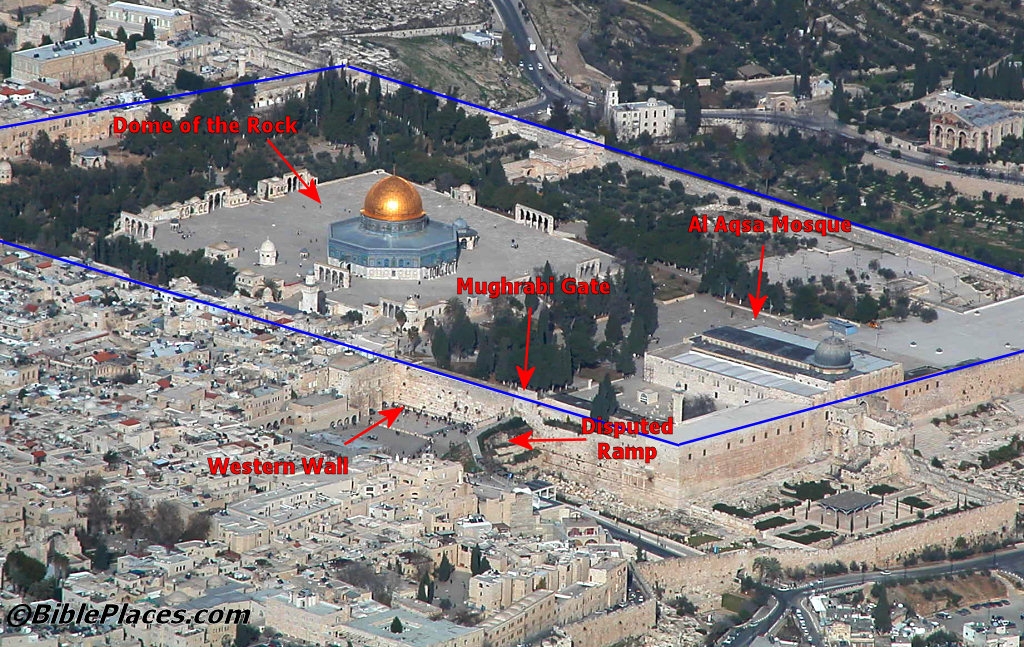
The blue lines mark the limits of the Temple Mount, which is controlled by the Muslim religious authority. One of the gates providing access to the Temple Mount is the Mughrabi Gate, and it is the earthen ramp leading to this gate which is the basis for claims that the Israelis are undermining Al Aqsa Mosque. Any viewer can see, however, that the ramp is outside of the Temple Mount, has no bearing on the structure of the Temple Mount, and is immediately adjacent to the Jewish prayer area of the Western Wall.
Picking up the BBC story from 1967:
Israel allowed the Muslim religious authority known as the Waqf to administer the whole compound. But the Israelis claimed the right to enter it at will to keep security control. They enforce this claim regularly.
They do so by entering the compound through a small gate known as the Mougrabi or Moors’ Gate.
It is this gate that is at the centre of the current controversy.
Because the gate is high up in the wall (it overlooks the Western Wall,) it has to be reached by either an earth mound or a walkway.
Last year [actually three years ago], the earth mound collapsed after a rainfall [actually a snowfall]. So a temporary wooden structure was put up. The current work is designed to replace this with something stronger and more permanent.
This entails removing the remains of the earth mound down to bedrock in order that there can be secure foundations for the new walkway or bridge.
An independent observer, Father Jerome Murphy-O’Connor, from the French institute the Ecole Biblique in East Jerusalem, said that the work was “completely routine”.
“This work is not inside the Haram. It is outside, leading to the Moors’ Gate. The earth ramp fell down and has to be replaced,” Father Murphy-O’Connor, author of an Oxford University guide “The Holy Land”, told me.
“I do not know why the Palestinians have chosen to make an issue out of this. It is a recognised Jewish area under the arrangements that prevail in the Old City.
“One can contrast this to the extensive excavations just round the corner in a Muslim area where huge pilgrim hostels from the 8th Century were revealed, with no protest. There has also been no protest over digs at the City of David nearby.
“There is absolutely no danger to the foundations of the al-Aqsa mosque since that is built on the huge Herodian blocks that are still there.”
The reason for the protest does not really have much to do with archaeology in fact. It is a protest about presence. The Palestinians and the wider Muslim world have an objection to anything the Israelis do that touches on the Haram.
Such work is seen as symbolising a threat to Palestinian and Muslim identity and a rallying point for Palestinians to express their desire for their own space, their own state.
In this atmosphere, the arguments of the archaeological academics do not carry much force.
The Moors’ Gate is perhaps even more sensitive than other sites, as it is the only gate to the compound for which the Israelis hold the key. They do so, Father Murphy-O’Connor said, under an agreement reached in 1967 between General Moshe Dayan and the Waqf.
In 1996, the Israelis tunnelled further along the Western Wall, prompting riots and unrest. Again, the issue was not so much the actual dig as the concept.
There’s a little more, including a nice diagram at the bottom of the article that shows the relation of the ramp to the Temple Mount and Al Aqsa Mosque. The Jerusalem Post has an article explaining the “Intimidation Tactics” at work.
HT: Paleojudaica