“Thousands of animal bones, ceramic animal figurines, wall stones and limestone altars have been found at an Iron Age temple in Khirbet Al Mudayna,” possibly biblical Jahaz.

Lawrence Schiffman explains why he believes that Gershon Galil’s discovery of new inscriptions from the time of Hezekiah is the product of scholarly imagination.

The Inscriptions project seeks to collect and make freely accessible all of the previously published inscriptions (and their English translations) of Israel/Palestine from the Persian period through the Islamic conquest (ca. 500 BCE – 640 CE).”

The New York Public Library has available for viewing online Charles W. Wilson’s Ordnance Survey of Jerusalem (1865).

Grunge’s list of “female archaeologists who changed history forever” includes Kathleen Kenyon.

Jonathan Moore is a guest on Digging for Truth to discuss the archaeological evidence for the destruction of Jericho.

Zoom lecture on May 2: “The Antiquities Trade in Israel and Palestine: Same as It Ever Was?,” by Morag Kersel and Michael Press, sponsored by PEF and AIAR.

Zoom lecture on May 4: “Exploring the Archaeology of Jesus’ Nazareth,” by Professor Ken Dark, sponsored by Jerusalem University College

Bryan Windle begins a new series entitled “Weighing the Evidence.” In the first post, he evaluates the evidence both for and against the authenticity of the James Ossuary and its inscription.

HT: Agade, Arne Halbakken, Keith Keyser, Alexander Schick, Explorator

Excavations have uncovered an ancient farming system from the Middle Ages in the sand dunes next to Caesarea.

The Washington Post reviews the archaeological evidence for crucifixion.

In reporting on the recently published inscription from Jerusalem with possible ties to the Queen of Sheba, Bible History Daily notes some resistance by Christopher Rollston to the interpretation.

A new paper argues that Jews in the Roman army could have kept kosher.

Chandler Collins reviews proposed locations for Jerusalem’s Gennath Gate, often connected with the place of Jesus’s crucifixion and tomb.

A spring storm dropped snow on Mount Hermon and caused flooding that nearly cut off Eilat from the rest of the country.

In its Summer Institute this year, Jerusalem University College is offering three courses:

  • The Dead Sea Scrolls: Myth and Reality, taught by Adolfo Roitman, Curator and Director of The Shrine of the Book
  • Genesis 1-3 in its Ancient Near Eastern Context, taught by Oliver Hersey, President of Jerusalem University College
  • The Zionist Idea, taught by Jonathan Kaplan, Former Vice Provost of the Rothberg International School, Hebrew University of Jerusalem

This month only, Accordance Bible Software is offering the full version of Accordance 13 to everyone for free.

New resource: 14 Fresh Ways to Enjoy the Bible, by James F. Coakley. Though only one chapter is directly about Bible geography, the whole of this book looks like an excellent guide to better reading (Moody, 208 pages; $15).

HT: Agade, Arne Halbakken, Ted Weis, Alexander Schick, Explorator

A new study suggests that a 10th-century BC inscription discovered near the Temple Mount in Jerusalem may have been written in the Ancient South Arabian language, providing a possible link with the Queen of Sheba’s visit to Solomon.

Gold jewelry discovered in a Roman-era tomb on Mount Scopus in Jerusalem in 1971 is now on display for the first time. The jewelry “bears the mark of the Roman goddess of the moon Luna.”

Ruth Schuster investigates the earliest Christian pilgrims to the Holy Land and how they knew were to go.

It’s a Passover tradition for journalists to write about the exodus, and Judith Sudilovsky’s article in The Jerusalem Post is not entirely negative.

You can find the full series of Passion Week devotionals written by Will Varner and illustrated with our photos here.

Megan Sauter considers the question of how Jesus’s tomb was sealed.

Chris McKinny and Kyle Keimer discuss the archaeology of the Passion Week in a three-part series on the Biblical World podcast.

John DeLancey is on The World and Everything in It talking about the Church of the Holy Sepulcher (23:40; transcript at link).

Israeli police detained several individuals with lambs or goats near the Temple Mount.

Jordan Ryan’s recent BAR article, “Jesus in the Synagogue,” is excerpted online, including a list of 16 synagogues in Judea and Galilee that date before AD 135.

Ellen White writes about Israelite attitudes toward dogs.

Peter Lacovara attempts to explain why ancient ivory cosmetic spoons were made in the shape of a young girl swimming.

Archaeologists excavating the Hyksos palace at Tell el-Daba have discovered 12 severed hands.

“Researchers at Simon Fraser University (SFU) in Ottawa, Canada are learning more about ancient graffiti and their amazing comparisons with modern graffiti as they produce a state-of-the-art 3D recording of the Temple of Isis in Philae, Egypt.”

New release: Assyria: The Rise and Fall of the World’s First Empire, by Eckart Frahm (Basic Books, 528 pages, $35; Amazon).

New release: The Oxford History of the Ancient Near East: Volume IV: The Age of Assyria, edited by Karen Radner, Nadine Moeller, and D. T. Potts (Oxford, 1288 pages, $150; Amazon)

Turkish Archaeological News has a roundup of stories in the month of March.

Greek City Times has a survey of the (many) Greek theaters in Turkey.

“The Asia Minor Research Center is pleased to announce a new study program in Turkey for people in the Majority World.”

The Gospel of Matthew in the LUMO Project has been dubbed using a restored Koine Greek pronunciation.

WarGamer’s April Fool’s prank was about the world’s first trading card game.

The Oriental Institute is being renamed to the “Institute for the Study of Ancient Cultures, West Asia and North Africa.” Pretty catchy.

HT: Agade, Arne Halbakken, A.D. Riddle, Andy Cook, Ted Weis, Gordon Dickson, Keith Keyser, Explorator

“A 6,000-year-old copper fishing hook, possibly used for catching sharks or other large fish, has been discovered during an Israel Antiquities Authority excavation in Ashkelon.”

Andy Cook posts a short video he just filmed in the drainage channel underneath the City of David.

Sussita National Park is now open to the public. The site, also known as Hippos, overlooks the Sea of Galilee on its eastern side.

Bible History Daily addresses the question of who lived in the ancient city of Hazor: commoners, elites, or a mix of the two. This issue is explored further in an article by Shlomit Bechar in the latest issue of Biblical Archaeology Review.

Several dozen articles on the topic of “The Ancient Written Wor(l)d” have been published in the latest issue of ‘Atiqot (open access). One of the articles challenges the identification of the signet ring of Pilate.

“Jerusalem was named one of TIME magazine’s 50 most extraordinary travel destinations, as part of the publication’s third annual list of the World’s Greatest Places.”

“Caesarea was given awarded the ACTA Archeological and Cultural Award for the best foreign archeological site by GIST, Italy’s foremost tourism press agency.”

Chandler Collins will now be posting information about excavations and publications about Jerusalem on Facebook, Twitter, and Instagram.

As Emily Master steps down after five years as Executive Director of the Friends of the Israel Antiquities Authority, she identifies three milestone projects completed in this time: a renovated Davidson Center, the Shelby White and Leon Levy Lod Mosaic Archaeological Center, and the Jay and Jeanie Schottenstein National Campus for the Archaeology of Israel.

Aren Maeir’s latest publication is in a volume dedicated to Indiana Jones. (Despite the date of its posting, the book appears legitimate.)

New release: In the Shadow of the Wall: The Life and Death of Jerusalem’s Maghrebi Quarter, 1187–1967, by Vincent Lemire (Stanford University Press, $32; Amazon).

ASOR webinar on April 13: “New Perspectives on Jerusalem’s 7th Century BCE Elite,” by Yuval Gadot

Online lecture on April 27: “The Archaeology of Mount Zion in Jerusalem – Past, Present, and Future,” by Shimon Gibson. Registration is free and required.

On YouTube: “The Jewishness of the New Testament: An Interview with R. Steven Notley” (17 min)

Israeli authorities are forecasting severe heat waves this summer, with temperatures possibly reaching 120 degrees F (49 C).

The Infusion Bible Conference digital download of all 42 videos of “The Last Days of Jesus” is now on sale for $30 off. Purchase includes the pdf notebook with 170 pages of notes, resources, and recommendations.

Focus on the Family is celebrating Passion Week with a series of devotionals by Will Varner, illustrated with photos from BiblePlaces.com.

HT: Agade, Arne Halbakken, Alexander Schick, Explorator

Andy Cook was at the Pool of Siloam excavations on Thursday, and he interviewed an archaeologist working there about what’s next.

“The recently renovated Davidson Center Archaeological Garden in Jerusalem’s Old City opened an exhibition on Monday featuring a number of rare and ancient artifacts related to the Temple Menorah.”

Joe Zias looks at some unknown inscriptions on the “Tomb of Absalom” in Jerusalem and suggests renaming the monument the “Tomb of Zacharias,” father of John the Baptist.

A Herodian wall and Second Temple period burial caves at Samaria-Sebaste has been destroyed by road construction.

“Military officials intercepted an antiquities-smuggling ring in the West Bank.” The Jerusalem Post story reports on several other recent antiquities busts.

A seven-mile stretch of the Jordan River south of the Sea of Galilee is being cleaned of its pollution and developed for tourism.

Aren Maeir recounts his two-day trek in eastern Samaria, including a climb up Sartaba.

Adam Montefiore, known as the English voice of Israeli wines, looks at the history of winemaking in the land of Israel.

Seetheholyland.net has added a page for the newly discovered tomb of Salome.

Phillip J. Long writes about the traditional location of the Garden of Gethsemane and the nearby grotto.

Accordance is offering 40-74% off on many graphics resources, including several of our photo collections. Ends Monday.

HT: Agade

Pool of Siloam March 20232635b

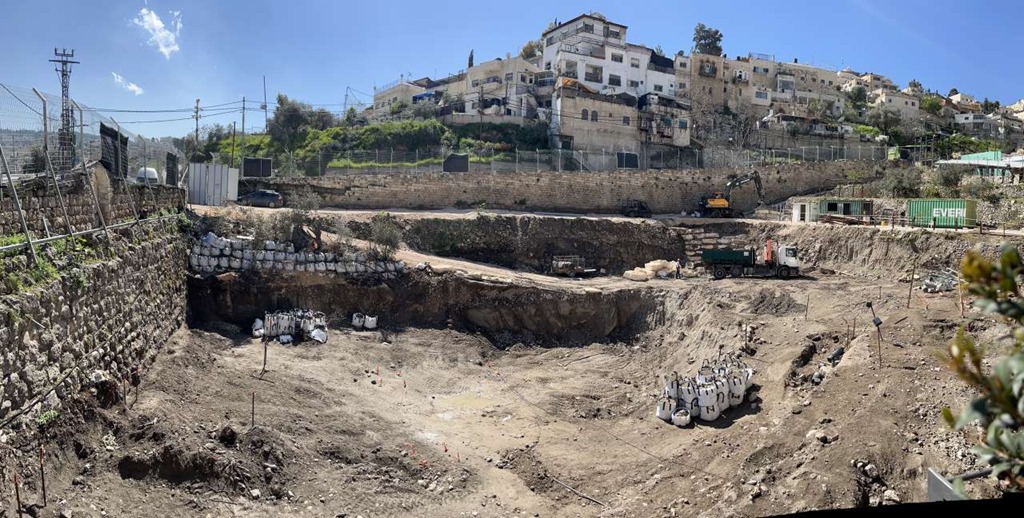
Pool of Siloam excavations, March 16. Photo by Andy Cook (Experience Israel Now)

Graduate students on a field trip discovered a statue of a lioness near a synagogue in the Golan Heights.

Several editorials reflect on the Darius Ostracon fiasco, including Nathan Steinmeyer at BAS, Ruth Schuster at Haaretz, and The Jerusalem Post.

“The Davidson Center in Israel’s Jerusalem Archaeological Park will reopen to the public next week after being closed for three years for renovations. The center will have updated exhibits featuring first-ever publicly displayed archaeological finds, innovative technology, and interactive galleries.”

Nixza Gonzalez writes about 11 beautiful national parks in Israel, most of which are not on the itineraries of most groups.

Chandler Collins evaluates the evidence that identifies Herod’s tower near Jaffa Gate (“the tower of David”) as either Hippicus or Phasael, concluding that the popular view today is wrong.

Piotr Bienkowski disputes the recent proposal that Edom was related to the copper mining at Faynan in the 10th and 9th centuries BC.

New release: A Handbook of the Aramaic Scrolls from the Qumran Caves: Manuscripts, Language, and Scribal Practices, by Daniel Machiela (Brill, $192; free download)

In the latest Digging for Truth episode, Bryan Windle recounts his top 10 list of discoveries in biblical archaeology in 2022.

Excavations of the Pool of Siloam in late February. Photo courtesy of Simeon Western

HT: Agade, Arne Halbakken, Ted Weis, Mark Hoffman, Explorator