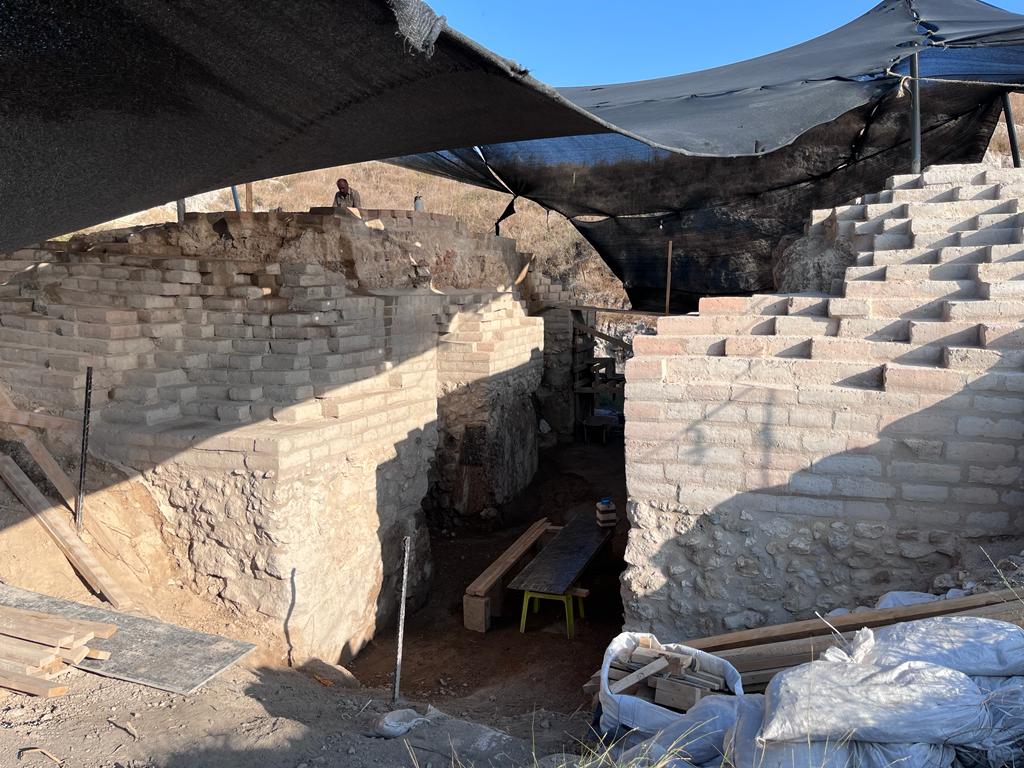
Excavations conducted during the laying of a water pipe not too far from Lachish revealed the “most ancient gate ever discovered in Israel.” They are dating it to about 300 years earlier than the Early Bronze gate at Tel Arad. The gate has already been backfilled.

Archaeologists excavating Tel Shimron announced the discovery of a massive Middle Bronze monument that was 15 feet tall and covered the entire acropolis. The monument was very well-preserved because soon after its construction it was filled in with gravel.

A beautiful Herodian ceiling panel was discovered in secondary use in the Ophel excavations (YouTube).

One of the arches in Caesarea’s Roman aqueduct collapsed on Friday.

A suspension bridge crossing the Hinnom Valley is now open to pedestrians (YouTube).

Zedekiah’s Cave (aka Solomon’s Quarries) reopened earlier this month, and Zahi Shaked gives a 30-minute tour.

Some Jews and Christians are arguing over the right to pray in the area of a possible tomb of Elisha at Stella Maris on Mount Carmel.

Israeli officials are considering loaning the Megiddo Mosaic, which comes from an early Christian building, to the Museum of the Bible. (Ilan Ben Zion’s AP article is a disappointment.)

WUNC interviews Jodi Magness upon the completion of her 11-year excavation of the Huqoq synagogue.

Aviva and Shmuel Bar-Am write about some of the many ritual baths that have been discovered throughout Israel. The article includes many photos.

Abigail Leavitt recounts various sites she visited this summer in Jerusalem. She has another post about a tour of the Shephelah.

“The Jewish National Fund, KKL-JNF, recently welcomed guests to visit the ancient Jewish synagogue in Ma’on, located in Israel’s southern Negev desert.”

Tour Caesarea virtually with DIVE (Digital Interactive Virtual Experiences) on August 30 ($20).

Joel Kramer goes to Mamre in the latest episode from Expedition Bible.

There are a number of late-summer festivals being held around Israel.

New release: The Changing Landscape of Israeli Archaeology: Between Hegemony and Marginalization, by Hayah Katz (Routledge, $42/$136).

The latest Jerusalem Tracker has been posted, with a roundup of news, publications, and media.

It may be hard to believe, but apparently there are unscrupulous shopkeepers in the Old City of Jerusalem.

HT: Agade, Gordon Dickson, Al Sandalow, Will Varner, Arne Halbakken, Roger Schmidgall, Keith Keyser, Wayne Stiles, Explorator

With the Israeli military gone, there are no obstacles to visiting Hyrcania in the Judean wilderness.

Share:

“Experts from Rome have wrapped up weeks of careful archaeological work in one of the most sensitive parts of the Church of the Holy Sepulchre,” the area in front of the Edicule.

A 1,500-year-old “magic mirror” from the Byzantine period was discovered by a 17-year-old Israeli taking part in a Young Leaders’ Survival Course at the Usha archaeological site in northern Israel.”

“A rare 2,500-year-old marble disc designed to protect ancient ships and ward off the evil eye was discovered by a lifeguard” near Palmachim Beach.

“Archaeologists excavating the site of Legio—the legionary camp of Rome’s Sixth Legion located at the foot of Tel Megiddo in northern Israel—have unearthed the remains of a small amphitheater used not for performances but rather for brutal combat training exercises.”

Aren Maeir mentions four sites in the Jezreel Valley that are being excavated this summer. Of Tel Shimron, he writes that they have discovered “some of the nicest and most important finds ever found in Israel!”

A rare half-shekel coin dug up in the Ein Gedi nature reserve was inscribed with the words ‘The Holy Jerusalem’ in Hebrew.”

Scott Stripling discusses the latest results from the excavations at Shiloh on CBN News. Or listen to the two recent episodes of The Bible and the Spade.

UNESCO’s World Heritage Committee will be voting soon on whether to include Jericho on its list.

Aviv and Shmuel Bar-Am have written an informative article about the best viewpoints in Jerusalem (though I think they left one of the best out).

A fox was spotted along the wall of Jerusalem’s Temple Mount.

Jonathan Klawans recommends a visit to the Benedictine Monastery of the Resurrection in the village of Abu Ghosh.

“The director of the Israel Museum, Denis Weil, has resigned just a year and a half after taking up the position.”

New release: The Two Houses of Israel: State Formation and the Origins of Pan-Israelite Identity, by Omer Sergi (SBL Press, $55)

Walking The Text’s recommended resource of the month is Experiencing the Land of the Book, by Charles H. Dyer.

Israeli authorities have taken actions to protect Tel Aroma in Area B from destruction by vandals.

Guiding tours of the Dead Sea on his boat, Noam Bedein is making new discoveries, including a bubbling brook and new rock formations.

HT: Agade, Arne Halbakken, Explorator

The newest national park in Israel is Hippos. Now this Roman-Byzantine site in the Decapolis boasts paved paths, clean restrooms, and of course, a shop.

Share:

Bryan Windle’s report on “three things in Shiloh Samuel likely saw” includes discussion and photos of recent discoveries, including a building they think may be the tabernacle.

“Archaeologists working on a 2,000-year-old Roman cemetery discovered in Gaza last year have found at least 125 tombs, most with skeletons still largely intact, and two rare lead sarcophaguses.”

“A sword that was discovered by a diver off the coast of northern Israel in 2021 was likely lost overboard during a fierce naval battle between Crusaders and Muslim residents of coastal cities some 800 years ago.”

David Moster gives a video walkthrough of a beautiful 3D model of Herod’s Temple and Temple Mount.

The latest video from Expedition Bible looks at Jesus’s tomb, showing how strong the evidence is for the authenticity of the Church of the Holy Sepulcher.

Scott Stripling talks about the New Testament excavations at Khirbet el-Maqatir on a recent episode of Digging for Truth.

A volunteer at the Abel Beth Maacah excavations describes what a typical day on the dig is like.

Hybrid lecture on August 10: “Excavations at Khirbet Summeily, 2011-2023: A Preliminary Report,” by Jeff Blakely

Carl Rasmussen shares some older photos of an Intermediate Bronze cemetery discovered at Dhahr Mirzbaneh (Ain Samiya).

Abigail Leavitt shares photos of tombs in Jerusalem she recently visited.

Ferrell Jenkins shares photos of vineyards at Lachish then and now.

HT: Agade, Arne Halbakken, Alexander Schick, Explorator

This is the “Holy Sepulcher ladder” of the Jewish Quarter. This temporary pedestrian bridge floating over the Western Wall plaza is nearly 20 years old now.

Share:

Archaeologists are making progress in their second season of renewed excavations at Nimrud (ancient Calah), including the discovery of a depiction of Ishtar in a temple dedicated to her.

Royal tombs full of artifacts dating to 1500-1300 BC have been discovered near Hala Sultan Tekke on Cyprus. The site was discovered using magnetometers.

A 2,500-year-old Phoenician shipwreck has been found underwater in the southeastern Spanish region of Murcia.”

MutualArt surveys the results of excavations and repatriations in Egypt this year.

Yigal Levin writes about the city of Dibon and the single reference to Dibon-Gad in the book of Numbers.

Marek Dospěl gives an overview of the Epic of Gilgamesh.

Adam E. Miglio considers the similarities between the Epic of Gilgamesh and the Book of Genesis.

Jessica Nitschke, the new editor of The Ancient Near East Today, explains her vision for the future of the website and newsletter.

New release: Ancient Egyptian Gold: Archaeology and Science in Jewellery (3500–1000 BC), edited by Maria F. Guerra, Marcos Martinón-Torres & Stephen Quirke (McDonald Institute Monographs; Cambridge; open access)

The Bible Mapper Blog continues to create helpful maps for Bible readers. Here are the latest:

HT: Agade, Joseph Lauer, Explorator

The best museum in the Old City is now the Terra Santa Museum on the Via Dolorosa. Though it is not yet finished, it displays hundreds of impressive artifacts from around the country.

Share:

In the 11th and final season at the Huqoq synagogue, Jodi Magness discovered additional sections of the Samson mosaic panels along with a new mosaic section with an enigmatic Hebrew inscription and an Aramaic inscription identifying the synagogue’s donors or artists. The site will now be developed into a tourist attraction.

“Skulls and lamps found in the Twins Cave in the Jerusalem Hills indicate that the cave was used for necromancy rituals” in Hellenistic and Roman times.

A new study has determined that Caesarea was destroyed by a giant tsunami in the aftermath of the AD 749 earthquake.

Tim Chaffey follows up his introductory article on the location of the temple with a more extended study, arguing that Ernest L. Martin and Robert Cornuke “are highly selective in their use of source material, even to the point where they remove the most relevant details from passages of Scripture.”

Nathan Steinmeyer describes how the Central Timna Valley Project conducts experiments to determine how people in the Chalcolithic period smelted copper.

Jamie Fraser has been appointed to be the new director of the Albright Institute in Jerusalem.

New release: The Excavations at Khirbet el-Maqatir: 1995–2001 and 2009–2016. Volume 2: The Late Hellenistic, Early Roman, and Byzantine Periods, edited by Scott Stripling and Mark A. Hassler (Archaeopress, £85; free download)

Chandler Collins writes about the “Russian Compound Plateau” in Jerusalem, including the recent excavation of a portion of the Third Wall there.

Carl Rasmussen has posted a new photo of the Methuselah date palm tree.

Ferrell Jenkins shares a new photo he took of the village of Nain, where Jesus raised a dead boy back to life.

Abigail Leavitt writes about her visits to the excavations at Tel Burna.

Israel’s Good Name provides a well-illustrated report on his visit to Ein Harod.

Your humble roundup writer teaches a Bible chapter a week nearly every Sunday morning (with photos), but he generally stays away from the pulpit. With the pastor on sabbatical and the situation desperate, my church lowered the standard. There’s not much geography or archaeology in a sermon on “Jesus the Servant,” but it is a subject I love very much.

HT: Agade, Joseph Lauer, Explorator

These men are hard at work restoring an ancient mosaic in the Church of the Multiplication of Loaves and Fish at Tabgha.

Share:

“A team of Israeli physicists and archaeologists is now attempting to track the movement of subatomic particles called muons to map a complex array of ancient tunnels, cisterns and other underground voids beneath Jerusalem.”

Ancient rock engravings at Timna Park are now being studied using 3-D micromorphological characteristics of the incisions.

A new study questions the view that there were Jewish gladiators in the Roman empire. The underlying journal article is here.

Noam Aharon has created a map of the kingdom of Ugarit, c. 1300 BC. Bibliographic references are here. Permission is granted for non-commercial use.

“A bronze head of Emperor Septimius Severus on display at a Copenhagen museum has become a bone of contention between the Danish museum and Turkey, which claims it was looted during an archaeological dig in the 1960s and wants it back.”

Turkish Archaeological News rounds up the top stories for the month of June.

Ferrell Jenkins explains the possibility that Paul visited Adramyttium.

“A new virtual reality (VR) app which takes users on a journey back in time to Ancient Greece where they are able to experience first-hand what it was like to consult with the Greek god Zeus at the Oracle of Dodona has been developed by a team of academics led by the University of Bristol.”

Timothy P. Harrison has been appointed director of the University of Chicago’s Institute for the Study of Ancient Cultures, West Asia & North Africa (ISAC; formerly Oriental Institute).

Open access from Brill: Ancient Egypt, New Technology: The Present and Future of Computer Visualization, Virtual Reality and Other Digital Humanities in Egyptology, edited by Rita Lucarelli, Joshua A. Roberson, and Steve Vinson (free pdf; hardback $174)

Free download on Academia: Cultural Atlas of Mesopotamia, by Michael Roaf

Heinz-Wolfgang Kuhn, one of the first to engage with the archaeological research of Bethsaida, died last week.

Aren Maeir is guest on the What Matters Now podcast, discussing archaeology in the shadow of Indiana Jones. The link includes a transcript.

Nathan Steinmeyer explains why archaeologists love Indiana Jones.

HT: Agade, Arne Halbakken, Joseph Lauer, Explorator, Alexander Schick

I’m thankful that the Tabernacle Model in Timna Park is still going strong after nearly 25 years, though one could wish that the Park authorities could park their RVs somewhere else.

Share: