For only the 4th time, a Bar Kochba coin has been found in Jerusalem, possibly brought there by a Roman soldier. This article has nice photos, and this article has a short video.

The Jerusalem Post surveys how archaeology in Israel has been affected by governmental actions in response to COVID-19.

El-Araj, a good candidate for Bethsaida, has been flooded by this winter’s rains and the rise of the Sea of Galilee.

Critics are claiming that construction by the Palestinian Authority is destroying remains at Tel Aroma, the northernmost Hasmonean fortress in Samaria.

“Exploratory drilling has started just outside the Old City for a project to extend the Tel Aviv-Jerusalem fast rail to the Old City’s Dung Gate — the main entrance to the Western Wall.”

The Greek Orthodox Church of Jerusalem has filed a lawsuit demanding closure of Ein Yael outdoor museum.

Four fragments of Dead Sea Scroll fragments that were thought to be blank are not.

A new excavation at Petra will focus on the lower part of the Treasury as well as nearby tombs and facades.

A new burial chamber has been discovered at the mummification workshop complex of the 26th Dynasty at Saqqara.”

“A stone chest excavated by archaeologists near Deir el-Bahari and the temple of Hatshepsut could lead archaeologists . . . to a royal tomb.”

Egypt’s decision to move ancient objects from their original setting in Luxor to Cairo’s Tahrir Square is stirring controversy.

“The excavation team working on the site of the ancient city of Patara, near the Mediterranean resort city of Antalya, has unearthed a new inscription in the ancient theater.”

“A small sinkhole that appeared next to the Pantheon in Rome has enabled archaeologists to examine the original Roman paving that was laid when the Pantheon was built by Marcus Agrippa around 27-25 BC.”

The traditional tomb of Esther and Mordechai in Hamadan, Iran, was set afire yesterday.

David Moster has created a new video on “Biblical Pandemics.”

The Temple Mount Sifting Project Symposium on May 24 features eight lectures via Zoom on the archaeology of Jerusalem and the Temple Mount. Registration is required.

Francis I. Andersen died recently. His breadth of publications is remarkable.

Thomas O. Lambdin died on May 8.

HT: Agade, Ted Weis, Joseph Lauer, Explorator, BibleX
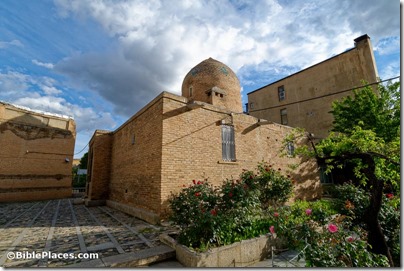
Ecbatana tomb of Esther and Mordecai, tb0510183126

Traditional tomb of Esther and Mordecai in Hamadan (biblical Ecbatana) before attack

The Western Wall plaza reopened this week, with worshippers limited in number, required to wear masks and to have their temperature checked.

A new excavation has determined that Solomon’s Pools were built by the Romans in the 2nd century AD. The academic report was published in Palestine Exploration Quarterly last year.

“The Dead Sea Scrolls in Recent Scholarship” is a 4-day virtual conference hosted by NYU that begins on May 17. Registration is free and required for each day.

Thieves have plundered and destroyed remains at Khirbet Astunah as well as a number of other sites in the West Bank.

Bill Barrick has written an interesting and well-illustrated post on the ancient city of Jezreel.

King Saul appears to be the theme of the week, as Ferrell Jenkins shares photos of Gibeah, Beth Shean and flowers on Mount Gilboa.

Shmuel Browns shares photos from a recent visit he made to Samaria-Sebaste.

Scott Stripling is interviewed in the second installment of “Discussions with the Diggers.”

Walking the Text has created a number of study guides for recent series, including Psalm 23, The Lord’s Prayer, and The Sabbath.

Patrick D. Miller died last week.

HT: Ted Weis, Agade, Joseph Lauer, Charles Savelle, Explorator

Erez Speiser has written a detailed and well-illustrated walking guide of the Mount of Olives, including visits to various churches, monuments, and tombs of notable Jewish figures.

Carl Rasmussen explains how the background of the imperial cult in Israel informs Peter’s confession at Caesarea Philippi.

Bryan Windle begins a new series entitled “Discussions with the Diggers,” and his first interviewee is Bryant Wood.

“Archaeological research at sites across Egypt shows that climate change drives the landscape between two modes; cool and warm.”

The Egypt Exploration Society is sponsoring a series of online lectures.

The Egyptian Ministry of Tourism and Antiquities has produced a virtual tour of the tomb of Wahti in Saqqara, one of the most impressive discoveries of the decade.

The Italian Ministry of Cultural Heritage and Activities has produced a virtual tour of two recently excavated homes in Pompeii. See the article for how to get the commentary in English.

Stephen Hutcheon was digging around in the Eric Matson Collection and discovered photos of the Anzacs in Palestine during WWII.

An archaeologist breaks down 10 treasure-hunting scenes in movies, beginning with the Raiders of the Lost Ark.

HT: Agade, Ted Weis, Joseph Lauer

A team excavating Khirbet a-Ra‘i (the alleged Ziklag) in January and February discovered “a rare ‘smiting god’ figurine, a bronze calf figurine, two seals and decorated Canaanite and Philistine pottery from the 12th Century BCE.”

With everyone home, antiquities thieves are having a field day in Judea and Samaria.

With the Israel Museum closed, the Dead Sea Scrolls are now safely stored “behind five locked doors in a humidity and temperature-controlled vault at the Shrine of the Book.”

Owen Jairus reports on discoveries made in the Nazareth Archaeological Project, as recently published by its director Ken Dark.

The summer season at Tell es-Safi/Gath has been cancelled. Other excavations have apparently cancelled as well, though I haven’t yet seen those notices.

The Temple Mount Sifting Project has unveiled a new virtual exhibition.

The Palestine Open Maps project has just launched, and it is based on the 1940s survey maps from the British Mandate.

On Kindle for $2.99: Jesus and the Eyewitnesses: The Gospels as Eyewitness Testimony, by Richard Bauckham.

Hisham’s Delights is a new digital cookbook from the kitchen of the Albright Institute.

HT: Agade, Ted Weis, Joseph Lauer

The Sea of Galilee may fill up for the first time since 1992 after rising more than 10 feet in recent months. And since the water is not considered kosher for Passover, it isn’t pumped out during the week-long holiday.

Only 10 people gathered at the Western Wall for the priestly blessing during Passover, and Al Aqsa Mosque will be closed through Ramadan.

“With the coronavirus keeping Israelis indoors, dozens of jackals have taken over a deserted park in Tel Aviv, scavenging for food in what is usually a playground for joggers and families.”

Here’s another video of the 500 mines blowing up at Qasr al-Yahud near the Jordan River.

John Monson answered questions about the state of biblical archaeology in light of the closure of Southwestern’s program.

The Pergamon Museum in Berlin has posted a 16-minute virtual tour video of the Museum of the Ancient Near East (subtitles in English).

The Harvard Semitic Museum has been renamed the Harvard Museum of the Ancient Near East. The museum’s website includes a virtual tour of the entire museum.

Oxford University professor Dirk Obbink has been arrested on suspicion of theft and fraud of ancient papyrus fragments from the Oxyrhynchus collection.

The latest video from John DeLancey: Jesus heals the paralytic in Capernaum.

New: A History of Ancient Moab from the Ninth to First Centuries BCE, by Burton MacDonald.

Carl Rasmussen takes a more careful look at the famous Pilate Inscription, with particular interest in its connection to another “son of God.”

Agrippa I: An Archaeological Biography includes photos of coins of this king, Roman baths in Beirut, the Third Wall in Jerusalem, and the amphitheater in Caesarea.

Fun read: “‘Terminate and Liquidate’: How the Megiddo Ivories were Almost Not Discovered.” This fascinating story is taken from Eric H. Cline’s latest book, Digging Up Armageddon: The Search for the Lost City of Solomon.

HT: Agade, Paleojudaica

Southwestern Baptist Theological Seminary (SWBTS) has terminated its biblical archaeology program, laying off five professors and ending the MA and PhD programs of 25 graduate students. The Gezer excavation publication project now lacks funding.

“Pieces of papyrus sold as rare fragments of Dead Sea Scrolls to Southwestern Baptist Theological Seminary a decade ago are ‘likely fraudulent’ and the seminary might seek financial restitution.”

Sergio and Rhoda show how much the Sea of Galilee’s water level has changed in the last two years.

Egypt’s Ministry of Tourism and Antiquities is launching a series of virtual tours of some of its archaeological sites and museums, beginning with the tomb of Kheti at Beni Hasan.

“New University of Arizona-led research uses tree rings to shed light on discrepancies between archeological and radiocarbon evidence in dating the ancient volcanic eruption of Thera.”

The last land mine has been removed from the Jordan River baptismal area near Qaser al-Yahud, The article includes a video of 562 mines being set off.

Erez Ben-Yosef, director of the Central Timna Valley Project, is interviewed on LandMinds about metallurgy, nomadic societal organizations, and implications for the biblical record.

The Temple Mount Sifting Project has not stopped, though there are no guests or volunteers.

David Christian Clausen discusses the evidence for identifying the location of the Upper Room in Jerusalem.

Rabbi David Moster will be teaching Biblical Hebrew this summer in a 40-session online course. Readers use use the coupon “BiblePlaces” will receive a $500 discount.

For the 100th episode of The Teaching Series, Brad Gray takes a look at the significance of the number 40 in the Bible, reflecting on its repeated presence in episodes of testing and trials.

The Conference DVD Bundle for last year’s Institute of Biblical Context is on sale through Monday, with all 42 presentations available for $79 (digital) or $99 (DVD).

Some Carta resources are finally coming to Logos Bible Software, including The Sacred Bridge, The Quest, and the Carta Bible Atlas. A 13-volume set is also available.

Mark Wilson’s Seven Churches Network website has been greatly updated, including many of his published articles.

Ferrell Jenkins has posted a series this week showing photos of rolling stones from the Tomb of the Kings, the Herodian family tomb, Hesban, and Khirbet Midras.

HT: Agade, Ted Weis, Paleojudaica