Excavations in the Sharafat neighborhood in west Jerusalem revealed a Hasmonean-era agricultural village. Haaretz (premium) has a longer article with more photos.

A study of the garbage dumps of the Byzantine city of Elusa in Israel’s Negev reveals that the city’s decline was the result of climate change.

The Malham Cave, under Mount Sedom near the Dead Sea, has been identified as the longest salt cave in the world.

The third artifact in the TMSP’s 12 object series is a fiscal bulla inscribed “Gibeon / to the king.”

Amnon Ben Tor will be awarded the Israel Prize in the field of archaeology.

Gabriel Barkay, an Israeli archaeology, recalls his experience in excavating Susa in Iran

The Anglo-Israel Archaeological Society will be hosting lectures in the coming months by Amihai Mazar (on Tel Rehov), Jonathan Price (on Beth Shearim), and Jürgen Zangenberg (on Horvat Kur).

Andrea Berlin will be lecturing in Rockford, Illinois, on April 1, on “Phoenicians and Jews — A Tale of Two Peoples in Israel’s Upper Galilee.”

“Striking Power: Iconoclasm in Ancient Egypt” is a new exhibit at the Pulitzer Arts Foundation in St. Louis. A review article explains why so may of the statues’ noses are broken.

The latest video by the Institute for Biblical Culture is on “Ancient Israelite Fashion.” New classes in April include “The Prophets of Ancient Israel” and “The Geography of Biblical Israel/Canaan II.”

The founder of Sirin Riders explains why Israel is a great place to ride horses.

James Papandrea is on The Book and the Spade discussing his new book, A Week in the Life of Rome.

HT: Agade, Ted Weis
Share:

A winepress from the Byzantine period was discovered at Chorazin by a team doing conservation work.

The recent discovery of a depiction of the Egyptian god Bes in the City of David Givati parking lot excavation is the first of its kind ever found in Jerusalem.

The Times of Israel features a well-illustrated story on the Beth Shemesh excavations including the controversy and the museum exhibit.

A new sound-and-light show, used advanced technologies, has been unveiled at Masada.

A shipwreck discovered in Heracleion matches the description of a Nile River boat described by Herodotus.

Excavation work at Macherus is complete after 11 years, but conservation work will continue.

Over a million people are expected between March-September to attend the Louvre exhibition of the  Egyptian pharaoh Tutankhamun. The show features the largest number of Tut items ever displayed together. As construction nears completion for the new Grand Egyptian Museum in Giza, the Egyptian Ministry for Antiquities states that after the six city world tour is completed, key pieces related to Tut will never again leave Egypt.

The Basrah Museum in southern Iraq has added three new galleries, totaling 2,000 pieces, focused on Sumer, Assyrian, and Babylonian objects.

Erin Darby will be lecturing on “The Archaeology of Women in Ancient Israel” in Oak Ridge, Tennessee, on April 2.

The History Channel has a photo essay of ten biblical sites.

Wayne Stiles recently visited the Royal Mummies Hall in the Cairo Museum.

Bible History Daily features a profile on Julia Berenice, the companion of King Agrippa II in Acts 26.

New from the Oriental Institute of the University of Chicago: The Great Hypostyle Hall in the Temple of Amun at Karnak, by Peter J. Brand, Rosa Erika Feleg, and William J. Murnane. For purchase in hardback or a free download.

“The Setting of the Assassination of King Joash of Judah: Biblical and Archaeological Evidence for Identifying the House of Millo,” by Chris McKinny, Aharon Tavger, Nahshon Szanton, and Joe Uziel, is a paper read and illustrated by Chris McKinny.

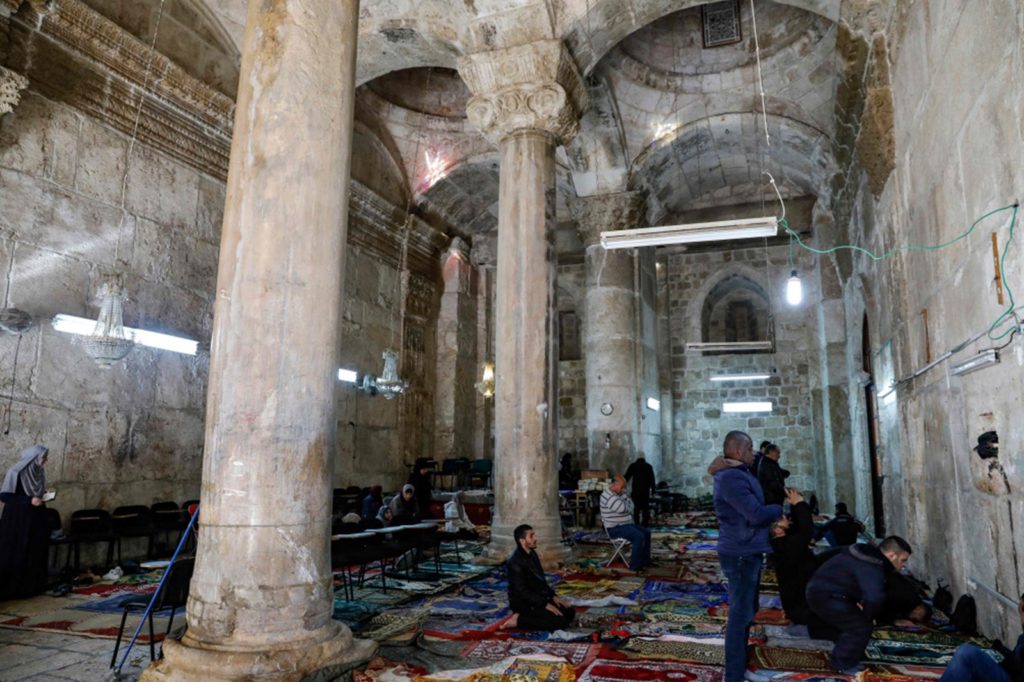
The photo below, from DerStandard, shows the interior of the Golden Gate in recent times.

HT: Ted Weis, Agade, Charles Savelle, Alexander Schick, Paleojudaica

Interior of the Golden Gate
Photo from DerStandard
Share:

A Greek inscription found at the Nabatean city of Halutza confirms previous scholarly identification of the site as Elusa. The Times of Israel article provides more information about the results of the excavation.

Aren Maeir made a visit to Gath/Tell es-Safi this week, where everything is very green.

Tel Tzuba (Belmont) is the latest destination for Israel’s Good Name.

Cesares de Roma is a Spanish art project that has brought to life silicone images of Julius Caesar, Caesar Augustus, and Nero.

The Romans attempted to ban wild Purim parties in the year 408.

In light of the present controversy, Leen Ritmeyer explains the history of the Golden Gate of Jerusalem.

Egypt has opened a 105-mile hiking trail called the “Red Sea Mountain Trail” that west of Hurghada.

40,000 runners from 80 different countries ran 42 kilometers in the Jerusalem Marathon.

David Moster explains biblical geography in a 9-minute video entitled, “If an ancient Israelite had Google Earth.”

This isn’t new, but I haven’t seen it before: Flight of Faith: The Jesus Story is a 48-minute documentary with lots of aerial footage.

The Bible Lands Museum in Jerusalem has opened a new exhibit entitled “Highway through History.” As part of the launch, they have created a five-minute drone video of Beth Shemesh and the excavations in preparation for the road expansion.


The New York Times reviews “The World Between Empires” exhibit now at the Met.

The “Alexander son of Simon” ossuary is possibly related to the man who carried Jesus’s cross. It is on display now at the Museum of the Bible in Washington, DC, and this week they recorded a short video about it. Apparently they were so inspired by an inquiry from your roundup writer.

HT: Agade, G. M. Grena, Chris McKinny, Ted Weis, Steven Anderson, Paul Kellogg, Charles Savelle

Share:

Emek Shaveh is requesting that the plans for renovation in the Jewish Quarter include opening the massive Nea Church from the Byzantine period.

The controversy continues over whether the Muslims can open the Golden Gate to worshippers.

The Karaite community is concerned that the proposed Jerusalem cable car will desecrate its ancient cemetery.

Mark Barnes explains why Jesus was crucified outside Jerusalem.

Ferrell shares a favorite photo this week of the Dead Sea.

Israel’s Good Name shares nature photos from his hike along Nahal Alexander.

A clever vandal spray-painted on the ancient synagogue of Merom, “This holy place will not be desecrated.”

The water level of the Sea of Galilee has risen above the lower red line for the first time in two years.

A study of the mountain fortress of Sela confirms the importance of the site in the Iron II period.

Video: An archaeologist is using drone imagery to track tomb looting in Jordan.

The Department of Antiquities of Jordan has made some great resources available for free online, including the Annual of the Department of Antiquities of Jordan and Studies in the History and Archaeology of Jordan.

HT: Explorator, Agade, Chris McKinny, Paleojudaica

Share:

A well-preserved Greek inscription from the 5th century recording a blessing for one ‘Master Adios’” was discovered in central Israel.

Plans to convert the Golden Gate of the Temple Mount into a Muslim place of prayer are being resisted by Israeli police.

Two crews of antiquities thieves working in eastern Samaria were arrested in recent weeks. One of them was looting Alexandrium-Sartaba.

A short trailer has been released promoting this season’s excavations at Tel Shimron.

There is still time to sign up for this summer’s season at Tel Burna. Shiloh has some openings as well.

Heavy rains this week caused flooding in the Jerusalem area.

The Times of Israel shares a photo essay of wildflowers of the Dead Sea.

Israel’s Good Name recounts his recent university trip to Wadi Dalia and Sartaba in eastern Samaria.

Leon Mauldin reflects on Proverbs’ view of sluggards and ants, and he shares a photo of ants at Neot Kedumim.

The BBC visits the recently opened Terra Sancta Museum in Jerusalem.

New book: Exploring the Holy Land: 150 Years of the Palestine Exploration Fund, edited by David Gurevich and Anat Kidron. (Amazon)

I am on the Diligent Pastors podcast this week with Scot Chadwick, talking about the land of the Bible, photo collections, and preparing for a trip to Israel. Pastors especially may want to check out other episodes in this new podcast.

HT: Ted Weis, Agade, G. M. Grena

Share:

Researchers have constructed kilns to determine how iron was smelted in ancient Israel. (Haaretz premium)

New research has identified where refugees fleeing Mount Vesuvius’s eruption later settled.

The New York Metropolitan Museum of Art will return a recently purchased gold-gilded Egyptian coffin that turned out to be looted.

$55 million will be invested to renovate several sites in the Jewish Quarter of Jerusalem’s Old City, including the Burnt House, the Wohl Archaeological Museum, and the Tiferet Yisrael Synagogue.

A new museum will join the complex of tourist attractions at Latrun, this one honoring Jews who fought in WWII.

The Madaba Plains Project is celebrating 50 years of archaeological work in central Jordan.

Cyrene, Leptis Magna, and other antiquities sites in Libya are being neglected and vandalized since the fall of Gaddafi.

“Israel is hundreds of years overdue for a massive earthquake,” writes Ruth Schuster (Haaretz premium).

Sebastian Fink explains the significance of salt in ancient Mesopotamia.

Wayne Stiles: “The Judean Wilderness illustrates the greener grass we envy.”

Ferrell’s photo of the week is of the Appian Way that Paul traveled as he approached Rome.

Mark Barnes explains why Jesus was baptized in the Jordan River, with reference to the ministries of Elijah and Elisha.

Kings of Israel is a board game taking place in Israel (the Northern Kingdom) during the reign of its kings up until Israel’s destruction by Assyria. Players are on a team, with each person representing a line of prophets…” BibleX has a list of other Christian board games.

The Institute of Biblical Culture’s new course in March, “Daily Life in Ancient Israel,” will cover topics like agriculture, the calendar, tribalism, and lifecycles.

The topic of the Tyndale House Conference 2019 is “Exploring the Old Testament and Its World.”

HT: Agade, Ted Weis

Share: