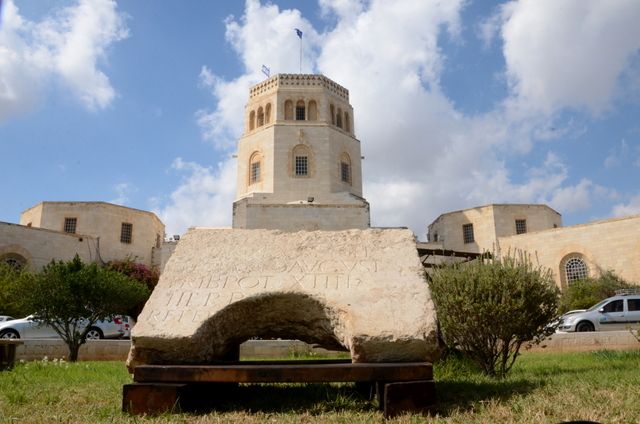
The Gaza Museum of Archaeology survived the summer war.

The cultic finds at Tel Burna received some attention in the mainstream press this week.

Leen Ritmeyer explains why he’s been on a hiatus from blogging—and what you need to do if you want to get the publisher to print his new guide book on the Temple Mount!

The Assyria to Iberia exhibit at the Met includes the Tel Dan Inscription (until Jan 4).

The amazing Amphipolis Tomb has its own website. The most recent discovery is a large mosaic showing Persephone being abducted by Pluto.

Just released: The Bible Reader’s Joke Book, by Stephen J. Bramer, a friend and former professor. He loves Bible geography, so I’m sure he’ll have some good puns and stories related to Bible places.

(Also in Kindle.)

HT: Steve Sanchez

A Digital Reconstruction of the Northwest Palace at Nimrud, Assyria is a 3-minute video posted by the Metropolitan Museum of Art. It’s very good.

Steve Green’s museum in Washington, DC now has a name: museum of the Bible.

Some of Josephus’s works are available in audio format for free.

Shimon Gibson and James D. Tabor summarize their 2014 excavations on Mount Zion.

The Times of Israel: “Beneath the houses of Old Jerusalem’s Cotton Market neighborhood, a massive series of ancient buildings excavated by Israeli archaeologists is set to open to the public.”

ArtDaily: “The huge flat-topped rock on which the ancient Parthenon sits in the centre of Athens is starting to give way.”


Haaretz reports on large-scale animal sacrifice related to the Early Bronze temples at Megiddo.

Science 2.0: The enemy of archaeology is not people, it’s salt.

A Polish team has begun a new archaeological project near Tafilah in southern Jordan.

Filming has begun for a movie about four women whose lives intersect in the siege of Masada. “The Dovekeepers” is being produced by Roma Downey and Mark Burnett and is based on a historical novel by Alice Hoffman.

HT: Ted Weis, Agade, Joseph Lauer

Tafileh, possible Tophel, from north, tb061404220
The area of Tafileh, Jordan
Photo from the Pictorial Library of Bible Lands

Joseph Patrich and Benny Arubas offer four reasons against identifying the mausoleum discovered at the Herodium with the tomb of Herod. Unfortunately, they do not suggest an alternative identification.

Some IAA photos of the Byzantine monastery uncovered near Beth Shemesh are available for download. [link has expired]

The oldest known Jewish prayer book just went on display at the Bible Lands Museum in Jerusalem.

3 Sea of Galilee Sites You’ll Pass But May Not See. Before you click, see if you can guess the three.

Ferrell Jenkins looks at two outstanding architectural remains in the Pergamum Museum in Berlin: the Miletus Market Gate and the Altar of Zeus.

Leon Mauldin has two illustrated posts about the two Temple boundary inscriptions: the complete one on display in Istanbul and the fragment in the Israel Museum.

The Baptist Press runs a story on the Bronze Age water system of Gezer.

Wheaton’s Archaeology Lecture Series 2014-2015 has two lectures remaining.

An electronic edition of supplementary volume of The New Encyclopedia of Archaeological 
Excavations in the Holy Land is now available to all members of the BAS Library.

Subscriptions are now available to the Loeb Classical Library, but the prices aren’t cheap and you must inquire by email.

In stock on Monday: the first volume of the Dictionary of Daily Life in Biblical and Post-Biblical Antiquity, edited by Edwin M. Yamauchi and Marvin R. Wilson ($20).

HT: Joseph Lauer

3
Byzantine monastery near Beth Shemesh
Photo by Griffin Aerial Photography Company, courtesy of the Israel Antiquities Authority.

Here’s a photo of the Temple Mount ramp that is being dismantled.

Mike Rogoff’s article in Haaretz describes the various baptismal sites on the Jordan River and gives guidance on which one is best.

Matt Glassman writes about his time excavating this summer at Khirbet el-Maqatir.

This article on “gender studies” at Tel Abel Beth Maacah is really just a piece about someone’s experience on the dig.

A conference this week in the City of David focused on gold treasures discovered in Jerusalem. The article ends with an insightful comment by Gabriel Barkay.

The re-discovery of a fragment of a lead coffin from Tyre prompted a lengthy article about the subject in Haaretz. Paleojudaica suggests its relevance for the forged lead codices.

The land of 10,000 caves is profiled in this piece on Beit Guvrin’s bell-shaped quarry caves.

Ferrell Jenkins has collected his articles related to the route of the Exodus and the location of Mount 
Sinai.

Aviva Bar-Am details the history and significance of Ashkelon, the first national park in Israel.

Wayne Stiles has all the visual aids you need for thinking about Jericho: photos, videos, and a map.

HT: Agade, Joseph Lauer

Ashkelon tell aerial from northwest, tb121704841
Tell Ashkelon from the northwest
Photo from Judah and the Dead Sea

Benjamin Netanyahu has ordered that a new foot bridge providing access to the Temple Mount for non-Muslims be dismantled. From the Jerusalem Post:

The Prime Minister’s Office ordered the dismantling of a foot bridge under construction from the Western Wall Plaza to the Temple Mount to supplement the  Mughrabi Bridge, government officials confirmed Wednesday.
The officials said that the move came at the request of the Jordanian government. According to the officials, the PMO has ultimate jurisdiction – because of the sensitivity of the area – for the site.
Prime Minister Binyamin Netanyahu made it clear at a press conference on August 6 that he had no intention of altering the status quo on the Temple Mount, a highly sensitive issue in Jordan and throughout the Muslim world.
“I want to make sure that everyone understands that Israel respects and will continue to respect the status quo on the Temple Mount,” he said. “We know that there are arrangements there, including the traditional role of the Hashemite Kingdom of Jordan, and we are not about to change it.”
One government official said that the new footbridge to the Mughrabi Gate was a private initiative taken “without any coordination with the PMO, or permission.”  He said that the Jordanians made it clear that any change in the area created problems for them and asked that it be dismantled.

The article continues here. According to the Times of Israel, dismantling work began yesterday.

Access to the Temple Mount will apparently continue to be allowed via the temporary wooden bridge erected in 2004.

Temporary wooden bridge leading to Mughrabi gate of Temple Mount, tb050312541
Temporary wooden bridge leading to Temple Mount built in 2004;
photo taken in 2012

Maritime archaeologists have discovered a Phoenician shipwreck dating to 700 BC off the coast of Malta.

A new study of the Timna copper mines shows that the workers in the 10th century BC were not slaves but highly skilled craftsmen.

Corinthian Matters has a review of a field trip app that accompanies the ASCSA’s new Ancient Corinth: A Guide to the Site and Museum.

Ferrell Jenkins describes his recent visit to the Louvre in Paris.

Tiberias—There’s More to See than Just Hotels. Yes, indeed.

Leon Mauldin visits the other Bethlehem. This lesser-known biblical site is in Galilee.

Clyde Billington is on the Book and the Spade this week discussing the “stone rejected by the builders” along with the use of tokens for counting.

Accordance has a sale now on a five-resource bundle from Rose Publishing, including their guides to the tabernacle and temple.

Paul L. Maier’s Pontius Pilate is marked down to $2.99 for the Kindle. I recommend it.

HT: Charles Savelle

Timna Chalcolithic copper mine, tb030807061
Copper mine in Timna Valley
Photo from Negev and the Wilderness