Haaretz profiles the late archaeologist Nahman Avigad on the anniversary of his birthday. Leen Ritmeyer shares some personal reflections.

Mark Hoffman shares a Google Maps Exercise for Biblical Geography.

Many ancient leopard traps have been discovered in Israel’s Negev.

What if Cyrus had not freed the Jews? The Jewish Journal asks the question.

Adam Zertal’s theory about Gilgal is detailed in Israel HaYom.

Lior, the lion king of Jerusalem, has died at the age of 16.

HT: Charles Savelle, Jack Sasson

Share:

The Center for Near Eastern Archaeology at La Sierra University is hosting its 5th Annual Archaeology Discovery Weekend on November 16–17, 2013 with this year’s focus on Jerusalem.

Most of the lectures and events appear to be free though there is a charge for some workshops and the Grand Opening Gala and Middle Eastern Banquet on Saturday evening.

Lectures include:


Jerusalem through the Ages: Prehistory to Modern, by Dan Bahat. Respondents: Jane Cahill West, Mahmoud Hawari, and Larry Herr


Jerusalem in the Iron Age, time of Old Testament Kings, by Jane Cahill West


Jerusalem in the Roman Period, time of the New Testament, by Dan Bahat


Jerusalem and the Knights Templar, by Kent Bramlett


The “Golden Age” of Islamic Culture, Art and Architecture in Jerusalem: The Ayyubid and 
Mamluk Periods (AD 1187–1516), by Mahmoud Hawari


Jerusalem Inscriptions, by Larry Herr

The closing lecture is a series of short presentations on The Archaeology of Jerusalem in the Context of the Modern Middle East: Risk, Responsibilities, Opportunities. Presenters include Dan Bahat, Kent Bramlett, Mahmoud Hawari, Lawrence Geraty, Larry Herr, Robert Mullins, and Jane Cahill West.

For more information, follow the links from La Sierra University’s website. La Sierra University is located in Riverside, California.

HT: James Lancaster

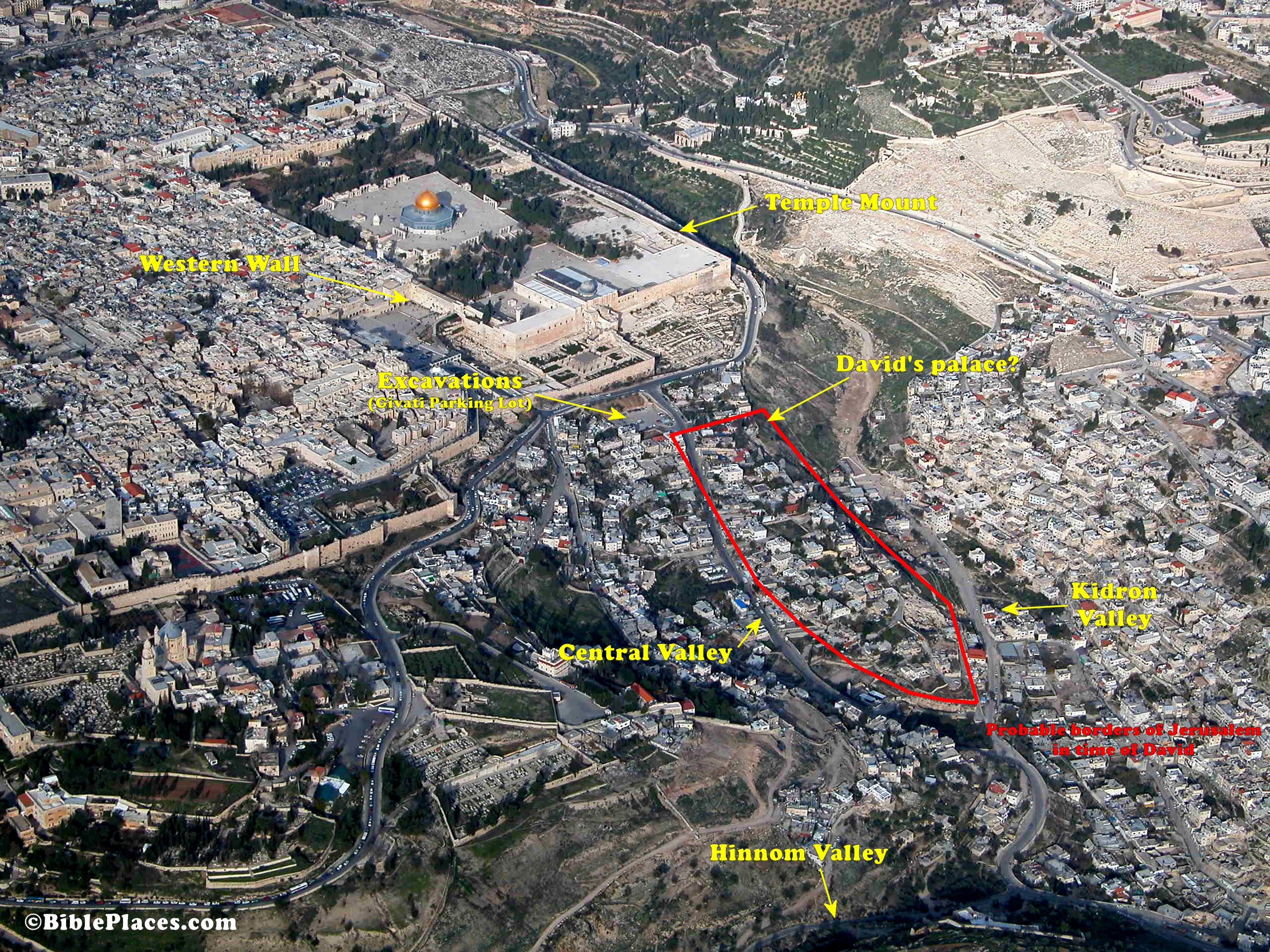
Temple Mount and Western Wall aerial from southwest, tb010703235
The Temple Mount and Western Wall from the southwest
Photo from the Pictorial Library of Bible Lands
Share:

Yosef Garfinkel is interviewed about Khirbet Qeiyafa at The Bible and Interpretation. He explains why he believes that King David “certainly slept there a few nights every year.”

Bryant Wood has a round-up of significant archaeological discoveries made in 2013.

Ferrell Jenkins shares an illustration of bargaining in the Middle Eastern.

Clyde Billington and Gordon Govier discuss the discovery of gold near the Temple Mount on this week’s edition of The Book and the Spade (direct link here).

There’s a new website for the Montfort Castle project.

This video on the Bread Culture of Jordan addresses both ancient and modern aspects of this way of life.

Gordon Franz passes on word that Gabriel Barkay recently presented a paper in Jerusalem suggesting that Absalom’s Pillar in the Kidron Valley belonged to Herod Agrippa (Acts 12:20-23). If I hear
more, I’ll note it in a future blog post.

HT: Jack Sasson, Aren Maeir

Pillar of Absalom with snow, tb022603216
The “Pillar of Absalom” in the Kidron Valley, Jerusalem
Photo from the
Pictorial Library of Bible Lands
Share:

Excavations on Mount Zion this summer revealed a Early Roman period mansion that archaeologists suggest belonged to the family of a priest in the first century. The story is also reported by livescience.

A summary of this year’s excavations of Tel Yafo (Jaffa) is now online. The work focused on the only Egyptian gate known in Israel.

There’s another article on the alleged discovery of Dalmanutha.

Why was Samaria made the capital of the Kingdom of Israel? Norma Franklin argues from her archaeological research that it was the city’s economic potential.

The University of Pennsylvania is celebrating a century since it received the Sphinx.

Logos Bible Software is looking for a Bible Map Designer.

“Explorations in Antiquity in LaGrange will soon open its Biblical Life Artifacts Gallery.”

Philologos explains why Sukkot is a harvest holiday, even though there’s little to harvest. For those beginning the joyous celebration of Sukkot tonight, we say hag sameah!

HT: Mark Hoffman, Jack Sasson, Joseph Lauer

Sphinx, red granite, 19th Dynasty, from Memphis, tb072311783
The Sphinx of the University of Pennsylvania
Share:

There are many Biblical archaeology programs scheduled for the Washington DC area.

Haaretz provides a review of the significance of Magdala and the recent excavations.

Paleojudaica links to the latest “bad-news articles on the Middle East for the last couple of weeks.”

St. Catherine’s Monastery at Mount Sinai has closed due to the security situation in Egypt.

Shmuel Browns provides the latest Israel Roundup.

Aren Maeir announces that a new exhibit is opening at Bar-Ilan University entitled “The Rise and Fall of Philistine Gath (Tel Zafit).

Some Palestinians are claiming that the golden treasure recently announced by Eilat Mazar is a fake.

Wayne Stiles provides a very good overview of the Garden of Gethsemane.

St Catherine's Monastery, mat02025

St. Catherine’s Monastery, circa 1915 
Share:

In the summer excavations of Eilat Mazar south of the Temple Mount, two collections of gold and silver were discovered, including one golden medallion depicting a menorah, shofar and Torah scroll.

From the press release:

A third-generation archaeologist working at the Hebrew University’s Institute of Archaeology, Dr. Mazar directs excavations on the City of David’s summit and at the Temple Mount’s southern wall. Calling the find “a breathtaking, once-in-a-lifetime discovery,” Dr. Mazar said: “We have been making significant finds from the First Temple Period in this area, a much earlier time in Jerusalem’s history, so discovering a golden seven-branched Menorah from the seventh century CE at the foot of the Temple Mount was a complete surprise.”

hu130909_mazar2

Golden medallion with depiction of menorah, shofar, and Torah scroll

The discovery was unearthed just five days into Mazar’s latest phase of the Ophel excavations, and can be dated to the late Byzantine period (early seventh century CE). 

The gold treasure was discovered in a ruined Byzantine public structure a mere 50 meters from the Temple Mount’s southern wall.

The menorah, a candelabrum with seven branches that was used in the Temple, is the national symbol of the state of Israel and reflects the historical presence of Jews in the area. The position of the items as they were discovered indicates that one bundle was carefully hidden underground while the second bundle was apparently abandoned in haste and scattered across the floor.

hu130909_mazar4

View of Jerusalem’s Temple Mount from the south, with area of discovery marked. Photo by Ouria Tadmor.

Given the date of the items and the manner in which they were found, Mazar estimates they were abandoned in the context of the Persian conquest of Jerusalem in 614 CE.

After the Persians conquered Jerusalem, many Jews returned to the city and formed the majority of its population, hoping for political and religious freedom. But as Persian power waned, instead of forming an alliance with the Jews, the Persians sought the support of Christians and ultimately allowed them to expel the Jews from Jerusalem.

Hanging from a gold chain, the menorah medallion is most likely an ornament for a Torah scroll. In that case it is the earliest Torah scroll ornament found in archaeological excavations to date. It was buried in a small depression in the floor, along with a smaller gold medallion, two pendants, a gold coil and a silver clasp, all of which are believed to be Torah scroll ornamentations.

“It would appear that the most likely explanation is that the Ophel cache was earmarked as a contribution toward the building of a new synagogue, at a location that is near the Temple Mount,” said Dr. Mazar. “What is certain is that their mission, whatever it was, was unsuccessful. The treasure was abandoned, and its owners could never return to collect it.”

The Ophel cache is only the third collection of gold coins to be found in archaeological excavations in Jerusalem, said Lior Sandberg, numismatics specialist at the Institute of Archaeology.  “The thirty-six gold coins can be dated to the reigns of different Byzantine emperors, ranging from the middle of the fourth century CE to the early seventh century CE,” said Sandberg.

hu130909_mazar3

36 gold coins from the Byzantine period

Found with the coins were a pair of large gold earrings, a gold-plated silver hexagonal prism and a silver ingot. Remnants of fabric indicated that these items were once packaged in a cloth purse similar to the bundle that contained the menorah medallion.

hu130909_mazar1

Archaeologist Eilat Mazar holding medallion affixed to necklace

The finds are also announced on a rather dramatic 2-minute video.

The story is reported by the Jerusalem Post, Haaretz, Ynetnews, and many others.

The Trumpet has an exclusive interview with Eilat Mazar.

Share: