Joe Yudin’s weekly travel column suggests a way to get a taste of everything in a one-day hike in the Golan.
Looters searching for treasure mentioned in the Copper Scroll uncovered a mikveh near Modiin before they were arrested.
The “Million Dollar shekel” actually sold for 1.1 million at a New York auction. This sets a record for the sale of a Judean coin.
“The Israel Nature and Parks Authority (INPA) will open 22 of its nature reserves and national parks for free to the public for a couple weeks in honor of Nature and Heritage Conservation Week.”
Haaretz profiles a 20-year plan to publish every ancient inscription ever discovered in Israel. The photo that accompanies the story shows one of the most easily accessible inscriptions, at the base of the first lamppost in Jerusalem, just inside Jaffa Gate.
Norma Franklin, co-director of the Jezreel Expedition, is interviewed on the LandMinds radio show (part 1, part 2).
ASOR is making progress in its efforts to digitize its archives. Here is a direct link to hundreds of thumbnails from the collection of Nelson Glueck.
Significant discussion continues about Talpiot Tomb B. If you’ve fallen behind, the best place to catch up is with James McGrath’s recent roundup. The preliminary report has been updated a third time.
The Bible and Interpretation has a single entry point for their dozens of articles published over the years related to the James Ossuary and the Jehoash Inscription.
I doubt that there are many tours of Israel that do as well as Insight for Living in sharing their experiences with the world.
In light of the current discussion concerning the so-called “Jesus Discovery” of the depiction of a Jonah/resurrection motif on a 1st century CE ossuary (see here) it is probably prudent to re-examine the typological relationship between the two prophets of Jonah and Jesus.
Besides the explicit connection of “the sign of Jonah” mentioned in Matt. 12:38-41; 16:4; Luke 11:29-32 there are several probable connections that can be derived through comparing the Gospels to the book of Jonah and 2 Kings 14:25 (i.e. the only Old Testament mention of the prophet outside of the prophetic book of Jonah).
Consider the following suggested similarities/parallels:
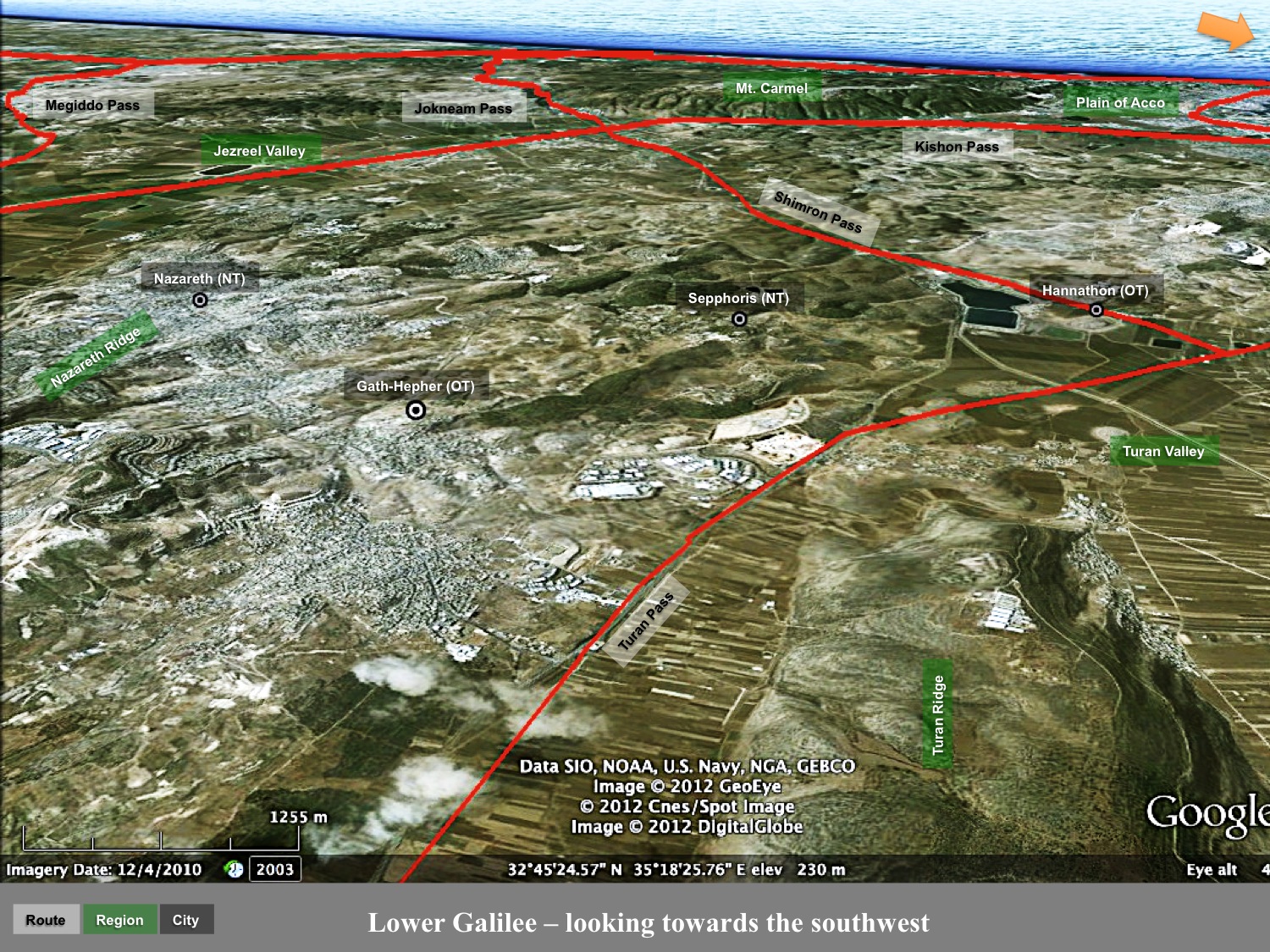
1. Each prophet heralded from and began his ministry in Lower Galilee. Jonah/Gath-Hepher and Jesus/Nazareth – 2 Kings 14:25; Matt. 2:23.
2. Each prophet’s ministry occurred during a time in which Israel’s hierarchical, wealthy members “trampled upon the poor.” Jonah/“cows of Bashan” during the time of Jeroboam II (8th cent. BCE); Jesus/”devourers of widow’s households” – Amos 4:1-3; 5:11-12; 8:3-7; Matt. 19:23-25; Mark 12:41-44; Luke 16:19-31; 20:46-47.
3. Each prophet preached Yahweh to Gentiles despite a desire to primarily minister to their own Israelite/Jewish population. Jonah joined Phoenicians on their way to North Africa (i.e. Tarshish) to avoid the goyim of Nineveh (Jonah 1:1-3) and Jesus stated that he was sent “only to the lost sheep of the house of Israel” (Matt. 15:24). However, both eventually ministered to Gentile populations – Jonah with Nineveh and Jesus for example with the Syro-Phoenician woman (Mark 7:25-28), Legion of the tombs of Gadera (Luke 8:26-34), and the centurion’s servant at Capernaum (Matt. 8:5-13).
4. Each prophet slept in the bottom of a ship in the midst of a raging storm while the ship’s sailors were wracked with fear and bewilderment due to the prophet’s slumber (Jonah 1:4-6; Mark 4:35-38). Additionally, each prophet was the reason for the ceasing of the storm (Jonah 1:7-16; Mark 4:39-41).
5. Explicit connection (see above) Each prophet spent “three days and three nights” in the “heart” of the earth before being “brought up from the pit.” Compare Jonah’s prayer (Jonah 2) and Jesus’ “sign of Jonah” (Matt. 12:38-41; 16:4; Luke 11:29-32) to Jonah’s expulsion (Jonah 3:1) and Jesus’ resurrection (e.g. Matt. 28:1-6).
6. Each prophet, despite being from northern Israel (i.e. Israel in the 8th cent. BCE and Galilee in the 1st cent CE), were obedient to the Law of Moses in worshipping Yahweh at his chosen location of Jerusalem (Deut. 12:5-7; 2 Sam. 7:13; 1 Kings 5:5). Compare Jonah’s “worship in the temple” (Jonah 2:4, 7), despite the enduring presence of the syncrestic temples of Dan and Bethel, to Jesus going up to Jerusalem for various feasts (e.g. Luke 2:41; 22:1).
7. Each prophet proclaimed coming destruction upon his audience’s capital city. Compare Jonah’s proclamation to Nineveh (Jonah 3) and subsequent, vengeful grief over their repentance (Jonah 4:1-4) to Jesus’ prophecy of doom to Jerusalem (e.g. Matt. 24) and subsequent, knowing grief over their rejection (Matt. 23:37; and especially Luke 19:41-44). As an aside, I find Jonah’s statement in Jonah 4:3 to be an ironic double entendre in the vein of Caiaphas’ statement in John 11:49-50.
8. Each prophet left the city that they had just preached in and went to the east of the city and prayed. Compare Jonah’s selfish, languishing prayer concerning the loss of his shade east of Nineveh and Yahweh’s response (Jonah 4:5-11) to Jesus’ selfless, anguish-filled plea to “let this cup pass” in Gethsemane and Yahweh’s silence (e.g. Luke 22:39-44).
More could be said about the typology of Jonah in relation to Jesus, especially with regards to the notable differences between the two. Nevertheless, in my opinion the above similarities undergird the connection between Jonah and early Christian motifs (see for example Jensen’s post which mentions 4th cent. CE depictions in Rome). Whether, the Talpiot ossuary is the first known example of this connection is an open, debatable question, but in either case it seems clear that the motifs derive from a clear typology that is rooted in the Gospels.
And I thought the days of archaeological treasures was long past…
The Megiddo Expedition have recently discovered a collection of gold, silver and bronze jewelry, wrapped in fabric, hidden in a vessel at Tel Megiddo. The vessel was found in a domestic context that was dated to the Iron Age I (around 1100 B.C.). This vessel was actually excavated during the 2010 season, but remained uncleaned while awaiting for a molecular analysis of it’s [sic] content (soil). When it was finally emptied during the summer of 2011, the pieces of jewelry appeared.
Both the textile and the jewelry itself were sent to analysis that should tell us more about the origins of this exceptional collection.
According to the biblical record, Megiddo was held by the Canaanites during the period of the judges (Judg 1:27).
The news report was that Tel Shiloh would receive about $1.3 million for renovation and preservation of the site, besides an additional $2.5 million from private sources. Only a fewbloggers seem to note the new archaeological excavation underway on the southwestern side of the tell, with work scheduled to begin on the proposed tabernacle site in a few weeks.
Arutz-7: “Muslims hurled stones and shoes at police escorting Jewish and Christian visitors on the Temple Mount in Jerusalem’s Old City on Tuesday.”
JPost: “The Tourism Ministry on Tuesday launched an online ballot where the public can vote on what shape the NIS 833 million renovation of the Dead Sea will take in the coming years.”
NASA has a photo showing the weekend’s snowfall on Mount Hermon and the ranges to the north.
Wayne Stiles connects the beauty on display at Neot Kedumim with the Passover holiday.
The Jerusalem Post has a new column named “All Out Adventure.” It begins with a rather tame outing to Sataf in the Judean hills.
Tom Powers has an interesting and well-illustrated post on the Historic Valley Railway that once connected Damascus to Haifa.
G. M. Grena teases his readers with an Arabic-English riddle. I think I can make some sense of it.
Aren Maeir and the excavations he directs at Gath are profiled in an interesting article at Israel 21c.
Wayne Stiles describes the biblical significance of Ein Harod. I would add that when I was at the site a few weeks ago, the gates were locked up tight. A call to the office revealed that the national park is closed “indefinitely.”
Tom Powers takes his readers on a tour underneath the Lutheran Church of the Redeemer. The excavations are slated to open to the public later this year.
Shmuel Browns hikes Nahal Michmash. He notes some of the many biblical connections.
Ferrell Jenkins provides two helpful photos for the next time you’re studying or teaching the story of Samson tying the foxtails together.
The Bible Lands Museum Jerusalem is hosting a lecture this evening in English by Sarah Salon,
“Sprouting Stories – Medicinal Plants in the Bible and growing a 2,000 Year Old Date seed from Masada.”
Cliffs near Michmash and Geba, the area where Jonathan climbed to surprise the Philistines (1 Sam 14)
Horvat Tevet, a site with remains from the Iron Age (1200-600 BC), has been attacked and damaged by vandals. The site is located in the Jezreel Valley about 6 miles (10 km) south of Nazareth. Horvat Tevet is next to Afula Illit and along the route of a future bypass road. From the Jerusalem Post:
Vandals attacked and heavily damaged an Antiquities Authority site near Afula overnight Wednesday, destroying findings dating back to the First Temple era.
“All the signs” pointed to a group of haredi activists as the main suspects, due to their opposition to what they describe as the desecration of graves, Dror Barshad, an archeologist for the authority’s northern district, told The Jerusalem Post.
“They rioted at another archeological site nearby, at Yakuk,” Barshad said. “With no legal authority, they take the law into their own hands and try to dictate where roads and tunnels can or can’t be built.”
The same group vandalized a second archeological site near the Kinneret last month, he said.
The full story and photos are here. The Hebrew version of the Ynet article includes a photo of the site before the destruction. A report of the 2008 excavations and a photo of a Late Bronze tomb was published last month in Hadashot Arkheologiyot.
HT: Joseph Lauer
Archaeological site near Afula after attack (Photo: IAA)
The BiblePlaces Blog provides updates and analysis of the latest in biblical archaeology, history, and geography. Unless otherwise noted, the posts are written by Todd Bolen, PhD, Professor of Biblical Studies at The Master’s University.