Earlier this year I made a seven-day trip to Jordan to take photos. For the first time in my travels in the Middle East, I used a GPS. It worked well. If you’re planning to rent a car and travel around on your own, you might consider it as an option. Here is what I did.

1. I bought a GPS. The one I purchased was not the cheapest, but I was very happy with it.

2. I bought a map set for Jordan (for Garmin). This set actually includes all of the Middle East except Israel. If you need Israel, there’s one here. (Beware the very cheap ones; they are illegal copies.)

3. The most important part of the process is to identify the sites you plan to visit ahead of time. This is particularly important if you are planning to see lots of random tells that aren’t on the maps and that the locals may not be able to help you with.

3a. First, locate the sites of interest on Google Earth. This can be challenging, depending upon how obscure your sites are. If you have a reference source with coordinates, see A.D.’s post on how to convert them to GE points. You may find the Site Index for the Pictorial Library of Bible Lands helpful for its list of coordinates as well. If you are looking for a GE file (kml) of lots of biblical sites in Israel and/or Jordan, search on the web (though reliability varies).
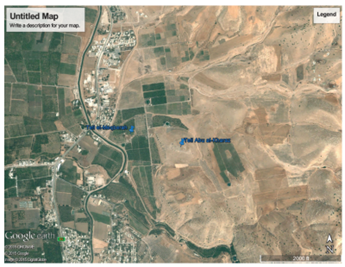
3b. Then, export your chosen sites to a kml file (simple instructions here). Convert that to a format your GPS can read. You can do this at kml2gpx.com or similar sites. Then copy the converted file to your GPS (video instructions here).

That’s it. I would recommend you bring a map or two, just in case your GPS fails on the trip. (I packed my GPS in my carry-on luggage so it wouldn’t be “borrowed” by luggage handlers.) You might even consider bringing a backup GPS if funds allow. (And part of that question is also, how much would it be worth to you in the middle of your trip if your other failed?)

One other step I took, not knowing how the GPS would work, was to use the (now free) Google Earth Pro to print off high-quality images of the sites and their surroundings. I figured this might help me when the GPS map data was wrong or incomplete. Several times these print-outs came in handy.

image

I didn’t find every site I was looking for, but that wasn’t the fault of the GPS. Sometimes I had limited information in originally locating the site in GE. At other times, the site just seemed to disappear (as did Beth-jesimoth, in the midst of a quarrying operation). I missed a few sites because of rental car troubles, but I saw far more than if I had been at the mercy of a bus schedule or even a taxi driver. I also preferred this method to using a guide because most guides don’t like to pull out at 6 am and return after dark.

A few additional notes:

1. There are no good detailed maps for Jordan.

2. Don’t trust the time estimates your GPS gives you. The program data may be limited and it may
assume that you can drive 90 km/h down that narrow alleyway.

3. Sometimes the GPS gets it wrong. Sometimes you think you know better and you get it wrong.
You learn as you go, and it helps to have a flexible schedule.

4. Walking and taking a cab in downtown Amman (or Jerusalem or other major cities) beats driving.

5. Don’t be in such a rush that you don’t get to know the people. (Or, make sure the car breaks down in the right place.)

6. A newer book that is quite helpful in Jordan is Burton MacDonald’s Pilgrimage in Early Christian Jordan: A Literary and Archaeological Guide (Oxford: Oxbow, 2010).

7. Jordan is beautiful in March.

Macherus Roman siege ramp and camp from east, tb031415756
The Dead Sea from Macherus

Just posted: Preliminary Report of the 2015 Jezreel Expedition Field Season

A full schedule of speakers and topics for the Annual Bible and Archaeology Fest is now online. Eric Cline is the plenary speaker.

After the heat wave and brutal sandstorm, Israel this past week experienced lightning, hail, and flash floods. This is not typical September weather.


Near Eastern Archaeology‘s latest issue is devoted to “The Cultural Heritage Crisis in the Middle East.” It is available online for free to all.

Eisenbrauns has just released its fall catalog.

A new book: Distant Views of the Holy Land, by Felicity Cobbing and David Jacobson. 330 pages, 350 illustrations, $200. A free sample is available here.

Here’s more about Penn Museum’s new exhibit, “Sacred Writings: Extraordinary Texts of the Biblical World.”

This Wednesday, Sept 23, Brent Strawn of Emory University will give a lecture at Trinity Evangelical
Divinity School entitled “The Historical Psalms, Iconographically Considered.” The event will take place at 7:00 pm on Trinity’s campus, Hinkson Hall in Rodine Building. The lecture is free and open to the public.

Clashes on the Temple Mount have caused damage to Al Aqsa Mosque.

Aren Maeir is on the Book and the Spade talking about his excavations of Gath and the discovery of a large gate this season (part 1, part 2).

Egyptian security officials have ordered the shutdown of St. Catherine’s Monastery.

From ASOR: Can you pass this Sea of Galilee quiz?

The latest issue of Popular Archaeology includes articles on Gath and Magdala.

Ferrell Jenkins explains the significance of Mahanaim (mentioned 13x in the OT) and shares some photos.

HT: Agade, Charles Savelle, A.D. Riddle, Paleojudaica

The excavation season at Magdala has concluded, and the wrap-up describes the major findings, including a fourth mikveh that was fed by spring water.

The Temple Mount Sifting Project has just released a video about their work, its importance, and the need to keep it going.

Leen Ritmeyer offers his thoughts and diagrams on the recent discovery of the stepped podium in the City of David.

The cross-border environmental organization EcoPeace has opened two hiking tours, a bike route, and a walking path in Israel, the West Bank, and Jordan. The two hiking tours each take eight days.

Arutz-7 reports briefly on the Studies of Ancient Jerusalem’s 16th Annual Conference in the City of David.

A study of 15 Roman-era Egyptian mummy portraits and panel paintings reveals that the artists used Egyptian blue, contrary to what has been long believed.

British conservation specialists have restored some Hellenistic-era paintings from Petra.
‘Atiqot 82 is now online.

Attempts by ISIS to blow up the Temple of Bel at Palmyra have apparently failed.

The Codex Sinaiticus will leave the walls of the British Library for only the second time since 1933, this time headed down the street for display in an Egyptian exhibit at the British Museum.

The Philistines introduced new plants to the coastal plain when they migrated from the Aegean.

HT: Ted Weis, Joseph Lauer, Agade

The finds keep coming in the excavations of Gath.

A mosaic with a verse from Isaiah 65 has been discovered in Adana, Turkey.

A thief has returned two ballista balls he took from the excavations of Gamla twenty years ago.

The US has returned more than 400 ancient artifacts to Iraq seized from a leader of the Islamic State.

There are many photos here.

Researchers are working to restore Iraq’s destroyed monuments online.

Police have arrested suspects in the arson case of the Tabgha Church of the Multiplication of Loaves and Fish.

Simon Gathercole: 5 Reasons Why the Gospel of Jesus’s Wife is a Fake

The Temple Institute is raising a red heifer in Israel.

Ayelet Gilboa writes about the significance of Tel Dor in the Jerusalem Post.

Jennie Ebeling talks about the Jezreel excavations on the Book and the Spade.

You can get up to speed on the excavations at Tel ‘Eton (Eglon?) with this article by Avraham Faust and Hayah Katz at the ASOR Blog (registration required).

The Water Gate in Jerusalem gets Wayne Stiles to thinking about its past and present significance.

Are you a Mesopotamian know-it-all? The ASOR Blog has 14 questions to test your knowledge.

The PEF introduces a new series: Interviews from the Jerusalem Chamber.

The dates for the 2016 season at Tel Burna have been announced.

Exploring Jordan: The Other Biblical Land is a free e-book from the Biblical Archaeology Society that includes articles on Bethany, Rabbath of the Ammonites, Philadelphia, Moab, and Petra.

The Illustrated Life of Paul by Charles L. Quarles is $0.99 on Kindle today.

HT: Ted Weis, Charles Savelle, Agade, Paleojudaica

The first permanent Roman legionary camp has been discovered near Megiddo. Scholars long knew of its existence because of the site’s preserved name of Legio, but only recently have they found remains. This year-old article at Bible History Daily has more of the background than the recent news reports.

Excavators working at the Jewish village of Shikhin near Sepphoris have discovered a pottery workshop.

A family in Ein Kerem near Jerusalem found an ancient mikveh (ritual bath) underneath their living room. High-res photos are available here.

Jodi Magness has discovered more mosaics in her excavation of the Jewish synagogue of Huqoq. For photos, see the links at the end of the article.

Here’s the latest on the gate discovered this week at Gath.

UNESCO has added the tombs of Beth Shearim, Jordan’s Baptism Site, and Susa to its World Heritage List.

CNN has put the Dome of the Rock in the number one spot of places to visit before they are destroyed. ISIS-controlled Palmyra is not on the list.

This looks interesting: Urban Legends of the New Testament: 40 Common Misconceptions. It quotes this blog and comes out on Monday.

Wayne Stiles is leading a tour focused on the life and land of Jesus in 2016, with a $550 reduction from this year’s tour price with the early bird rate.

A detailed report of the destruction to the archaeological site of Palmyra is available from the ASOR Syrian Heritage Initiative.

Ross Burns is keeping a tally of destruction to historic Syrian sites.

The Palestine Exploration Fund has been celebrating its 150th anniversary.

Here’s a unique aerial photo of Gibeah of Saul (Tell el-Ful), taken in 1931 before King Hussein’s construction destroyed Saul’s palace.

Shlomo Moussaieff died recently.

HT: Agade, Paul Mitchell, Joseph Lauer, Charles Savelle, Steven Anderson

Roman-camp-Megiddo
Location of Roman legionary camp at Megiddo

Archaeologists have discovered a Byzantine church near Abu Gosh during construction to widen Highway 1. UPI has five photos of the excavation. High-res photos may be downloaded here.


Haaretz has posted a 1-minute video in Hebrew with English subtitles.

The season at Khirbet el-Maqatir (Ai?) is underway with Bryant Wood giving a report from the first week and Suzanne Lattimer giving a report from the second week.

A summary of the first week of excavations at Tel Burna includes many photos.

If you’re interested in knowing more what’s involved in an archaeological excavation, you can check out this year’s manual for the Tell es-Safi/Gath excavation.

Israel has approved a scaled-down version of a visitor’s center in the City of David. Both sides claimed victory.

An Israeli judge ruled that Joe Zias overstepped the bounds of proper academic criticism and awarded a judgment of $200,000 to Simcha Jacobovici. Jacobovici had been seeking $3 million.

The Herodium and Herod’s palace at Jericho provide some striking geographic ironies of Jesus and Herod the Great.

PEF posts a photo with Starkey, Petrie, and Tufnell.

Ferrell Jenkins reports on recent changes made at the site of Capernaum.

Leon Mauldin explains and illustrates the significance of Nahal Besor.

Carl Rasmussen has long wanted a tour of the excavations under the Kishle and yesterday his wish was fulfilled.


The New York Times reports on how tourism in Jordan is suffering due to the conflict in Syria. That is too bad; Jordan is safe and has many important biblical sites.

Here are five reasons you shouldn’t buy that ancient artifact.

This week on the Book and the Spade Gary Burge discusses his new book, A Week in the Life of a Roman Centurion.

HT: Agade, Joseph Lauer