The Israel Antiquities Authority has issued a press release with an accompanying video (below) describing a rare papyrus dating to the time of Judah’s monarchy and mentioning the name of Jerusalem. The two-line document measures 4 inches long and 1 inch tall and describes jars of wine shipped to Jerusalem. It was written by a high-ranking female official in the time of Kings Manasseh or Josiah. The papyrus was discovered by antiquities thieves working in a cave in the Judean wilderness.

From the press release:

“Two lines of ancient Hebrew script were preserved on the document that is made of papyrus (paper produced from the pith of the papyrus plant [Cyperus papyrus]). A paleographic examination of the letters and a C14 analysis determined that the artifact should be dated to the seventh century BCE – to the end of the First Temple period. Most of the letters are clearly legible, and the proposed reading of the text appears as follows:


[מא]מת. המלך. מנערתה. נבלים. יין. ירשלמה.
[me-a]mat. ha-melekh. me-Na?artah. nevelim. yi’in. Yerushalima.
From the king’s maidservant, from Na?arat, jars of wine, to Jerusalem

“This is a rare and original shipping document from the time of the First Temple, indicating the payment of taxes or transfer of goods to storehouses in Jerusalem, the capital city of the kingdom at this time. The document specifies the status of the sender of the shipment (the king’s maidservant), the name of the settlement from which the shipment was dispatched (Na’arat), the contents of the vessels (wine), their number or amount (jars) and their destination (Jerusalem). Na’artah, which is mentioned in the text, is the same Na’arat that is referred to in the description of the border between Ephraim and Benjamin in Joshua 16:7: “And it went down from Janohah to Ataroth, and to Na’arat, and came to Jericho, and went out at Jordan”.


“According to Dr. Eitan Klein, deputy director of the IAA’s Unit for the Prevention of Antiquities Robbery
, “The document represents extremely rare evidence of the existence of an organized administration in the Kingdom of Judah. It underscores the centrality of Jerusalem as the economic capital of the kingdom in the second half of the seventh century BCE. According to the Bible, the kings Menashe [Manasseh], Amon, or Josiah ruled in Jerusalem at this time; however, it is not possible to know for certain which of the kings of Jerusalem was the recipient of the shipment of wine”.


“Israel Prize laureate and biblical scholar Prof. (Emeritus) Shmuel Ahituv attests to the scientific importance of the document, ‘It’s not just that this papyrus is the earliest extra-biblical source to mention Jerusalem in Hebrew writing; it is the fact that to date no other documents written on papyrus dating to the First Temple period have been discovered in Israel, except one from Wadi Murabbaat.  Also outstanding in the document is the unusual status of a woman in the administration of the Kingdom of Judah in the seventh century BCE.’”
The full press release includes more quotes from senior officials.
One assumes that the cave where this papyrus was discovered was thoroughly searched, but no additional fragments were found. Even so, it surely increases hope that more such ancient documents are preserved. Hopefully the IAA will get ahead of the thieves by conducting more excavations. With a tantalizing discovery like this one, I suspect that the public might be willing to support it financially.

I’m trying to think of other papyrus fragments from the time of Jerusalem’s destruction in 586 BC and earlier, and none are coming to mind. The press release does not mention any. If this is unique in that regard, this discovery is all the more remarkable.

The reports in the Times of Israel and the Jerusalem Post include various photos.

UPDATE: Christopher Rollston believes the papyrus may be ancient but the writing a modern forgery. Joseph Lauer has alerted us to high-res photos available here.
Word is out about a ancient papyrus to be presented next week by Shmuel Ahituv. The Hebrew papyrus includes the word “to Jerusalem,” and dates to about the time of King Hezekiah. It was discovered recently in the Judean wilderness and purchased from an antiquities dealer. For information about the conference, see Aren Maeir’s post and his mention of this “VERY
INTERESTING” papyrus.

HT: Joseph Lauer

UPDATE (10/22): The now-deleted reference to the number of lines on the papyrus was based on the mistaken assumption that the article’s photo showed the newly discovered papyrus.

A stone seal discovered this summer at Abel Beth Maacah suggests Israelite presence at the site in the 9th century.

Luke Chandler has collected a number of photos of floor tiles from Herod’s Temple Mount that have been restored by the Temple Mounting Sifting Project. The Jerusalem Post has more details. There are more photos here. A 20-minute video of the press conference is online, with English starting at about 3 minutes.

Archaeologists have uncovered a Byzantine-era stable at Avdat in southern Israel. High school students joined in the sifting of hundreds of buckets of organic material left behind by donkeys, sheep, and goats. Five high-resolution photos are available.

There’s now an island in the Sea of Galilee. It’s near the southern shore and is the result of the low water level. Artillery shells from WWI have also been discovered nearby.

A mosaic from the Huqoq synagogue may depict Alexander the Great meeting the high priest of Jerusalem. Another interpretation is that it shows the battle between Antiochus VII and John Hyrcanus I. The National Geographic article has photos.

Israel’s ancient capital of Samaria has been vandalized. A video in Hebrew shows some of the damage.

Exploring Bible Lands continues its series on “Walking like Jesus” with a photo of a Roman road in Galilee.

Wayne Stiles explores why Kiriath Jearim is ignored, and why it shouldn’t be.

Thursday’s Archaeological Conference in the City of David entitled “Digging for Truth — Jerusalem,
Archaeology & UNESCO” may be watched online. Parts are in Hebrew and other parts in English, with the whole lasting 4.5 hours. The program may be viewed here. The Jerusalem Post reports on the talk by Dore Gold.

Olive pits discovered at Khirbet Qeiyafa receive special attention at a new exhibit at the Bible Lands
Museum Jerusalem.

HT: Joseph Lauer, Charles Savelle, Agade, Ted Weis

A high school student found a ballista ball from the Bar Kochba Revolt during recent excavations of Beitar.

Excavators working at Abel Beth Maacah discovered one of the earliest silver hoards ever found.

There’s more information about the excavation of the chariot race mosaic in Cyprus.

To make the looting of Syrian artifacts more difficult, the US State Department announced emergency import restrictions.

“Oxford University researchers say that trees which grew during intense radiation bursts in the past have ‘time-markers’ in their tree-rings that could help archaeologists date events from thousands of years ago.”

Wayne Stiles explains how the Herodium testifies to God’s sovereignty.


The New York Times is no fan of the Ben-Hur remake.

The Associates for Biblical Research are beginning to recruit for their first season of excavations at Shiloh next summer.

Leon Mauldin posts on the end of wicked Queen Athaliah and shares a photo of a model of Jerusalem at the Bible Lands Museum.

If you wanted to know a little more about Enoch’s journey through the world (referenced in
Thursday’s survey results), Paleojudaica explains.

The new NIV Cultural Backgrounds Study Bible is being released on Tuesday. It looks impressive, and you can flip through the entire books of Genesis and Matthew online to see for yourself.

Hundreds of photos, maps, and charts accompany study notes edited by John Walton (OT) and Craig
Keener (NT). The promotional website also includes videos and infographics.

HT: Agade, Ted Weis, Joseph Lauer

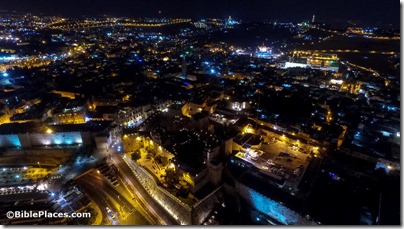
Old City aerial at night from southwest, ws052016101
Our most re-tweeted photo of the week was this aerial photo taken by Bill Schlegel of Jerusalem from the southwest. The Citadel of David is in the foreground and the Mount of Olives is in the distance.

The Israeli police arrested five members of the Waqf for erecting scaffolding and carrying out structural changes on the Dome of the Rock without authorization.

A new study suggests that there was widespread literacy in the kingdom of Judah in the 6th century BC. The full study is available for purchase or free through Academia.

The Temple Institute is planning to open the first school for training priests to serve in the Jerusalem temple.

Jeremy Smoak compares the silver amulets from Jerusalem with the Ekron temple inscription.

Wayne Stiles: “God inspired metaphors of biblical geography and botany to highlight one of the most important aspects in any healthy marriage.”

The Winter 2016 issue of DigSight is now online and includes stories on Qeiyafa finds, past lectures, and a new exhibit.

An article on the Inspiration Cruises website gives a little history of a Finnish moshav established in Israel in the 1970s and named in memory of Jews surrendered to the Nazis in World War II.

Frank L. Benz, longtime professor at Wartburg Seminary, died last week. Several years ago, we mentioned here his little-known New Testament marking guide to the Student Map Manual.

Martin Bachmann, the German Archaeology Institute’s deputy Istanbul director and the head of the Pergamon excavations, died this week at the age of 52.

George Mendenhall died yesterday, 8 days shy of his 100th birthday.

HT: Joseph Lauer, Agade

The archaeological co-directors provide a summary of this summer’s work at Tel Ein Jezreel.

Archaeologists working at Bethsaida have found some monumental towers guarding the approach ramp to the city gate.

Haaretz (premium) reports on the latest discoveries in the Mount Zion excavation, including a bathtub and a cup with a priestly inscription. Joel Kramer’s drone photo gives a good perspective.

Wayne Stiles reflects this week on lessons to be learned from Jeremiah’s hometown of Anathoth.

For the first time, researchers have succeeded in sequencing the genome of ancient barley grains found in a cave near Masada.

An update on the renovations of Bethlehem’s Church of the Nativity includes photos of newly restored mosaics.

IAA inspectors raided a shop in the Old City of Jerusalem suspected to be selling antiquities without a license.

Invitations are now open for a 2017 conference entitled “The Anglo-German Exploration of the Holy Land, 1865-1915.”

Eric Mitchell has begun a series on biblical archaeology for the Christian Examiner.

An article in Forbes asks how augmented reality will affect archaeological sites.

With a recent grant, plans are moving forward in the creation of the Digital Library of the Middle East.

Gordon Govier speaks this week with Cynthia Shafer-Elliott about “Daily Life in Ancient Israel” on the Book and the Spade (part 1, part 2).

Some Leon Uris favorites are on sale for Kindle now: Exodus, Mila 18, QB VII, and others.

HT: Agade, Joseph Lauer, Ted Weis, Charles Savelle, Explorator, Daniel Wright