A high school student found a ballista ball from the Bar Kochba Revolt during recent excavations of Beitar.

Excavators working at Abel Beth Maacah discovered one of the earliest silver hoards ever found.

There’s more information about the excavation of the chariot race mosaic in Cyprus.

To make the looting of Syrian artifacts more difficult, the US State Department announced emergency import restrictions.

“Oxford University researchers say that trees which grew during intense radiation bursts in the past have ‘time-markers’ in their tree-rings that could help archaeologists date events from thousands of years ago.”

Wayne Stiles explains how the Herodium testifies to God’s sovereignty.


The New York Times is no fan of the Ben-Hur remake.

The Associates for Biblical Research are beginning to recruit for their first season of excavations at Shiloh next summer.

Leon Mauldin posts on the end of wicked Queen Athaliah and shares a photo of a model of Jerusalem at the Bible Lands Museum.

If you wanted to know a little more about Enoch’s journey through the world (referenced in
Thursday’s survey results), Paleojudaica explains.

The new NIV Cultural Backgrounds Study Bible is being released on Tuesday. It looks impressive, and you can flip through the entire books of Genesis and Matthew online to see for yourself.

Hundreds of photos, maps, and charts accompany study notes edited by John Walton (OT) and Craig
Keener (NT). The promotional website also includes videos and infographics.

HT: Agade, Ted Weis, Joseph Lauer

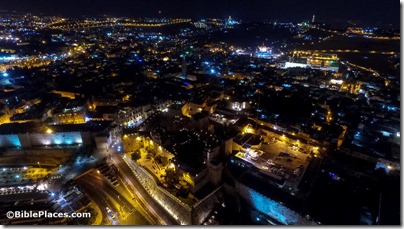
Old City aerial at night from southwest, ws052016101
Our most re-tweeted photo of the week was this aerial photo taken by Bill Schlegel of Jerusalem from the southwest. The Citadel of David is in the foreground and the Mount of Olives is in the distance.
Share:

The Israeli police arrested five members of the Waqf for erecting scaffolding and carrying out structural changes on the Dome of the Rock without authorization.

A new study suggests that there was widespread literacy in the kingdom of Judah in the 6th century BC. The full study is available for purchase or free through Academia.

The Temple Institute is planning to open the first school for training priests to serve in the Jerusalem temple.

Jeremy Smoak compares the silver amulets from Jerusalem with the Ekron temple inscription.

Wayne Stiles: “God inspired metaphors of biblical geography and botany to highlight one of the most important aspects in any healthy marriage.”

The Winter 2016 issue of DigSight is now online and includes stories on Qeiyafa finds, past lectures, and a new exhibit.

An article on the Inspiration Cruises website gives a little history of a Finnish moshav established in Israel in the 1970s and named in memory of Jews surrendered to the Nazis in World War II.

Frank L. Benz, longtime professor at Wartburg Seminary, died last week. Several years ago, we mentioned here his little-known New Testament marking guide to the Student Map Manual.

Martin Bachmann, the German Archaeology Institute’s deputy Istanbul director and the head of the Pergamon excavations, died this week at the age of 52.

George Mendenhall died yesterday, 8 days shy of his 100th birthday.

HT: Joseph Lauer, Agade

Share:

The archaeological co-directors provide a summary of this summer’s work at Tel Ein Jezreel.

Archaeologists working at Bethsaida have found some monumental towers guarding the approach ramp to the city gate.

Haaretz (premium) reports on the latest discoveries in the Mount Zion excavation, including a bathtub and a cup with a priestly inscription. Joel Kramer’s drone photo gives a good perspective.

Wayne Stiles reflects this week on lessons to be learned from Jeremiah’s hometown of Anathoth.

For the first time, researchers have succeeded in sequencing the genome of ancient barley grains found in a cave near Masada.

An update on the renovations of Bethlehem’s Church of the Nativity includes photos of newly restored mosaics.

IAA inspectors raided a shop in the Old City of Jerusalem suspected to be selling antiquities without a license.

Invitations are now open for a 2017 conference entitled “The Anglo-German Exploration of the Holy Land, 1865-1915.”

Eric Mitchell has begun a series on biblical archaeology for the Christian Examiner.

An article in Forbes asks how augmented reality will affect archaeological sites.

With a recent grant, plans are moving forward in the creation of the Digital Library of the Middle East.

Gordon Govier speaks this week with Cynthia Shafer-Elliott about “Daily Life in Ancient Israel” on the Book and the Spade (part 1, part 2).

Some Leon Uris favorites are on sale for Kindle now: Exodus, Mila 18, QB VII, and others.

HT: Agade, Joseph Lauer, Ted Weis, Charles Savelle, Explorator, Daniel Wright

Share:

An in-depth article by the Atlantic Monthly has uncovered the original source for the fake Jesus wife papyrus. The Harvard professor who published the artifact now believes that it is probably a modern forgery.

With the help of Google Earth and drones, researchers have discovered a massive ceremonial platform in Petra.

The Jerusalem Post has an update on the on-going renovations at Bethlehem’s Church of the Nativity.

One of the discoveries is a mosaic of an angel.

A $1.3 million gift has launched the restoration of the Edicule in the Church of the Holy Sepulcher.

People are speculating on what they will find.

“Some 1,800 years ago, Roman troops used ‘whistling’ sling bullets as a ‘terror weapon’ against their barbarian foes.”

Israeli authorities have ordered the Jordanian Waqf to halt construction of toilets just outside the Temple Mount.

A collection of 16 coins from the Hasmonean period were discovered in excavations in Modiin.

A Greek archaeologist thinks he may have found the tomb of Aristotle. Others disagree.

“Massive fortifications and sunken ship-sheds thousands of years old have been found in Piraeus, the harbor city of Athens.”

Canaanites living in Gath in the Early Bronze Age were sacrificing animals imported from Egypt.

The journal article is available here.

The Giza pyramid is not square. The ancients were off by about 5 inches (14 cm).

The Guardian has posted a dozen photos of excavations in Egypt in the 1910s, including several of John Garstang.

The Bible and Interpretation has posted an important new article: Addressing Survey Methodology in the Southern Levant, by Aaron Tavger, Joe Uziel, Dvir Raviv, and Itzhaq Shai.

Scott Stripling is on The Book and the Spade this week talking about the latest from his excavations at Khirbet el-Maqatir.

Wayne Stiles traces the geography of God’s dwelling place on earth.

You don’t see this for sale very often: Survey of Western Palestine, 1881 – 1888, 9 vols and 78 maps/plates (set) & The Survey of Eastern Palestine 1889. $10k.

HT: Joseph Lauer, Ted Weis, Charles Savelle, Steven Anderson, Agade, Explorator, Daniel Wright

Share:

The Israel Antiquities Authority has issued a press release, forwarded to us by Joseph Lauer, about recent excavations in the Cave of the Skulls in the Judean wilderness. Here are a few paragraphs and photographs from the press release:

Last week, the Israel Antiquities Authority took a first step in the plan by commencing a complicated and extraordinary archaeological excavation in search of scrolls in Nahal Tse’elim. A team from the IAA’s Unit for the Prevention of Antiquities Robbery accompanied by researchers from the Caves Research Center of the Hebrew University and hundreds of volunteers from across the country is participating in the excavation, which is taking place with the support of the Heritage Project in the Ministry of Jerusalem Affairs. The excavation is being directed by archaeologists Dr. Eitan Klein, Dr. Uri Davidovich, Royee Porat and Amir Ganor. For many years, IAA inspectors have been proactively enforcing the law in the desert, during the course of which they have made a number of seizures and foiled bands of antiquities robbers that sought to become rich through the detrimental exposure of items of great historical importance. However, these actions are a mere drop in the ocean and the Israel Antiquities Authority stresses that only by excavating all of the scrolls in the ground and transferring them to the state, will it be possible to ensure their well-being and preservation for future generations.
[…]
The Cave of Skulls, where the excavation is taking place, is located about 80 meters from the top of the cliff, and c. 250 m above the base of the wadi. Because of the difficulty in reaching the site, the Israel Antiquities Authority obtained a special permit from the Nature and Parks Authority to construct an access trail, which requires the use of rappelling equipment for the safety of the participants in the excavation. More than 500 volunteers and field personnel from Israel and abroad were required for the undertaking, and they are sleeping and living in a camp in desert field conditions. Many requests by individuals offering to participate have been denied because of the lack of infrastructure to provide for such a large group of archaeologists, volunteers and interested parties. The current excavation season will end in another two weeks, assuming this will be sufficient time in order to extract the valuable archaeological information from the cave.
According to Amir Ganor, director of the IAA’s Unit for the Prevention of Antiquities Robbery, “The excavation in Nahal Tse’elim is an operation of extraordinary complexity and scope, and one that has not occurred in the Judean Desert in the past thirty years. Despite the rigorous enforcement actions taken against the antiquities robbers, we still witness acts of severe plundering that unfortunately are possible in such large desert expanses. There are hundreds of caves in cliffs in the area, access to which is both dangerous and challenging. In almost every cave that we examined we found evidence of illicit intervention and it is simply heart-breaking. The loss of the finds is irreversible damage that cannot be tolerated”.

1
The cave where the archaeological excavation is being conducted is situated c. 80 meters from the top of the cliff and c. 250 meters above the base of the wadi. Photographic credit: Guy Fitoussi, courtesy of the IAA Unit for the Prevention of Antiquities Robbery.
9
10
Volunteers at work in the archaeological excavation. Photographic credit: Yoli Shwartz, courtesy of the Israel Antiquities Authority.
12
The ancient text that dates to the Year Four of the Destruction of the House of Israel (139 CE), which was seized in a joint operation by the Unit for the Prevention of Antiquities Robbery and the Israel Police. Photographic credit: Shai Halevi, courtesy of the Leon Levy Digital Library, Israel Antiquities Authority.

Arutz-7 has posted a 1.5-minute video.

Share:

A leaked report of a scan of King Tut’s tomb suggests that there are no hidden chambers. A few days earlier, scholars at a conference disagreed on the significance of radar scans.

Three tombs on the west bank of the Nile in Luxor are being opened to the public for the first time.

The symphony orchestra of the St. Petersburg Mariinsky Theater performed in the Roman theater of Palmyra recently.

Of 28 Egyptian obelisks standing today, only 6 are in Egypt. That’s one of many interesting facts about obelisks in a WSJ article that is based on a book by Bob Brier entitled Cleopatra’s Needles.

The collapse of one of the walls of Solomon’s Pools has raised concern that the entire pool could be in danger.

If you’ve never visited the site of ancient Dan, this article is a terrific introduction, drawing out the biblical history, making sound application, and illustrating with numerous photos.

A new 15-volume series entitled the Dead Sea Scrolls Editions will be published by Brill.

The ASOR Archive Photos of the Month is an easy way to revisit the past.

Archaeologists have discovered the weight-loss diary of the prophet Daniel, according to a report in the Babylon Bee.

HT: A.D. Riddle, Joseph Lauer, Agade

Share: