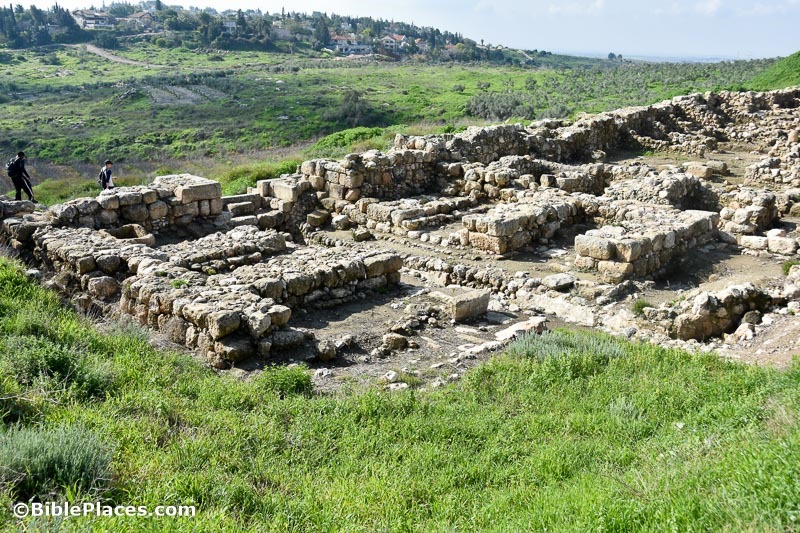
The Tel Moza website gives details for joining the spring excavation as well as background about recent discoveries.

A family volunteering at an excavation in Lower Galilee discovered remains of an iron industry from the 6th century AD.
 
Some of the latest discoveries from Shiloh are described in a somewhat disjointed article in the Jerusalem Post.
 
The “Tomb of the Kings” in Jerusalem has been reopened to visitors (again) by France, which owns the site. Access is allowed only to the outer courtyard.
 
Naama Sukenik explains how new technology is being used to provide insights into counterfeiting dyes in the ancient textile industry.
 
Mark Barnes looks at the significance of the Mount of Olives in the Bible, including some interesting comparisons and contrasts between David’s and Jesus’s time there.
 
Who is Gallio and why is he so important to New Testament history? Bryan Windle explains in a well-illustrated article.
 
The “world’s oldest natural pearl” has been discovered in excavations on an island near Abu Dhabi.
 

“Ancient Assyrian stone tablets represent the oldest known reports of auroras, dating to more than 2,500 years ago.”

“Life at the Dead Sea” is a new exhibit about the cultural history of the lowest place on the planet that recently opened at the State Museum of Archaeology Chemnitz.

An exhibit of Egypt’s southern neighbor, “Ancient Nubia Now,” is on display until January 2020 at the Museum of Fine Arts in Boston.

Sculptures from the Torlonia Collection will go on public display for the first time ever at the Capitoline Museums in Rome beginning in March.
 
The Washington Pentateuch is going on display at the Museum of the Bible.
 
The archaeological museum in Basra is adding English labels in hopes of welcoming more international visitors.
 
Jaafar Jotheri provides an overview of excavations in Iraq in the last year.
 
A conference will be held at the Louvre on November 25 on Tappeh Sialk: A Key Site for the Archaeology of Iran.
 
Farrell Monaco will be lecturing on “Dining with the Romans” at the Walters Art Museum on November 10.
 
4,500 tourists watched the sun illuminate the face of Ramses II in the temple of Abu Simbel.
 
Wayne Stiles is leading a tour of Israel (and pre-tour to Egypt) in October 2020.
 
There will be no roundup next weekend.
 
HT: Ted Weis, Mike Harney, Joseph Lauer, Keith Keyser

Share:

If you don’t pay attention, you would think they’re finding all kinds of first-century streets in Jerusalem. But it’s the same one, again and again. The story this week, based on a journal article in Tel Aviv, is that the Siloam Street/Stepped Street/Pilgrim’s Path was built by Pilate. The date is based on the most recent coin, from AD 30/31, found in the fill under the pavement. Leen Ritmeyer rejects the study, saying that the road was actually built by Herod Agrippa II. That last link has a nice map that shows the location of the Herodian/Pilatian/Agrippian Road.

A three-year salvage excavation near Beth Shemesh uncovered a Byzantine Church with an inscription mentioning a “glorious martyr.” The mosaics are quite well-preserved, and there is an intact underground burial chamber. Some of the artifacts are featured in a new exhibition at the Bible Lands Museum in Jerusalem.

Excavators have found a second monumental gate at Hacilar.

These reports from Beirut are from last year, but I did not see them then:

Rachel Bernstein provides an update on the Temple Mount Sifting Project since its recent reboot and relocation.

Israel Finkelstein responds to the “discovery that changes everything we know about biblical Israel.”

Artificial intelligence is better at deciphering damaged ancient Greek inscriptions than humans are.

The ArcGIS Blog interviews Tom Levy and one of his students about their use of GIS and 3D modeling in their work in the copper mines of Faynan.

Officials in Thessaloniki are arguing about what to do with a “priceless” 6th century AD Byzantine site found during work on a subway tunnel.

Spanish experts have replicated for Iraq two Assyrian lamassu statues previously destroyed by ISIS.

Dirk Obbink denies the charges against him of selling items owned by the Egyptian Exploration Society.

Two scholarships are available for students interested in participating in February’s excavation of Timna’s copper mines.

An international conference entitled “Philistines! Rehabilitating a Biblical Foe” will be held on Nov 17 at Yeshiva University Museum. Registration is required.

‘Atiqot 96 (2019) is now online, with reports on excavations at Rosh Pinna, Mazor, and el-Qubeibe.

Biblical Israel Ministries and Tours has released the 16th video in their series, “It Happened Here.” This one features life lessons from Beth Shean.

Jim Hastings shows how he built a model of a gate of Ezekiel’s temple.

Ferrell Jenkins shares photos from his 1970 tour of Iraq.

Aron Tal reflects on the remarkable return of the ibex. There was a day, apparently, when there were no ibex to be found at En Gedi.

HT: Gordon Franz, Mark Hoffman, Agade, Ted Weis, Joseph Lauer, A.D. Riddle, Steven Anderson

Share:

Wayne Stiles just walked the last five miles of the Appian Way into Rome, and he shares his experiences along with a video. Only one section was a hair-raising experience!

A preliminary report from the Swedish excavations at Hala Sultan Tekke in Cyprus is now online.

Israeli security inspectors discovered 69 coins from the time of Alexander the Great being smuggled from Gaza into Israel. But one expert suggests the coins are fake.

The Summer Session program of the American School of Classical Studies at Athens is now accepting applications. Scholarships are available.

Why do newspapers write dishonest headlines like this? “A Chance Discovery Changes Everything We Know About Biblical Israel.” Shame on Haaretz.

The lectures are in Hebrew, but you may find the topic list to be of interest for this year’s “New Discoveries and Insights” conference at Tel Aviv University.

The schedule is now online for next week’s Annual Conference, “New Studies in the Archaeology of Jerusalem and its Region.”

The final list of speakers and their topics for the 22nd Annual Bible and Archaeology Fest is now posted.

Yahoo Groups is shutting down. This will affect lists such as Explorator and ANE-2.

The En-Gedi Resource Center website has a new home, with new organization and a “Hebraic Studies” search bar to make it easier to find what you’re looking for.

Carl Rasmussen shares a number of photos of Göbekli Tepe.

John DeLancey is blogging each day on his tour of Greece, Rome, and Pompeii, now wrapping it up on Day 13.

Ferrell Jenkins explains why a photo he took of the cedars of Lebanon in 2002 is one of his favorites.

Bryan Windle has put together another great archaeological biography, this one on King Nebuchadnezzar.

HT: Ted Weis, Keith Keyser, Agade

Share:

“The rare ancient tomb of a wealthy Minoan woman has been discovered at a monumental archaeological complex on the Greek island of Crete.”

“Archaeologists have revealed the face of an Egyptian princess who lived almost 4,000 years ago by painstakingly piecing together the wooden shards of her sarcophagus.”

A study of legal texts from Susa reveals how elderly parents ensured that their children took care of them.

“A replica Phoenician vessel made in Syria is sailing the Atlantic to prove the ancient civilisation did it 2,000 years before Columbus.”

The Biblical Archaeology Society has announced their 2019 Publication Awards Winners.

A review of a new work from Oxford: Peter Mitchell, The Donkey in Human History: An Archaeological Perspective.

“Persepolis, Then & Now” is the title of a conference at NYU on November 21.

The latest issue of Biblical Archaeology Review includes articles on the Assyrian relief at Sela, the search for portraits of Herod, and hiking in Paul’s footsteps.

Bible Land Passages has just released a new video, “Go Now to Shiloh.” Here’s what you’ll see:

This full-length documentary complete with on-site interviews, a behind the scenes look at the process of archaeology, analysis of the newest and most exciting discoveries to date, reenactments, computer generated graphics and illustrations, and numerous biblical connections and faith building lessons.

Appian Media has launched its ‘inRoads’ podcast, and they have made it available via Apple Podcasts, Google Podcasts, Spotify, Stitcher, as well as video versions on Facebook and YouTube. If you sign up to be a supporter this month, you get a beautiful free coffee mug.

The Biblical Archaeology Society is having an inventory clearance sale on Carta and IES books, with the best prices on some items I’ve seen. Some examples, all of which I recommend:

  • Leen Ritmeyer, The Quest ($30)
  • Carta’s Illustrated Josephus ($30)
  • The Carta Bible Atlas ($25)
  • Jerusalem: Biblical Archaeology Map ($9)
  • New Encyclopedia of Archaeological Excavations in the Holy Land, 4 vols. ($100)

There’s still time to catch the second of the two-day Oriental Institute Indiana Jones Film Festival.

Carl Rasmussen has begun a series on hippodromes/circuses, with part 1 and part 2 of what happened there, featuring some beautiful photos of a splendid ancient mosaic in France.

Ferrell’s Favorite Foto this week is of the Siq and Treasury at Petra.

What do we know about Pontius Pilate from archaeology? Bryan Windle pulls it all together in the latest entry in his Archaeological Biography series.

HT: Agade, Keith Keyser

Share:

Tourism:
National Geographic has a beautifully illustrated article on the history of Jerash (ancient Gerasa).

Saudi Arabia is now giving visas to foreign tourists.

A $6 million, 9-year project has made much of Jerusalem’s Old City accessible to wheelchairs. And now you can rent a golf cart at Jaffa Gate (for $100/hour).

The entry fee for Rome’s Colosseum is jumping to €16.

Ferrell Jenkins shares a number of photos from his visit to the Brook Besor.

The first photograph of the Acropolis of Athens was taken in 1842.

I enjoyed talking about my visit to Susa on The Book and the Spade. Part 2 is now posted.


Lectures:
Peter Machinist will be lecturing on “Assyria and the Hebrew Bible: A Reassessment” at NYU on Nov 14. Registration required.

Felix Höflmayer, Katharina Streit, & Lyndelle Webster will be lecturing at the Albright Institute on Oct 31 at 4:00. Their topic:  The Austrian-Israeli Expedition to Lachish After Three Years of Excavation.


Videos:
New series on YouTube: “The Holy Land: Connecting the Land with Its Stories is a nine-episode series hosted by Dr. John (Jack) Beck that takes you to regions throughout Israel to experience the land, the culture, and the customs that surround the sacred stories of the Bible.” The first two episodes have been released, and you can see a 2-minute special feature about Jerusalem here.

The latest video from Biblical Israel Ministries and Tours: “It Happened Here” – Life Lessons from Israel: Beth Shemesh (6 min).

Appian Media is posting regularly to their YouTube channel, including some behind-the-scenes videos.

We’ll have more in part 3 tomorrow.

HT: Agade, Joseph Lauer, Ted Weis, Keith Keyser, Explorator

Share:

Museums:

“Assyrians in the Shadow of Vesuvius” is a new exhibit at the National Archaeological Museum in Naples.

“Buried by Vesuvius: Treasures from the Villa dei Papiri” is now on display at the Getty Villa in southern California. The post discusses how the Getty Villa was designed after the Villa of Papyri.

“Last Supper in Pompeii” is a new exhibit opening later this month at the Ashmolean Museum.

A replica of the destroyed Lion of Mosul is going on display at London’s Imperial War Museum.

A major exhibition on Troy will open at the British Museum on November 21.

The Egyptian Museum, though losing much of its collection to the Grand Egyptian Museum, will undergo a three-year renovation with the hope of securing status as a UNESCO World Heritage Site.

A new exhibition on Tall Zira’a opened this week at The Jordan Museum.


Lectures:

Shahrokh Razmjou will be lecturing on “The Rise and Fall of Persepolis: A Wonder of the Ancient World” in London on July 23.

Twenty scholars will be speaking at the 22nd Annual Bible and Archaeology Fest in San Diego, November 22-24.


Tourism:

Jerusalem’s “Tomb of the Kings” will reopen to visitors for the first time since 2010, but the tombs themselves will be off-limits.

With restorations complete, Bethlehem’s Church of the Nativity has been removed from UNESCO’s list of endangered world heritage sites.

The Lahun Pyramid opened to the public for the first time last week.

Every year there’s a story that Carchemish will soon be opened to the public.

Babylon has been named a 2019 UNESCO World Heritage Site.

Adam Stewart Brown articulates well why you should visit the Holy Land.

HT: Joseph Lauer, Ted Weis, Charles Savelle, Agade, Explorator, Bill Krewson

Share: