The big story in biblical archaeology this week was the announcement of the excavation of a series of rooms in 2010-2011 of a cultic site on the eastern side of the City of David, put out of use in the 8th century, possibly during the reign of Hezekiah. The story is covered by the regular outlets (TOI, HaaretzJP, JNS, Arkeonews), and the underlying journal ‘Atiqot article is here. I confess that I’m a bit skeptical about some of the interpretations, and that’s not only because you should always be skeptical when an archaeologist claims to have found a cultic site. I’m also curious as to what Ronny Reich thinks, as he is not credited as an author of the report.

Archaeologists working at Abel Beth Maacah in northern Galilee discovered a Late Roman period boundary stone with a Greek inscription that “provides critical information about land ownership, taxation, and rural administration during this period.” The underlying PEQ journal article is here.

Ruth Schuster: “Israel’s southern deserts feature sites that whisper of a ‘mountain cult’ that appeared in the Neolithic period.”

The Duke University Galilee Database (DUG) has just been released, featuring four Synagogues of Upper Galilee: Meiron, Gush Halav, Khirbet Shema, and Nabratein, all excavated under the direction of Eric Meyers.

New release: Judea under Greek and Roman Rule, by David A. deSilva ( Essentials of Biblical Studies; Oxford University Press, $25)

New release: Ritual and Power in Northern Israel. The Late Bronze and Iron Ages, by Erin Hall (Zaphon, €68)

Michael V. Fox, a well-known biblical scholar, died earlier this week.

Roy Brown has written a post about the Megiddo Mosaic with a number of really good photos.

Gesher Media is running a sale on its beautiful “Land of the Messiah Map.” Use coupon 50OFF through the end of the month to receive a 50% discount. Purchase includes five video lessons from Chris McKinny that provide insights into the map and the life of Christ.

HT: Agade, Gordon Franz, Andy Cook, Ted Weis, Arne Halbakken
Share:

“In a ceremonial nod to Purim, the Israel Antiquities Authority has disclosed to the public a ceramic jar fragment bearing a human face and dating back to the Persian period (4th-5th centuries BCE) that was discovered in 2019” in Jerusalem.

A high school student found an oil lamp at Mezad Tzafir that is nearly identical to one discovered by Nelson Glueck ninety years ago at the same location.

Archaeologists discovered a mastaba in an Old Kingdom necropolis at Dahshur.

“Archaeologists in Pompeii have unearthed an ancient building site that sheds light on construction techniques used by the Romans to make iconic structures such as the Colosseum and the Pantheon.”

“The only surviving funerary relief of the ancient Greek world depicting twin babies in the same arms was unveiled at the National Archaeological Museum of Athens and will be exhibited only for a few weeks.”

The British Museum went to court Tuesday against a former curator alleged to have stolen hundreds of artifacts from its collections and offered them for sale online.”

Kazuyuki Hayashi, a professor at Bethel Seminary, has been a supervisor at the Tel Shimron excavation since 2017.

Juan Tebes has been studying pilgrimage routes in the Levant and Hijaz.

Conflicting Jewish traditions place the tomb of Esther and Mordecai in Iran and Israel.

David Moster cut open an old pair of tefillin (phylacteries) to see what Scriptures are inside.

David Hendin, an expert in biblical coins, was interviewed on the Ancient Coin Hour.

Thomas Levy has been honored with a two-volume festschrift featuring research by more than 140 friends and colleagues. (It is a bit pricey, but chapters are available individually.)

The latest issue of Israel Museum Studies in Archaeology is online. One of the articles presents three architectural models from the museum’s collection.

Available for pre-order on Logos: Pondering the Spade: Discussing Important Convergences between Archaeology and Old Testament Studies, by David B. Schreiner

Webinar on April 4: “How did the dead die in Ancient Judah? Death as a social process in Iron Age tombs,” by Matthew Suriano

Webinar on April 18: “Amorites, Their Origins, and Their Legacy,” by Aaron Burke

Sara Japhet, longtime professor at Hebrew University, died this week.

“‘Art of Intimidation: Journey to Ancient Assyria’ is the Harvard Museum of the Ancient Near East augmented-reality Snapchat lens that brings to life the large casts of sculpted panels from the famed royal palaces of ancient Nineveh and Nimrud.” A video shows how it works.

For the Purim holiday, The Times of Israel profiles a 78-year-old baker who runs the last-of-its-kind Iraqi pastry shop in Israel.

A video of colorized footage from around the world in 1896 includes Jerusalem’s Jaffa Gate, Church of the Holy Sepulcher, West Jerusalem, and train station (start at 2:38).

Leen Ritmeyer explains how the tomb of Jesus was sealed.

Bible Archaeology Report proposes the top ten finds related to the death and resurrection of Jesus.

HT: Agade, Paul Mitchell, Arne Halbakken, Paleojudaica

Share:

“A rare and mysterious, multi-compartment stone container dating back to the days of the Second Temple that serves as evidence of the destruction of Jerusalem two millennia ago has been put on display for the first time at the Israel Museum in Jerusalem.”

Aaron Goel-Angot writes about the ancient site of Wadi Hamam and its first-century synagogue, located below Mount Arbel.

Excavations at the foot of Mount Tabor “provide a rare glimpse into the merchant market that functioned for centuries in the area between an adjacent fort and the khan” during the Mamluk and Ottoman periods.

Bryant Wood explains how the discovery of donkey dung supports the historicity of the Bible.

What do archaeology specialists do? Bible History Daily asked that question of ceramicists, zooarchaeologists, spatial archaeologists, marine geoarchaeologists, conservators, and osteologists.

The Spring 2024 issue of Biblical Archaeology Review includes articles on the cave of Salome, an Iron Age building in the Givati parking lot excavations, the Jerusalem ivories, and Azekah’s Canaanite temple.

Stamp seals from the southern Levant are the focus of the latest issue of Near Eastern Archaeology.

John DeLancey and Gordon Govier discuss ten important recent archaeological discoveries related to the life of Christ, with lots of illustrations.

Oded Lipschits is telling “The Untold Story of the Kingdom of Judah” in a new series of podcasts produced by Tel Aviv University.

Paul Evans is a guest on the Biblical World podcast to discuss his new book, Sennacherib and the War of 1812: Disputed Victory in the Assyrian Campaign of 701 BCE in Light of Military History.

The latest Jerusalem Tracker rounds up the news, publications and media about the city. It is amazing how much has been produced in the last three months.

This summer’s excavation season at Tel Shimron has been cancelled.

A trailer has been released for “Following the Footsteps: Walking Where Jesus Walked.”

Bryan Windle reviews the top ten archaeological discoveries of 2023 on the latest episode of Digging for Truth.

In a piece related to his recent book on the subject, Yaron Z. Eliav explores how Jews could have participated in Roman bathhouses. The article begins with a beautiful reconstruction drawing of a large Roman bathhouse.

HT: Agade, Joseph Lauer, Arne Halbakken

Share:

A group of students used “computer vision, machine learning, and hard work” to translate a portion of a scroll from Herculaneum and win a $700,000 prize. “This is a complete gamechanger,” said one scholar.

A reservist hiking in Galilee discovered a scarab made of carnelian and dating to about 800 BC, possibly related to the Assyrian conquest.

“Egypt’s antiquities ministry said Saturday it was setting up a committee to review the restoration of Giza’s Menkaure Pyramid after a public outcry over the project.”

“Excavations have given proof of a flourishing wine industry in the Byzantine and early Arab period, especially at sites like Shivta, Halutza, Nitzana, and Avdat.”

The latest episode of This Week in the Ancient Near East looks at the use of artificial intelligence to translate Mesopotamian texts.

Bryan Windle joins John DeLancey to talk about the top 10 archaeological discoveries related to Jesus.

Now online: Deborah Hurn’s dissertation, “Identifying and Delineating the Geographic Regions of the Israelite Migration from Egypt to Canaan Using a Hydrological Approach”

Hybrid lecture on Feb 29: “A Queen, her Son, and her Chamberlain. Seal Imagery and Socio-Administrative Hierarchies at Persepolis,” by Mark Garrison

Walking The Text’s recommended resource of the month is The Essential Archaeological Guide to Bible Lands, by Titus Kennedy.

Appian Media has released a trailer for “Out of Egypt.”

Abigail Leavitt shares some photos from her recent explorations in Jerusalem.

HT: Agade, Gordon Dickson, Arne Halbakken, Ted Weis

Share:

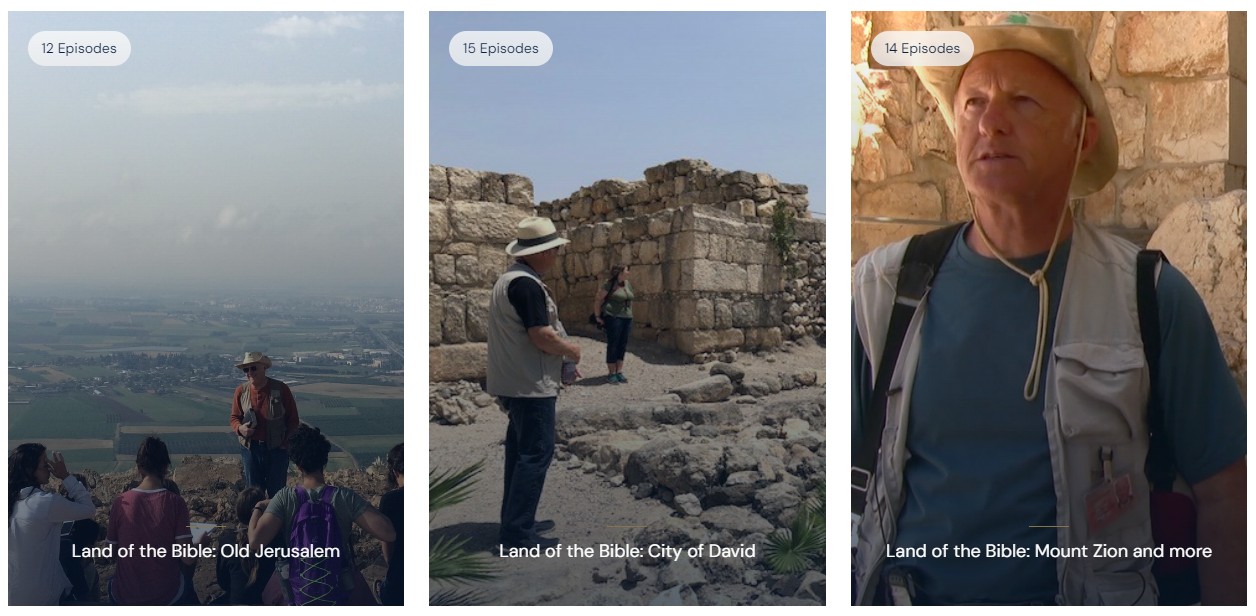
My longtime colleague William Varner has traveled to Israel more than 50 times, and a few years ago he worked with a team to film a complete tour. The resulting video series has been used with great effect in several courses at The Master’s University, and now TMU’s Center for Thinking Biblically has made the entire series available for free—no tuition required!

Here is a quick index of the eight sections, with notes to help you navigate to specific episodes.

Old Jerusalem (12 episodes, including the topography of Jerusalem, Church of the Holy Sepulcher, Christ Church, and the Tower of David Museum)

City of David (15 episodes, including Hezekiah’s Tunnel, Pool of Siloam, Davidson Museum, Kidron Valley tombs, and Southern Steps)

Temple Mount and more (19 episodes, including Mount of Olives, Jerusalem model, the Shrine of the Book, Western Wall Tunnel, Bethlehem, Herodium, and four episodes on Hebron)

Mount Zion and more (14 episodes, including Burnt House, Temple Institute, Via Dolorosa, Pools of Bethesda, Schindler’s Grave, and Garden Tomb)

Benjamin and Jericho (12 episodes, including Michmash, Wadi Qelt, High Place of Gibeon, and the Mount of Temptation)

Negev and more (22 episodes, including Gezer, Azekah, Lachish, Beersheba, Arad, Tabernacle Model, Masada, and Qumran)

Nazareth and more (17 episodes, including Caesarea, Mount Carmel, Megiddo, Jezreel, Mount Tabor, and Sepphoris)

Galilee and more (21 episodes, including Capernaum, Gamla, Caesarea Philippi, Dan, Beth Shean, Ai, Shiloh, and Mount Gerizim)

Share:

Excavations conducted during the laying of a water pipe not too far from Lachish revealed the “most ancient gate ever discovered in Israel.” They are dating it to about 300 years earlier than the Early Bronze gate at Tel Arad. The gate has already been backfilled.

Archaeologists excavating Tel Shimron announced the discovery of a massive Middle Bronze monument that was 15 feet tall and covered the entire acropolis. The monument was very well-preserved because soon after its construction it was filled in with gravel.

A beautiful Herodian ceiling panel was discovered in secondary use in the Ophel excavations (YouTube).

One of the arches in Caesarea’s Roman aqueduct collapsed on Friday.

A suspension bridge crossing the Hinnom Valley is now open to pedestrians (YouTube).

Zedekiah’s Cave (aka Solomon’s Quarries) reopened earlier this month, and Zahi Shaked gives a 30-minute tour.

Some Jews and Christians are arguing over the right to pray in the area of a possible tomb of Elisha at Stella Maris on Mount Carmel.

Israeli officials are considering loaning the Megiddo Mosaic, which comes from an early Christian building, to the Museum of the Bible. (Ilan Ben Zion’s AP article is a disappointment.)

WUNC interviews Jodi Magness upon the completion of her 11-year excavation of the Huqoq synagogue.

Aviva and Shmuel Bar-Am write about some of the many ritual baths that have been discovered throughout Israel. The article includes many photos.

Abigail Leavitt recounts various sites she visited this summer in Jerusalem. She has another post about a tour of the Shephelah.

“The Jewish National Fund, KKL-JNF, recently welcomed guests to visit the ancient Jewish synagogue in Ma’on, located in Israel’s southern Negev desert.”

Tour Caesarea virtually with DIVE (Digital Interactive Virtual Experiences) on August 30 ($20).

Joel Kramer goes to Mamre in the latest episode from Expedition Bible.

There are a number of late-summer festivals being held around Israel.

New release: The Changing Landscape of Israeli Archaeology: Between Hegemony and Marginalization, by Hayah Katz (Routledge, $42/$136).

The latest Jerusalem Tracker has been posted, with a roundup of news, publications, and media.

It may be hard to believe, but apparently there are unscrupulous shopkeepers in the Old City of Jerusalem.

HT: Agade, Gordon Dickson, Al Sandalow, Will Varner, Arne Halbakken, Roger Schmidgall, Keith Keyser, Wayne Stiles, Explorator

With the Israeli military gone, there are no obstacles to visiting Hyrcania in the Judean wilderness.

Share: