From Arutz-7:

A four-day international conference in the Negev is aimed at helping 200 million people around the world threatened by poverty and hunger. More than 50 countries will be represented at a four-day international conference in the Negev that is aimed at helping 200 million people around the world threatened by poverty and hunger. The third annual conference, with the unwieldy title of “Conference on Drylands, Deserts and Desertification: The Route to Restoration,” opens Monday at Ben Gurion University’s campus in Sde Boker, located between Be’er Sheva and Eilat. More than 500 government officials and academics, including those from the Palestinian Authority and Jordan, will participate. The conference is co-sponsored by the Arava Institute for Environmental Studies and the United Nations Educational, Scientific and Cultural Organization (UNESCO).  "If you do nothing about desertification, people will starve and die," said Prof. Alon Tal, Arava Institute founder, Ben Gurion professor and native of North Carolina. Israel’s success in rehabilitating the Arava desert has attracted worldwide attention to the Jewish State, where 97 percent of the land is arid. Israel has not only "made the desert bloom,” it also has also invested major resources in learning how to keep dry lands from overtaking fertile soil. With increasing worldwide soil erosion, salinization and groundwater mismanagement, Israel wants to share its solutions with the world.

The story continues here. Aravah, Neot Hakikar farms with child, db8004000209 Farm at Neot Hakikar in the Aravah of Israel
Photo by David Bivin

Share:

From the Jerusalem Post:

Many roads in the South were closed down following floods and a storm which has been raging since Sunday night.
Four tourists became trapped in their car in Arava Monday due to intense flooding.
Rescue units, including a helicopter, were working to evacuate them from the vehicle.
Route 90, leading from the Dead Sea hotels to the Center, Route 40 and Route 211 in the Negev were closed for traffic. The Nitzana Bridge collapsed due to heavy rainfalls.
The Nitzana, Tzin, Revivim Besor Haroe’h and Beersheba streams were overflowing.
A vehicle drifted away near the Revivim quarry and was still being sought on Monday morning. Two trucks with three travelers were swept into the Paran stream near Eilat and the travelers needed assistance from the local rescue unit and IDF helicopters.
All schools in the Ramat Hanegev Local Council were closed because of the floods. Schools in Kadesh Barne’a, Ezuz, Kmehin, Nitzana, Revivim, Mashabe Sadeh, Telalim and Retamim were closed.
Significant downpours swept the land, especially in the Negev and northern Negev, where 49 millimeters were registered during the night.

This reminds one of Psalm 126:4: “Restore our fortunes, O LORD, like streams in the Negev.”

UPDATE: Arutz-7 reports:

One tourist was killed in the Arava area north of Eilat Monday morning when he and two friends tried to drive their jeep through a raging river bed, powered by rare heavy rainfall. The roaring stream crushed the vehicle against rocks, and army helicopters manage to rescue two accompanying tourists. It was not known if they are from Israel or from outside the country.
Earlier on Monday, IDF helicopter rescue crews saved three people trapped in two trucks in flash floods in the central Negev and others near Eilat as the torrential but badly needed winter rains head north.
More than one inch of rain fell in Eilat, more than the normal rainfall for several years, and schools were closed throughout the region. Eilat also suffered electricity blackouts….
Nearly two inches of rain flooded Be’er Sheva, where a raging river bed was filled with water for the first time in years.

Share:

Hanukkah begins today.  You can read all about it in this month’s issue of Jewish Magazine.

JTA has an article on how the Maccabees would be viewed in today’s world.  “My guess is that most liberal Jews today wouldn’t necessarily get along with the Maccabees if they showed up again,” says Rabbi Jill Jacob.

Hanukkah is also the occasion for the Jerusalem Post to discuss in two articles the Heliodorus Stele and three additional fragments discovered earlier this year (previously mentioned here).

Israeli archaeologists have also found evidence recently that the Hasmoneans controlled territory south of the biblical Negev (near modern Sede Boqer).  The IAA has a few high-resolution images here. Apparently Josephus was right, after all.

Aren Maeir has posted a stratigraphic chart from Gath in PowerPoint format.

This article brought tears to my eyes, especially when I read about the pottery that has been found from the “Persians, Umayyad, Crusaders, Mukluks and Ottomans.”  The Mukluks—oh, I love that!  I just wish I had a lecture to give now on the Mukluks.  (The rest of the co-authored article is likewise
unreliable.) 

HT: Joe Lauer

Share:

I’ve often been asked how tells grew so tall.  True, winds in the Middle East blow lots of dust throughout the year, but that certainly cannot account for tells which are 80 feet high.  A.D. Riddle recently sent me the following quotation from C. Leonard Woolley, in which he gives a good explanation for the phenomenon of tells from his report on excavations at Carchemish.  I have placed in bold the answer to this question, but the whole is worth reading, despite its length.  Woolley writes:

The whole of North Syria is dotted with tells, artificial mounds which consist of and conceal old settlements. So little has been done in the way of excavating these mounds that it is dangerous to theorize too much about the nature of what lies beneath them; but certain features which are common to all, or which distinguish one from another, may, with such more sure information as digging has afforded, serve to throw light on the conditions of life which brought them into being and shaped their history.
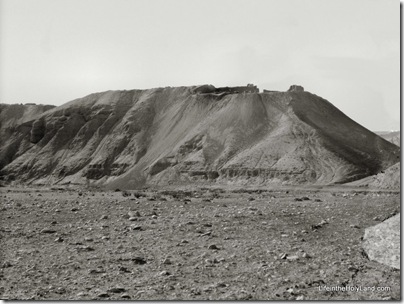
Tell el-Farah South, general view, mat13993 Tell el-Farah South

The neolithic folk, the original founders, undoubtedly, of all these tells, built their huts of mud and rubble either on some slight knoll or, where none such lay to hand, on an artificial platform laboriously piled up with basketful after basketful of earth,—piled just high enough to raise them above the damp of the level soil. The huts fell in ruins, and these ruins raised the ground level on which new homes were built, and that at a goodly rate, for mud-brick walls tend to be thick, and their cubic contents are very great in proportion to the area they enclose, and as the bricks can scarcely be used a second time the whole material of the fallen house was let lie where it fell and was merely leveled for the foundations of the new. Year after year went on this accumulation of débris and of house rubbish (there are sites in the Near East where the rubbish-heaps outside the walls are nearly as extensive as and much higher than the ruins themselves), and the original platform reached a height at which it commanded all the surrounding country. Then a wealthier generation, perhaps more warlike, or more timorous, walled the hill-top round, turning their village in to a stronghold. The chance of an asylum would attract new-comers, whose houses huddled together on the slopes of the mound and spread over the low ground at its foot, and this in its turn began to heap itself up above the level of the plain around. After a while the outsiders, too, might demand protection for their homes, not content to leave them in war-time to the mercy of the enemy while themselves taking refuge in the fort: they built a wall round the new outer town. In proportion as the whole town was thus made defensible, the original settlement, the tell, tended to become less a place of general residence, more and more the centre of administration and of worship; here the princeling might live in isolated state, here were the barracks of his regular retinue, here the temples which from of old had been the houses of gods or heroes deified. At the same time the defences of the tell were kept in good repair, for whatever might be its use of every day, it was still the inner stronghold, the last resort in case the rest should fall; from a military point of view the outer town and its high citadel within might be compared to the mediaeval castle with its bailey and its keep.
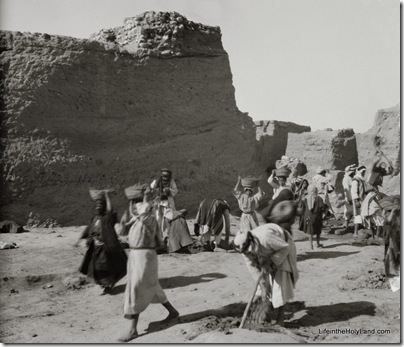
Tell el-Farah South, excavation, mat13986 Excavation of Tell el-Farah South, 1928-29, directed by Sir W. M. F. Petrie

Of course tells differ one from another in form as they differed in their history. There are low mounds scarcely noticeable above the level of the plain, short-lived villages whose ruins, scanty at their best, may have grown even less distinct through the gradual raising of the ground about them-the natural effect of long cultivation and often too of the ploughing of the nearer hillsides, whence little by little the rain carries the loosened surface soil down to the valleys. There are small steep-sided cones which, one thinks, can hardly be other than keeps or watchtowers, not the outgrowth of village settlements but military foundations to secure frontiers or trade-routes. There are rather larger whale-backed mounds, higher and more abrupt at one end and tailing off fanwise at the other, where one can almost see the cluster of domed or flat-roofed single-storied mud huts with, at the outskirts, the effendi’s two-storied house of stone dominating them from its higher ground. Again, on a larger scale, we have the steep-sided C-shaped tell with a broad channel running down it at a gentler slope between the horns of the letter, like a volcano’s crater with a gap in the rim; it looks as if, on the older mound’s flat top, a huge ring wall had been built with a gateway and an approach thereto between flanking towers. In other cases the main tell is more or less pyramidal in form with, on one side, the lower rounded mound of the outer town, its flimsier walls indistinguishable now from the heaped mass of house ruins which they enclose: in a few, the outer walls stand out clearly as a ring of earthworks overtopped only by the great bulk of the acropolis within.

Source: Woolley, C. Leonard. 1921. Carchemish: Report on the Excavations at Jerablus on behalf of the British Museum, Part 2: The Town Defences. London: Trustees of the British Museum.

The two photographs are from the newly published Southern Palestine volume of The American Colony and Eric Matson Collection (originally Library of Congress, LC-matpc-13993 and LC-matpc-13986).

Share:

The Nabatean site of Avdat was vandalized on Sunday night and two Bedouin have been arrested, including the site’s sole security guard.  From Ynet:

Hundreds of archeological artifacts were found smashed, walls smeared with yellow and brown paint, and oil paint was smeared on the ancient wine press. Items hundreds and thousands of years old were severely damaged. […] "We came in the morning and found the place in shambles," described Shapira, "They broke the staircase, destroyed the walls, and painted on them. The worst is that the two most ancient churches in Israel were destroyed, and 13-foot columns were shattered with hammers along with artifacts and the authentic marble alter, which is the most important (artefact) in the city."

The Jerusalem Post has the story and a couple of photos.  The Haaretz Hebrew article has two photos (but not the English version).  The Ynet article (Hebrew) has a gallery of 11 photos.  If you prefer a three-minute video (Hebrew), you can find that here.  Thanks to Joe Lauer for all of the links.

Share: