The excavations at Ramat Rahel have recently begun and they have their own blogToday they found a bomb!  Other excavations in Israel with blogs include Gath (regular and professional), Megiddo (regular), and Dan (they had good intentions).  I don’t know of any blogs for the current excavations at Hazor (where is that archive?), Gezer (is this another Macalister dump?), or Ashkelon.

There’s a few more days if you want to join in excavations on a site that used to be called Khirbet Qeiyafa, but is now dubbed the much more appealing “Elah Fortress.”  There’s some info here on what to bring.  Here’s the season brochure (front, back). You can also watch a YouTube video on the site.

Next year Bryant Wood is headed back to Khirbet el-Maqatir after a hiatus since Palestinian terrorism restarted in 2000.  Excavations of the candidate for biblical Ai are scheduled for May 20 – June 6, 2009. 

The Jerusalem Report has a lengthy article (published online, but poorly formatted, by the JPost) about the state of Dead Sea Scroll and Qumran research, including various theories of who lived at Qumran and who were responsible for the scrolls. The article also discusses the newly publicized “Gabriel’s Vision” tablet, and includes a sidebar on the Palestinians’ demand that the scrolls be turned over to them.

If you didn’t hear it already, Codex Sinaiticus is beginning to be posted online this week.  Here’s the story, and here’s the link to one of the oldest Bibles in existence.  Come back in a year if you want to read the whole thing.

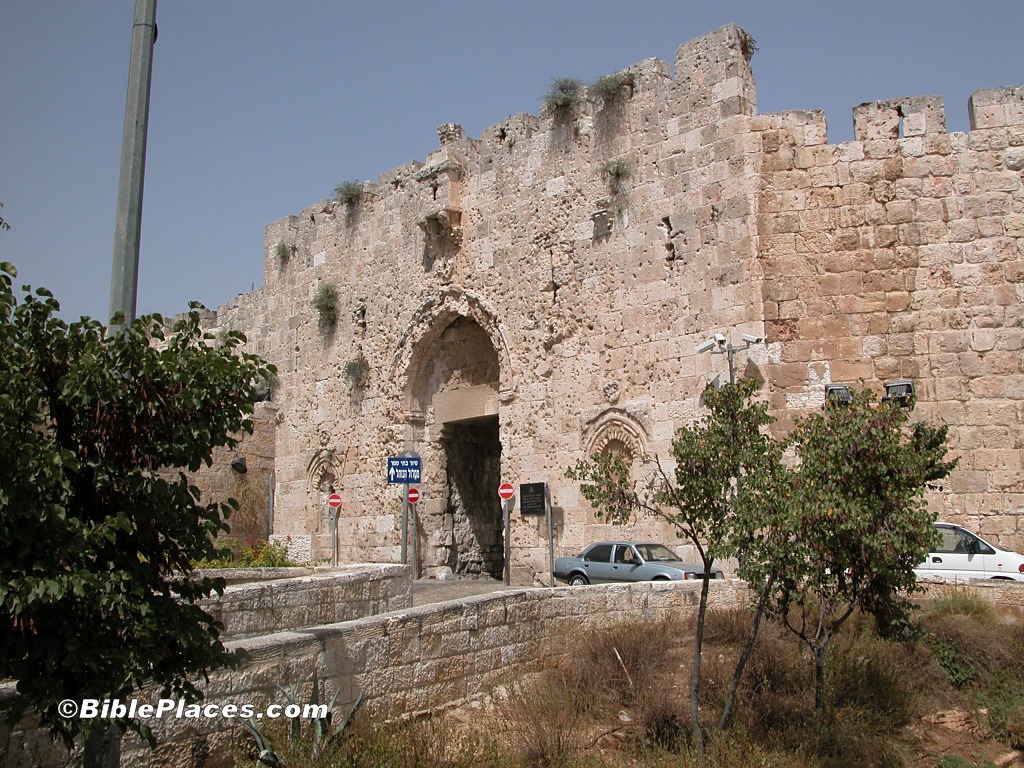
Six months and $200,000 later, Zion Gate is now back in view.  The hundreds of bullet holes and shell marks are still visible, but the stones are now stabilized and less likely to collapse on a vehicle executing a beautiful 11-point turn as they exit the city.

Zion Gate, tb091702701
Zion Gate, before renovation

And perhaps tourism to Iraq is not so far off.

Share:

The International Herald Tribune has the story:

It may sound like the escapist indulgence of a well-fed man fleeing the misery around him. But when Jawdat Khoudary opens the first ever museum of archaeology in Gaza this month, it will be an act of Palestinian patriotism, showing how this increasingly poor and isolated coastal strip ruled by the Islamists of Hamas was once a thriving multicultural crossroad.

Now only if there was a way for non-Palestinians to get there.  If he’s depending on revenue from Palestinians interested in history, he is going to be a poor man.

The exhibit is housed in a stunning hall made up partly of the saved stones of old houses, discarded wood ties of a former railroad and bronze lamps and marble columns uncovered by Gazan fishermen and construction workers.
And while the display might be pretty standard stuff almost anywhere else – arrowheads, Roman anchors, Bronze Age vases and Byzantine columns – life is currently so gray in Gaza that the museum, with its glimpses of a rich outward-looking history, seems somehow dazzling.
“The idea is to show our deep roots from many cultures in Gaza,” Khoudary said as he sat in the lush, antiquities-filled garden of his Gaza City home a few miles from the museum. “It’s important that people realize we had a good civilization in the past. Israel has legitimacy from its history. We do too.”

Someone’s going to have to explain this one to me.  I’m not sure how Roman or Byzantine antiquities have anything to do with the legitimacy of Palestinian Arabs. 

It’s a good article with a nice photo.  I recommend reading the whole thing, and I hope the venture is successful.

HT: Joe Lauer

Share:

If you’re in Israel this summer, you may be disappointed that the Archaeology wing of the Israel Museum is closed for renovation (until 2010 or so).  But some students of mine yesterday were going through other sections of the museum and found the Tel Dan Inscription displayed in the Youth wing.  The anthropoid sarcophagi are also on display.

The Isaiah Scroll is on display now until the end of August.  While two shorter sections of the scroll have been rotated on the permanent display over the years, the two longest sections have not been displayed since 1967.  Visitors can now see Isaiah 1-28 and 44-66.

Update (5/21): The above has been corrected to reflect that the inscription is in the Youth wing.

Share:

A couple of developments in the land of the Philistines are worth noting:

A Philistine temple is being excavated at a site south of the five major Philistine cities.  The temple dates to late Iron I (circa 1000 B.C.) and is a few miles south of biblical Gerar (Tel Haror) and northwest of Beersheba.  Aren Maier has a brief report of his visit and some of the finds.

The Canaanite gate at Ashkelon has now been completely restored.  They claim that it is the “oldest arched gate in the world,” but pushing the date of the Ashkelon gate a little earlier and the date of the Dan gate a little later.  Even archaeologists are competitive!  The JPost has a picture of the gate with a modern arch which looks like it was designed for schoolkids.  Below is a photo before they added the arch.

Ashkelon Middle Bronze gate, tb083006557
Ashkelon Middle Bronze Gate (circa 1800 B.C.)
Share:

There are a number of stories I’ve noted over the past week or so that may be of interest.

The Philistine city of Gath has been “civilized” with the creation of a new national park.  I think they should have called it the Gath National Park, instead of the Tel Zafit National Park, as no one seriously questions the identification any more.  The site is now off-limits to 4-wheel drive vehicles (that makes it a climb to the top!) and signs are posted around.  See the Official/Unofficial Gath Blog for details.

A special exhibit this summer will feature a long portion of the Isaiah Scroll.  The first 28 chapters (8 feet; 2.3 meters) will be displayed at the Shrine of the Book from May 13 to August 15, 2008.  The Isaiah Scroll was once on display in the center of the exhibit, but because of stress on the manuscript, it was replaced by a replica many years ago.

You don’t have to go anywhere to see these 12 stunning photos of Egypt from National Geographic

(HT: Dr. Claude Mariottini).

The biographer of Kathleen Kenyon recently gave a lecture on the archaeologist at Baylor University.  This link is to a (flawed) news report and not the lecture itself.  I mentioned the biography itself before here.

Here’s a good little article on the excavations in the City of David around the possible palace of David.  If you’ve kept up on the story, you won’t find anything new here, but it is an informed presentation.  CBN has another, less helpful, tourist visit to the City of David. 

(HT: Joe Lauer)

Share:

The Oriental Institute of the University of Chicago has just published an 88-page book on the looting in Iraq in the aftermath of the war.  From their website:

Catastrophe! The Looting and Destruction of Iraq’s Past
Edited by Geoff Emberling and Katharyn Hanson, 2008 With an introduction by Professor McGuire Gibson, this up-to-date account describes the state of the Iraq National Museum in Baghdad and chronicles the damage done to archaeological sites by illicit digging.

The book can be ordered for $30 or downloaded in pdf format for free.  An exhibit of the same name opens at the Oriental Institute on April 10.

Share: