The press release of the Israel Antiquities Authority:

Two Exhibitions from the Vast Collections of the IAA in New York City Beginning September 21, 2008


The Metropolitan Museum of Art will exhibit the dazzling Gold – Glass Table from Caesarea.  

The Gold Glass Table will be on display in the Byzantine Galleries of the Metropolitan Museum.

Dating to the late 6th, early 7th century CE, this extraordinary, one of a kind panel was excavated in a Byzantine period mansion in the coastal city of Caesarea, when a large mosaic floor known as the Birds Mosaic, was exposed for conservation in 2005. The nearly intact panel is shaped like the letter sigma and made of small glass pieces using the opus sectile technique. The panel was discovered with its face down directly on the mosaic floor and was covered by ashes and debris from the ceiling and the second floor. It comprises a wide frame surrounding the central part, both made of a combination of delicate, translucent gold – glass pieces and opaque, colored mosaic glass pieces. The square gold – glass pieces were decorated with a stamped design of flower or cross. A workshop for wall opus sectile made of stone panels was recently excavated in Caesarea, and one can assume the Gold Glass Table was produced by local artists. The conservation, restoration and exhibition of the Gold Glass Table, was made possible by generous funding from the Margot and Tom Pritzker Foundation. Also at the Met, in the Ancient Near Eastern Art Galleries, are remarkable Chalcolithic period objects on long-term loan to the museum, including examples from the Nahal Mishmar treasure such as the Hippopotamus tusk with circular perforations, and the wonderful copper standard, as well as ivory figurines from Beer-Sheva.


Separately, at the Jewish Museum, a wonderful exhibition – The Dead Sea Scrolls: Mysteries of the Ancient World, will include six Dead Sea Scrolls from the collections of the Israel Antiquities Authority – the largest and most comprehensive collection of Dead Sea Scrolls in the world. The scrolls on display represent the important transformation that occurred in Jewish worship from sacrifice to Bible study and prayer, the debates among Jewish groups of the Second Temple Period, and the indirect connections between the scrolls and early Christianity. The scrolls on display include a part of one of the earliest copies of the Hebrew Bible, the Book of Jeremiah, which dates to 225-175 BCE. Other texts include an apocryphal Jewish work, the Book of Tobit, which was rejected for the Hebrew canon but eventually accepted into the Christian Old Testament; an early example of a prayer from Words of the Luminaries; and Aramaic Apocryphon of Daniel, which mentions a son of God.

Also shown will be excerpts from two sectarian compositions.

The Israel Antiquities Authority is the pre-eminent organization in the field of Biblical and Israeli archaeology, custodian of more than 1.5 million objects among them 15,000 Dead Sea Scrolls, and 30,000 archaeological sites. These exhibitions are part of our continued effort to share the archaeological treasures of the Land of Israel with audiences around the world.

For downloading images please click here [ http://www.antiquities.org.il/images/press/iaa.zip ]

1. The Gold Glass Table – Photo by Niki Davidov, Israel Antiquities Authority

2. A Fragment of a 2,000 Year Old Psalm Scroll- Photo by Tsila Sgiv, Israel Antiquities Authority

HT: Joe Lauer
Share:

Haaretz has a story on the new “Pilgrim’s Route,” select portions of which are below. 

Some three million tourists are expected to visit Israel next year. And when they arrive, they will discover a new “Pilgrim’s Route” leading from Jerusalem to the Dead Sea. Along the way, they will be able to visit the site where the New Testament story of the Good Samaritan took place; the Qumran caves; and the site where, according to the New Testament, John the Baptist baptized Jesus.

It is not clear what is meant by “Pilgrim’s Route.”  Ideally, there will be a walking path along the ancient Roman road.  More likely, there will be signs installed at each place designating it as part of the “Pilgrim’s Route.”

The Good Samaritan site is just off the highway leading from Jerusalem to the Dead Sea. During the Byzantine era, a church was built at that spot to commemorate the New Testament’s tale of a man attacked by robbers while en route from Jerusalem to Jericho, who is refused help by all the passersby except the Good Samaritan. Archaeologists recently reconstructed the entire mosaic floor of the church.

It is unlikely that this site is anything more than a traditional place to remember the story.  If there was an inn, it was probably in Jericho, not in the middle of the inhospitable wilderness.  Furthermore, this may have been a story that Jesus created to teach a point and not a historical event (Luke 10:25-37).

Concerning the baptismal site:

According to Shai Weiner, the Tourism Ministry’s deputy director general for economics, planning and infrastructure, the first stage of the site’s development, which includes setting up shaded areas and making it wheelchair accessible, will be finished in about two months. The ministry has thus far invested some NIS 3.5 million in the site, and the Defense Ministry will invest about another NIS 1 million to improve the access road.

In addition to shaded areas, they need to get some of those amusement-park-type misters.

Weiner said that other Christian pilgrimage sites in Israel typically attract between 400,000 and 600,000 visitors a year, and he expects the same at this site. The ministry noted that the site would also jump start other businesses in the area, such as restaurants and souvenir shops.

Note to investors: buy stock in these new shops and sell your holdings in Yardenit.

Oni Amiel, CEO of Amiel Tours, which specializes in Christian pilgrims, said it is about time Israel began competing with the Jordanian site. “There’s an enormous flow of tourists there,” he said. “It’s important that the site on our side also be respectable – and above all, that there be water in that dried-up Jordan.”

So you get a flow of tourists where there once was a flow of water.  Not such a good trade-off.

The full story is here.

HT: Joe Lauer

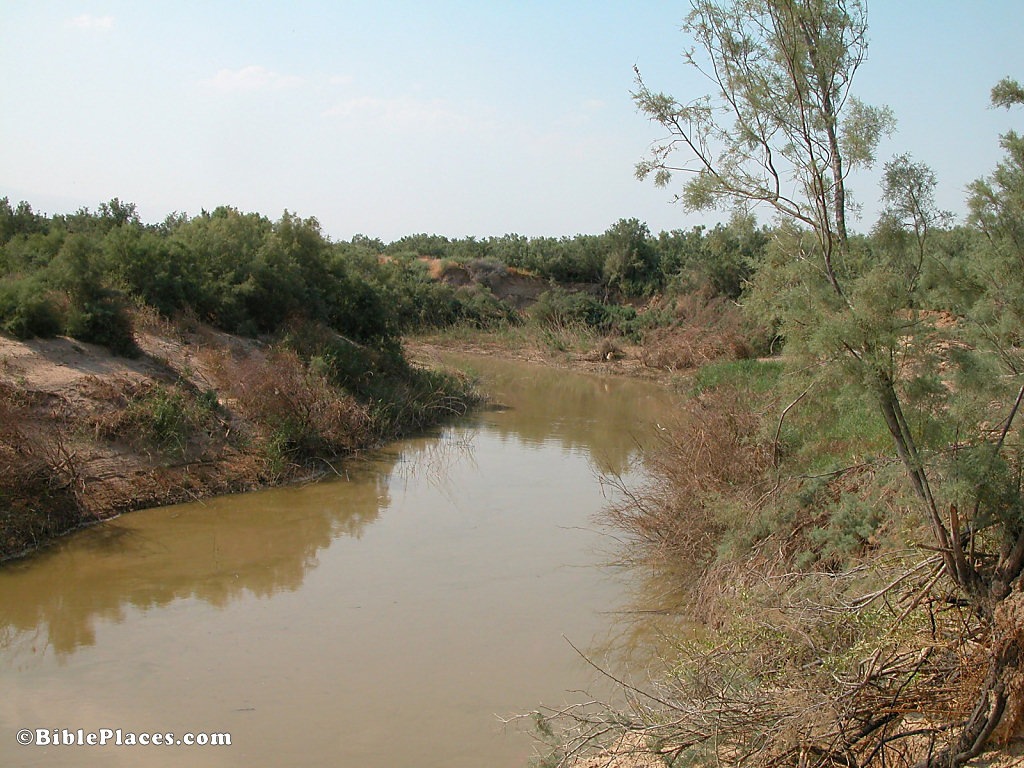
Jordan River by Bethany beyond Jordan, tb060303267
Jordan River near Jericho
Share:

Fifteen years ago, virtually no one could see the Dead Sea Scrolls.  In a few years, maybe everyone will be able to, without leaving their home.  From the NY Times:

In a crowded laboratory painted in gray and cooled like a cave, half a dozen specialists embarked this week on a historic undertaking: digitally photographing every one of the thousands of fragments of the Dead Sea Scrolls with the aim of making the entire file — among the most sought-after and examined documents on earth — available to all on the Internet.
Equipped with high-powered cameras with resolution and clarity many times greater than those of conventional models, and with lights that emit neither heat nor ultraviolet rays, the scientists and technicians are uncovering previously illegible sections and letters of the scrolls, discoveries that could have significant scholarly impact….
The entire collection was photographed only once before — in the 1950s using infrared and those photographs are stored in a climate-controlled room since they show things already lost from some of the scrolls. The old infrared pictures will also be scanned in the new digital effort.
“The project began as a conservation necessity,” Ms. Shor explained. “We wanted to monitor the deterioration of the scrolls and realized we needed to take precise photographs to watch the process. That’s when we decided to do a comprehensive set of photos, both in color and infrared, to monitor selectively what is happening. We realized then that we could make the entire set of pictures available online to everyone, meaning that anyone will be able to see the scrolls in the kind of detail that no one has until now.”
The process will probably take one to two years — more before it is available online — and is being led by Greg Bearman, who retired from the NASA Jet Propulsion Laboratory. Data collection is directed by Simon Tanner of Kings College London. Mr. Bearman is also using a specially made, $75,000 spectral camera that can produce a photographic image of previously illegible sections.

The rest of the story is here.

HT: Joe Lauer

Share:

From the Daily Democrat:

Soon, Yolo County residents won’t have to travel to Israel for a tour of the Holy Land. Locals will be able to stop by the Woodland Museum of Biblical Archaeology at Woodland United Fellowship, 240 N. West St., to visit a collection of artifacts from Biblical times.
The museum’s humble beginnings began in the foyer of Woodland United Fellowship a year ago.
Pastor Carl Morgan began a display case with a few juglets and lamps from archaeological digs he participated in, and the collection continued to grow.
“We live in a time when the Bible has come under a lot of criticism and attack as not being reliable or authoritative,” Morgan said. “Archaeology allows us to see the geography and historicity of the Bible is correct. Many times, we’ve been able to find a name or a city (on a dig) associated with a Biblical event, and we’re able to say to the critics, ‘They’re not myths. The Bible is accurate.’ It also helps build your faith.”
On the west wall of the museum artifacts from mainly the Middle Bronze Age (2200 BC to 1550 BC) will be displayed. Visitors will find sling stones, which were used as weapons and swung with a leather strap. They will also see swords from 2000 BC and a sacrificial knife from the time of Abraham.
There is pottery dated beyond 3000 BC and a battle-axe on display that dates at least 500 years before the time of Abraham.
“That’s the oldest piece of metal you’ll ever hold,” Morgan said.

The story continues here.  If they’ll let you hold it, they’ll probably let you take a picture of it as well. 

Which is something you won’t get at many other museums.  Woodland is 20 miles northwest of Sacramento.

HT: Joe Lauer

Share:

The excavations at Ramat Rahel have recently begun and they have their own blogToday they found a bomb!  Other excavations in Israel with blogs include Gath (regular and professional), Megiddo (regular), and Dan (they had good intentions).  I don’t know of any blogs for the current excavations at Hazor (where is that archive?), Gezer (is this another Macalister dump?), or Ashkelon.

There’s a few more days if you want to join in excavations on a site that used to be called Khirbet Qeiyafa, but is now dubbed the much more appealing “Elah Fortress.”  There’s some info here on what to bring.  Here’s the season brochure (front, back). You can also watch a YouTube video on the site.

Next year Bryant Wood is headed back to Khirbet el-Maqatir after a hiatus since Palestinian terrorism restarted in 2000.  Excavations of the candidate for biblical Ai are scheduled for May 20 – June 6, 2009. 

The Jerusalem Report has a lengthy article (published online, but poorly formatted, by the JPost) about the state of Dead Sea Scroll and Qumran research, including various theories of who lived at Qumran and who were responsible for the scrolls. The article also discusses the newly publicized “Gabriel’s Vision” tablet, and includes a sidebar on the Palestinians’ demand that the scrolls be turned over to them.

If you didn’t hear it already, Codex Sinaiticus is beginning to be posted online this week.  Here’s the story, and here’s the link to one of the oldest Bibles in existence.  Come back in a year if you want to read the whole thing.

Six months and $200,000 later, Zion Gate is now back in view.  The hundreds of bullet holes and shell marks are still visible, but the stones are now stabilized and less likely to collapse on a vehicle executing a beautiful 11-point turn as they exit the city.

Zion Gate, tb091702701
Zion Gate, before renovation

And perhaps tourism to Iraq is not so far off.

Share:

The International Herald Tribune has the story:

It may sound like the escapist indulgence of a well-fed man fleeing the misery around him. But when Jawdat Khoudary opens the first ever museum of archaeology in Gaza this month, it will be an act of Palestinian patriotism, showing how this increasingly poor and isolated coastal strip ruled by the Islamists of Hamas was once a thriving multicultural crossroad.

Now only if there was a way for non-Palestinians to get there.  If he’s depending on revenue from Palestinians interested in history, he is going to be a poor man.

The exhibit is housed in a stunning hall made up partly of the saved stones of old houses, discarded wood ties of a former railroad and bronze lamps and marble columns uncovered by Gazan fishermen and construction workers.
And while the display might be pretty standard stuff almost anywhere else – arrowheads, Roman anchors, Bronze Age vases and Byzantine columns – life is currently so gray in Gaza that the museum, with its glimpses of a rich outward-looking history, seems somehow dazzling.
“The idea is to show our deep roots from many cultures in Gaza,” Khoudary said as he sat in the lush, antiquities-filled garden of his Gaza City home a few miles from the museum. “It’s important that people realize we had a good civilization in the past. Israel has legitimacy from its history. We do too.”

Someone’s going to have to explain this one to me.  I’m not sure how Roman or Byzantine antiquities have anything to do with the legitimacy of Palestinian Arabs. 

It’s a good article with a nice photo.  I recommend reading the whole thing, and I hope the venture is successful.

HT: Joe Lauer

Share: