We have more stories this weekend than perhaps ever before for a single week (nearly 50), so expect a third installment of the roundup on Monday.

The first-ever ancient depiction of the balm of Gilead was discovered on an amethyst seal found by volunteers sifting soil from near the Temple Mount. There’s a 3-minute video here.

Excavations at el-Araj (Bethsaida?) have wrapped up for the season, and the archaeologists discovered a large apse and two partial inscriptions in the mosaic floor of what they believe is the Church of the Apostles.

A diver found a Crusader-era sword in perfect condition off the coast of northern Israel. There is a short video here.

Not only the Crusader sword but much more has been discovered because of a once-in-a-century storm that occurred in December 2010.

Archaeologists discovered a hoard of silver coins from the Hasmonean era in Modiin.

Daniel Master is a guest on the Book and the Spade to discuss the recent excavations at Tel Shimron.

An organization is calling on the Israeli government to excavate and open to tourists the site of ancient Gibeah of Saul, more recently home to King Hussein’s unfinished palace.

“Members of the Samaritan faith gathered at sunrise on Wednesday to mark Sukkot, a month after Jews celebrated the festival.” The short story includes a brief video.

NY Times: “Rameh, a Palestinian town [in Galilee] surrounded by olive groves, has long had a reputation for producing especially good oil.”

Megan Sauter writes about the importance of three purple textile fragments from the time of David recently discovered in the Central Timna Valley Project.

Andrew Califf writes about seven lesser-known archaeological sites in Israel (Haaretz paywall).

The Museum of the Bible is offering virtual tours of Masada and Megiddo on November 10 and 17, “using advanced images combined with an online interactive classroom to create a rich, immersive experience.”

A new exhibition by the Israel Antiquities Authority at the Yigal Allon Center in Kibbutz Ginossar offers a glimpse of the centuries when Jewish sages managed to rebuild a community in the Galilee.”

Kyle Keimer and Chris McKinny discuss Cabul in the days of Solomon in the latest episode of OnScript’s Biblical World.

When children volunteering at the Temple Mount Sifting Project stole some of the artifacts, the director used the opportunity to instruct them on the community’s responsibility.

On sale for Kindle: A Week in the Fall of Jerusalem, by Ben Witherington ($3.99)

HT: Agade, Joseph Lauer, Arne Halbakken, Ted Weis, A.D. Riddle, Paleojudaica, Explorator, BibleX

A huge complex of 1,500-year-old winepresses capable of producing some two million liters of wine a year has been uncovered by archaeologists in the city of Yavne, south of Tel Aviv.”

Margreet L. Steiner looks at the elusive Persian archaeological evidence in Jerusalem in order to determine what the city was like when the Jews returned from exile.

Meital Sharabi recommends visits to two interesting locations in the Judean hills west of Jerusalem.

Makhtesh Ramon in southern Israel is home to a crew simulating a colony on Mars.

Zoom lecture on October 17: “Family, food and health in the Bronze Age Aegean: Novel bioarchaeological insights into Mycenaean and Minoan societies,” by Philipp W. Stockhammer

Zoom lecture on October 20: “The City of Babylon from c. 2000 BC to AD 116,” by Stephanie Dalley. Her book on this subject was released earlier this year.

Zoom lecture on November 4: “Under Jerusalem: The Buried History of the World’s Most Contested City,” by Andrew Lawler, author of a forthcoming book with the same title.

The Florence Scroll, a 14th-century parchment depicting holy sites from Egypt to Lebanon, is now on display in the Israel Museum as part of the “Painting a Pilgrimage” exhibit.

Bible Mapper has created several new maps, available in high-res for free non-commercial use:

HT: Agade, Arne Halbakken, Joseph Lauer, Charles Savelle, Ted Weis

Weekend Sale: Cultural Images of the Holy Land – only $20 with coupon HARVEST

17-Cultural-Images

“Archeologists in Saudi Arabia have discovered the largest inscriptions in the Kingdom depicting the Babylonian King Nabonidus in the north-western city of Hail.”

Egypt has found remains of a military vessel from the Ptolemaic era at the ancient submerged port city of Thonis-Heracleio.

Treasures similar to those from King Tut’s tomb were allegedly found at a site recently discovered in southern Iraq.

“Turkey’s Izmir Archaeology Museum recently launched a new, unique exhibition centered around the historical artifact known as a ‘strigil,’ which 2,300 years ago was a tool used for cleansing the body by scraping off dirt, perspiration and oil.”

Lee Lawrence provides a well-illustrated introduction to the “meticulous, miniature world of Mesopotamian cylinder seals.”

Robert Deutsch is the guest this week on The Book and the Spade, discussing seals, seal impressions, and wet sifting.

Stephanie Lynn Budin takes issue with recent studies that assume that nude terracotta figurines are all related to fertility and childbirth.

New release: Egg Whites or Turnips? Archaeology and Bible Translation, by Paul J. N. Lawrence. The book has endorsements from Alan Millard and James Hoffmeier.

The Bible Mapper Blog has posted some new maps, with downloadable high-res versions:

HT: Agade, Charles Savelle, Ted Weis, Arne Halbakken, Joseph Lauer

Happy Leap Day! See below for a photo taken on this day sixteen years ago.

Bryan Windle identifies and explains the “top three reports in biblical archaeology” for the month, including the royal estate of Horvat Tevet, the Moza temple, and the Lachish temple.

Ira Rabin believes that the ink used in writing the Dead Sea Scrolls will shed new light on these ancient manuscripts.

A historian has re-discovered a well-preserved 616-page codex of the “Writings” section of the Old Testament that dates to AD 1028. The more technical journal article is available here, and the 1905 article is available here.

Yinon Shivtiel has identified a number of the caves that Josephus fortified during the First Jewish Revolt.

The latest issue of Biblical Archaeology Review features two articles making the case for competing sites for Bethsaida: et-Tell by Rami Arav and el-Araj by Steven Notley and Mordechai Aviam.

A 2,000-year-old silver dagger and its sheath has been restored to like new condition.

“Ancient Greeks had a great love and respect for their dogs, cherishing them as companions, protectors, and hunters, as evidenced by several dog tombstones discovered over the centuries.”

David Moster will be teaching a course in March on Ezra and Nehemiah for The Institute of Biblical Culture.

“Mesopotamia: Civilization Begins” is a new exhibition that opens at the Getty Villa on March 18 and runs to July 27.

New book: Digging Up Armageddon: The Search for the Lost City of Solomon, by Eric H. Cline

Scholars have digitized high-resolution photos taken by U-2 spy planes over the Middle East in the 1950s.

The Smithsonian has released 2.8 million images for free use, and Mark Hoffman briefly shares his experience in searching.

The icon collection for St. Catherine’s Monastery at Mount Sinai is now available online.

Ferrell’s Favorite Foto #34 – “I will make your enemies your footstool”

Shmuel Brown shares a number of photos of the “lovely carpet of wildflowers in reds, yellows, purple and white along the shore of the Dead Sea.”

HT: Agade, Joseph Lauer, Pat McCarthy, Keith Keyser, Ted Weis

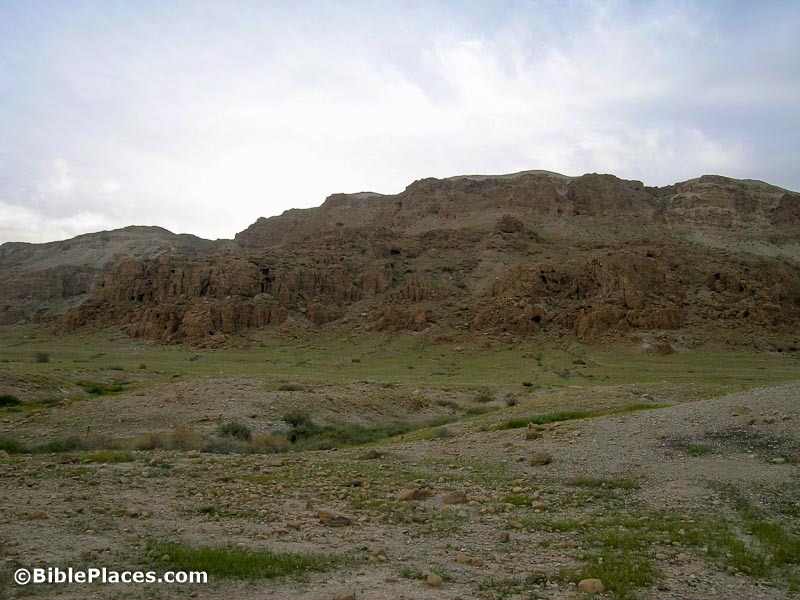
Qumran area of Caves 1 and 2, tb022904796

A view of green grass below the Qumran cliffs where Cave 1 is located;
photographed on February 29, 2004

Here’s a gem: a video about the excavations at Corinth made in 1945.

The first season of The Holy Land: Connecting The Land With Its Stories with John (Jack) Beck is now available on YouTube.

The Bible and Interpretation has an abridged version of a chapter from Margreet Steiner’s new book, Inhabiting the Promised Land: Exploring the Complex Relationship between Archaeology and Ancient Israel as Depicted in the Bible. This chapter surveys the history of modern scholars trying to locate the patriarchs in various periods.

A new exhibit at the Oriental Institute reveals the original colors of Assyrian reliefs.

Analysis of clay jar lids from the Qumran caves reveals residue of papyrus, supporting the theory that scrolls were once stored in the jars.

Ferrell’s Favorite Foto #33 is of the Cave of Adullam.

John Byron is on The Book and the Spade discussing the subject of his new book, A Week in the Life of a Slave (and Part 2).

The Temple Mount Sifting Project is now enjoying a new state-of-the-art greenhouse.

If you’ve ever been to an academic conference, you may appreciate this series of videos, especially the last one.

Biblical Archaeology Society is selling many DVDs for $5.

A couple of sets of Lois Tverberg’s excellent books are available for reduced prices this month.

HT: Agade, Joseph Lauer

The Tel Moza website gives details for joining the spring excavation as well as background about recent discoveries.

A family volunteering at an excavation in Lower Galilee discovered remains of an iron industry from the 6th century AD.
 
Some of the latest discoveries from Shiloh are described in a somewhat disjointed article in the Jerusalem Post.
 
The “Tomb of the Kings” in Jerusalem has been reopened to visitors (again) by France, which owns the site. Access is allowed only to the outer courtyard.
 
Naama Sukenik explains how new technology is being used to provide insights into counterfeiting dyes in the ancient textile industry.
 
Mark Barnes looks at the significance of the Mount of Olives in the Bible, including some interesting comparisons and contrasts between David’s and Jesus’s time there.
 
Who is Gallio and why is he so important to New Testament history? Bryan Windle explains in a well-illustrated article.
 
The “world’s oldest natural pearl” has been discovered in excavations on an island near Abu Dhabi.
 

“Ancient Assyrian stone tablets represent the oldest known reports of auroras, dating to more than 2,500 years ago.”

“Life at the Dead Sea” is a new exhibit about the cultural history of the lowest place on the planet that recently opened at the State Museum of Archaeology Chemnitz.

An exhibit of Egypt’s southern neighbor, “Ancient Nubia Now,” is on display until January 2020 at the Museum of Fine Arts in Boston.

Sculptures from the Torlonia Collection will go on public display for the first time ever at the Capitoline Museums in Rome beginning in March.
 
The Washington Pentateuch is going on display at the Museum of the Bible.
 
The archaeological museum in Basra is adding English labels in hopes of welcoming more international visitors.
 
Jaafar Jotheri provides an overview of excavations in Iraq in the last year.
 
A conference will be held at the Louvre on November 25 on Tappeh Sialk: A Key Site for the Archaeology of Iran.
 
Farrell Monaco will be lecturing on “Dining with the Romans” at the Walters Art Museum on November 10.
 
4,500 tourists watched the sun illuminate the face of Ramses II in the temple of Abu Simbel.
 
Wayne Stiles is leading a tour of Israel (and pre-tour to Egypt) in October 2020.
 
There will be no roundup next weekend.
 
HT: Ted Weis, Mike Harney, Joseph Lauer, Keith Keyser