A local imitation of an Athenian tetradrachma was discovered on the surface of Tel Azekah recently. Excavations begin at the site in July.

The Egyptian government has announced that “a big archaeological slab dating back to the era of Ramesses III” was found at the Karnak Temple.

Last week I was looking down on Tel Jokneam (Yokneam) from Muhraqa on Mount Carmel and wondering what was going on there. Joe Yudin has the answer: “Tel Yokneam is in the midst of a vast restoration project by the local communities’ schoolchildren in conjunction with the Antiquities Authority and the National Parks Authority.”

Wayne Stiles: “Perhaps because of the atrocities of Manasseh, Jesus used the Hinnom Valley as an illustration of eternal torment (Matthew 18:9).” Stiles compares the redemption of the evil king with the transformation of the valley today.

Ferrell Jenkins is posting photos of his current tour in western Turkey and Greece, including Smyrna, Pergamum, and more.

I like the photo of the Hidden Waterfall at En Gedi now posted at The Bible and Interpretation.

Aren Maeir was interviewed on the LandMinds program (part 1, part 2, part 3, part 4).

As a follow-up to the recent post on Esther in the Dead Sea Scrolls, it may be noted that only 1 manuscript (4Q118) with 4 complete words is preserved of the much longer 1-2 Chronicles (ABD 1:995).

HT: Joseph Lauer, Jack Sasson

Hinnom Valley from east, tb091306311

Hinnom Valley from the east
Share:

In an article published in the new issue of Biblical Archaeology Review, Emile Puech’s view of the Qeiyafa Ostracon is summarized. He believes that it “announces the installation of a centralized royal administration and it makes this announcement to a distant frontier province. He concedes that it is difficult to establish with certainty whether the new royal administration is that of Saul or David. On balance, however, he concludes that, most likely, the ostracon refers to Saul’s accession.”

Gordon Franz discusses three possible locations for the temple to Augustus near Panias/Caesarea Philippi. He concludes that the site of Omrit is likely the backdrop for Peter’s confession.

Using satellite images taken over a span of 40 years, Shmuel Browns shows how the Dead Sea is shrinking.

The first quarter of 2012 saw a record number of tourists to Israel.

The Israel Nature and Parks Authority says that if visitors pay they are less likely to trash a site.
Aren Maeir has announced a major scholarship for those wishing to join the excavations at Gath and/or Tel Burna this summer. The application deadline is May 6.

HT: BibleX

Omrit temple from east, tb032905151

Roman temple at Omrit
Share:

There are enough items related to the “Jesus Discovery”/Talpiot Tombs that I am going to exclude those from today’s roundup. Perhaps I will catch up next week. In the meantime, you can take a look at new photos posted at the official website.

A bronze Greek warrior’s helmet was discovered off the shore of Haifa.

The City of David is the focus of this week’s Jerusalem Post column by Wayne Stiles.

I think that Jesus and His World: The Archaeological Evidence, by Craig Evans, would be a much better use of time and money than any books about Jesus discoveries. (Two dings: it’s marketed as “provocative,” and it’s only 208 pages.)

A copy of Edward Robinson’s 3-volume Biblical Researches in Palestine just became available for $75. And a copy of Picturesque Palestine (4 vols.) was just listed for $1100. (Or pick up an electronic edition for $55.)

A Jerusalem Post article lists the Top 5 Spring Activities in Jerusalem as: Ramparts Walk, Tisch Family Zoological Gardens, Bezalel Fair, Café Itamar, Sacher Park. (The article’s introduction leaves something to be desired: “When rain let up, Spring will be upon us; here are some great outdoor activities in the capital to prepare for.”)

G. M. Grena has another riddle, but this one is so easy (he claims) that he has disqualified me from answering. So what is this great discovery that is pictured?

Congratulations to Aren Maeir for sending the final proofs off for the first double volume of the Tell es-Safi/Gath excavations.

If you’re interested in the broader world of biblical studies, you might check out the March Biblical Studies Carnival with dozens of links to the latest.

It snowed in Jerusalem on Friday. (For photos of a previous snowfall, see here.) The storm also filled Caesarea’s hippodrome with water.

Snow in Jerusalem. Photo by Austen Dutton.
Share:

Attempts to sensationalize this story by connecting it to the prophet Jonah should not be allowed to obscure the significance of a fortress recently uncovered in Ashdod. The Israel Antiquities Authority (IAA) press release blows it on all things “Jonah.”

At ‘Giv’at Yonah’, in Ashdod, Archaeological Finds were Uncovered that Verify the Existence of Life there at the Time of Jonah the Prophet
The foundation of a large fortress that was situated there during the First Temple period was exposed in an excavation the Israel Antiquities Authority conducted with funding provided by Hofit – Ashdod Development & Tourism Company, Ltd.
At ‘Giv’at Yonah’ (the Hill of Jonah) in Ashdod, which according to various traditions is identified with the burial place of the prophet Jonah, archaeological finds were exposed that verify the existence of life there during the First Temple period, at the time of this prophet.
In a trial archaeological excavation the Israel Antiquities Authority carried out on ‘Giv’at Yonah’ in Ashdod prior to development work by Hofit –Ashdod Development & Tourism Company, Ltd. remains of massive walls more than 1 m wide were found that are dated to the late eighth century and early seventh century BCE.
In the estimation of the excavation director, Dmitri Egorov, of the Israel Antiquities Authority, these walls constituted the base of a large building from the First Temple period, the time when Jonah the prophet was active, who lived in the eighth century BCE and was famous for having been swallowed by a fish after he refused to “go to Nineveh…and proclaim against it” (Jonah 1:2).

One can understand why a news organization would try to hype this discovery and in the process distort the data, but it is disturbing that a scientific governmental organization such as the IAA would fail to get basic historical and geographical facts right.

1. The IAA gets the chronology wrong. Jonah was a prophet in the first half of the 8th century, during the reign of Jeroboam II (793-753 BC). This fortress dates to the late 8th and early 7th centuries.

Thus the claim made in the headline and throughout the story is false. This should be clear later in the press release when the district archaeologist states that the fortress belonged either to the Assyrians or to the Judean king Josiah (640-609 BC).

2. The IAA gets the geography wrong. Jonah was a prophet in the northern kingdom, from the Galilean city of Gath-hepher (2 Kgs 14:25). He fled on a ship via the port at Joppa. There is no
evidence that he ever traveled to Judah or to the territory then controlled by the Philistines.

3. The IAA fails to note the value of the “various traditions” that identify the site as the “Hill of Jonah.” There is no Jewish or Christian tradition that Jonah was buried here. Only a decade ago did
“Atra Kadisha” identify it as the tomb of Jonah. It is relevant that the purpose of Atra Kadisha is to prevent the excavation of ancient Jewish tombs. The Atra Kadisha declaration follows a Muslim tradition, which is much too late to be taken as having historic value.

What is important in this story is the discovery of a fortress apparently from the time of Hezekiah when the Philistines were caught in a bit of a tug of war between Judah and the Assyrians. For more details, see Sennacherib’s Siege of Jerusalem in Context of Scripture 2.119B.
DSCN4502

Excavations of Iron Age fortress at Givat Yona. Photo by IAA.
Share:

Aren Maeir and the excavations he directs at Gath are profiled in an interesting article at Israel 21c.

Wayne Stiles describes the biblical significance of Ein Harod. I would add that when I was at the site a few weeks ago, the gates were locked up tight. A call to the office revealed that the national park is closed “indefinitely.”

Being covered in the dust of your rabbi is not an urban legend.

Tom Powers takes his readers on a tour underneath the Lutheran Church of the Redeemer. The excavations are slated to open to the public later this year.

Shmuel Browns hikes Nahal Michmash. He notes some of the many biblical connections.

Ferrell Jenkins provides two helpful photos for the next time you’re studying or teaching the story of Samson tying the foxtails together.

The Bible Lands Museum Jerusalem is hosting a lecture this evening in English by Sarah Salon,
“Sprouting Stories – Medicinal Plants in the Bible and growing a 2,000 Year Old Date seed from Masada.”

Cliffs near Michmash and Geba from south panorama, tb092706105
Cliffs near Michmash and Geba, the area where Jonathan climbed to surprise the Philistines (1 Sam 14)
Share:

A report from the Media Line describes plans to construct a boardwalk along the beach of Gaza City.

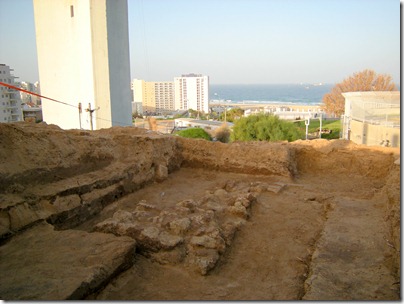
Archaeologists are concerned that the construction will destroy remains from the city’s past.

The Tourism and Antiques Ministry in Gaza has come out against the plan to give displaced residents land in the Beach Camp, saying they have archeological remains of an ancient port from the Roman era.
“These lands are the location of very important archeological sites. Excavations were conducted on this site from 1995 till 2005 by the French School of Antiques and Excavation,” says Hayam Al-Bittar, the head of the ministry’s museums department. “We should be doing our best to protect this site, not to offer it as compensation for people to build on it who don’t appreciate their heritage and history.”
She has vowed to file a complaint to the cabinet and, if all else fails, will resign from her position. “Not on my watch,” Hayam warns. “We will not rest until we ensure the safety of this location.”
The United Nations Education and Scientific Organization (UNESCO) and the French School of Antiques and Excavation are backing her, but an informal survey of Gazans about the corniche and its impact finds little concern about the damage to the archeological remains.

The full article is here.

Beach in Gaza Strip, tb040305579

Beach south of Gaza City
Share: